TỰ TRUYỆN
Note: Fb của G do bị trục trặc nên không log in được.
Note: Bài viết này có tính tự truyện. K.& O. chọc quê G hoài, mi dọa sẽ viết 1 cuốn tiểu thuyết, cái gì gì đi tìm 1 cuốn tiểu thuyết sẽ có.

Kafka’s Misdiagnosis
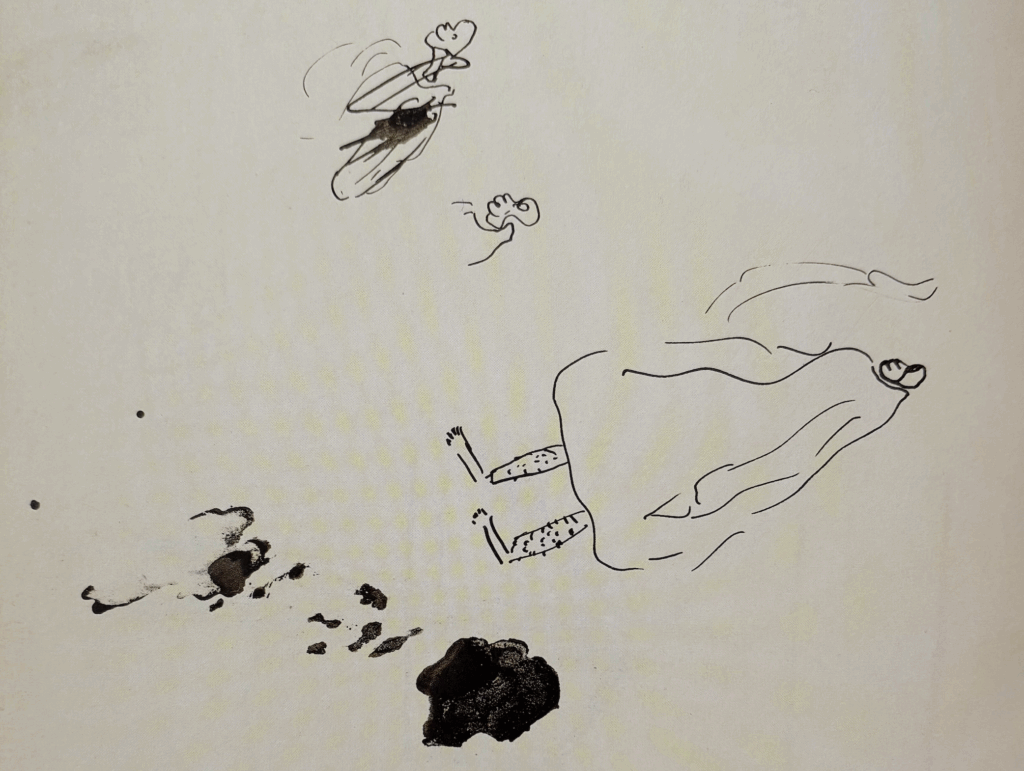
Drawings by Franz Kafka. Courtesy of the Literary Estate of Max Brod, National Library of Israel, Jerusalem. Public domain.
In a diary entry from February 1922, Franz Kafka writes of a deal he made with madness:
There is a certain failing, a lack in me, that is clear and distinct enough but difficult to describe: it is a compound of timidity, reserve, talkativeness, and half-heartedness; by this I intend to characterize something specific, a group of failings that under a certain aspect constitute one single clearly defined failing (which has nothing to do with such grave vices as mendacity, vanity, etc.). This failing keeps me from going mad, but also from making any headway. Because it keeps me from going mad, I cultivate it; out of fear of madness I sacrifice whatever headway I might make and shall certainly be the loser in the bargain, for no bargains are possible at this level.
The Kafkian protagonist (including the “I” of Kafka’s letters and diaries) is a loser who cannot make “any headway,” a schlemiel who secretly cultivates failure as the means of his persistence. The subject must lose, must fail; that’s the deal made with madness. Conversely, does this not imply that a successful Kafka would be not a socially well-adjusted, non-neurotic, even happily married Kafka, but rather a mad Kafka, one forced to pay a high price for not sacrificing headway in his pursuit, for going all the way to the end of his investigations? In “Investigations of a Dog,” the philosopher dog speaks of wanting to feed on the bone marrow of all the dogs, the marrow of truth—but then turns around and avows that this marrow is “no food; on the contrary, it is a poison.” Similarly, what if Kafka nourished himself on failure to avoid being poisoned by the truth he was seeking?
There is something profoundly unhinged about the Kafkian universe. In the first book-length study of Kafka in English (a rather eccentric work, largely forgotten today), Paul Goodman put it sharply: Relax your vigilance and “the entire order of the world will fly in pieces.” Kafka himself once called waking up “the riskiest moment”: “If you can manage to get through it without being dragged out of place, you can relax for the rest of the day.” It’s as if the interval between sleep and waking were not only a matter of fuzzy consciousness but also an ontological blurriness, threatening to open a rupture in the fabric of space-time where all sorts of demons might appear, like agents coming to arrest you for an unknown—and unknowable—crime, or a giant insect substituting for your formerly human self. Schizo- in Greek means cleft or split, and apart from the moment of awakening, there are many such figures of schizoid rupture in Kafka’s universe. “A Little Woman” opens with a delirious detail: “I have never seen a hand with the separate fingers so sharply differentiated from each other as hers; and yet her hand has no anatomical peculiarities, it is an entirely normal hand.” The too-finely-spaced fingers signal a subtle breach in the order of things, a breach into which the narrator can’t help but plunge.
Many psychoanalytically informed critics (though not all) have judged Kafka to be a writer of schizophrenia. One of the first was Otto Fenichel, who wrote, in a paper published in 1937: “In Kafka’s case no doubt we are faced with a moving portrayal, drawn from internal sources, of schizophrenic experiences.” Goodman went further, arguing that Kafka “asks us what it means to have a consciousness altogether … he introduces us to problems of psychosis rather than neurosis.” Louis Sass deemed Kafka’s early short story “Description of a Struggle” to be “perhaps the most vivid evocation of schizophrenic experience in all of Western literature.” Gilles Deleuze and Félix Guattari elaborated the most famous schizophrenic interpretation of Kafka’s writings, putting the emphasis on delirious metamorphoses and zoomorphic becomings as forms of “schizo escape.”
It is true that one of the recurrent motifs or atmospheres in Kafka is a kind of nonchalant absurdity or normal insanity, which gives to his writing much of its dry humor. Like when Gregor Samsa turns into a bug and no one’s really shocked, or when Blumfeld comes home to his apartment to discover a pair of magical bouncing balls, which he finds bothersome but not particularly extraordinary. “Blumfeld, an Elderly Bachelor” would appear to illustrate the schizophrenia diagnosis, with its quasihallucinatory pair of celluloid balls that keep jumping up and down, doggedly following an increasingly exasperated Blumfeld. But within this delirium lies a fundamentally neurotic problem: on the one hand, the lonely bachelor is frustrated and cannot fulfill his desire (to find a life companion); on the other, a strange enjoyment keeps popping up where it’s least expected (the unwanted “companions” hopping around him). Such is the paradox of a bachelor’s existence: Loneliness can never be dispelled, and solitude is always interrupted by an intruder. Loneliness is incurable, yet one is never left alone. Likewise, the dog in “Investigations of a Dog” recounts how he was first launched on his philosophical quest by a psychedelic musical concert he stumbled upon in his youth. However, it’s not the intensities of light, movement, and sound or the violently reality-bursting spectacle (its “deterritorializing” force, in Deleuze and Guattari’s language) that grip the dog; rather, it’s the silence of the musicians, their refusal to answer his questions. This silence triggers something in him, destining the rest of his life to repeat this primal scene. His adult quest is a philosophical neurosis, organized around the posing of questions and the nonreception of answers.
Another example: the digging animal in “The Burrow,” with his constant fear of predators and obsession with defense, might easily be taken for a paranoid psychotic. But rather than being possessed by the certainty of persecution, he is riven by doubts, admitting that he doesn’t know what the enemy knows or if he’s plotting against him; near the end of the story he even claims, “I have reached the stage where I no longer wish to have certainty.” As the psychoanalyst Darian Leader has argued, if there’s one thing that separates neurosis from psychosis, it’s certainty. What “The Burrow” brilliantly illustrates is the warped neurotic logic by which one clings more to one’s defenses than to the life they are supposed to be defending. Indeed, many of Kafka’s abiding themes point to neurosis rather than schizophrenia: the ambivalent relation to authority and the ever-frustrated desire for official permission and status; delay, deferral, postponement, and procrastination; compulsive overthinking (Kafka makes virtuosic use of the word but—the Belgian Germanist Herman Uyttersprot once dubbed him the Aber Mann); misunderstanding and the equivocations of interpretation; a floating sense of guilt, whose cause is unknown; the tortuous intricacies of grievance and complaint; and above all, failure—the failure to reach one’s goal or simply to make it from point A to B.
Samuel Beckett held a similar view. In a 1956 interview, Beckett underlined a certain serenity in Kafka’s writing: “The Kafka hero has a coherence of purpose. He’s lost but he’s not spiritually precarious, he’s not falling to bits.” He continues: “You notice how Kafka’s form is classic, it goes on like a steamroller—almost serene. It seems to be threatened the whole time—but the consternation is in the form. In my work there is consternation behind the form, not in the form.” Beckett reprises this point in a letter to the critic Ruby Cohn: “What struck me as strange in Kafka was that the form is not shaken by the experience it conveys.” Unlike Beckett’s writing, which tends toward disintegration, language collapsing into oblivion, in Kafka the form holds steady, despite the “consternation” it conveys. Now, Beckett may well have more in common with Kafka than he’s willing to admit, but his point stands: Kafka does not engage in the same kind of formal innovations and experiments as do other modern writers, making him the odd man out of the literary avant-garde. He adheres to the classical forms of the fable, chronicle, epic, and parable. Yet it’s not exactly that “the form is not shaken.” Kafka does something to the old forms: he twists them from the inside, riddling them with hesitations, gaps, and silences, but without abandoning them or splintering them apart.
The ways in which Kafka twists traditional forms according to his own disturbance are what introduce a new universal dimension for the Freudian age, the dimension of neurosis. Kafka invented a mythology for the twentieth century by neuroticizing the ancient myths: my own private Greece, my own private Judaism, even (given Kafka’s returns to Don Quixote) my own private literary modernism. The Abraham who can’t recognize himself in God’s call, or is just too busy to answer; the tardy messiah who arrives only the day after he’s needed; the not-so-great Alexander who cannot cross the Hellespont, arrested by the mere weight of his body (his warhorse, Bucephalus, makes more progress—studying hard, he becomes a lawyer in an age when there are no more Alexanders, when the reign of the master has been eclipsed by anonymous administration); the Sirens who don’t sing but rather silently gawk at an ear-plugged Odysseus; the office-comedy Poseidon turned into the harried supervisor of the seas, having exchanged cruising on the waves and his trident for paperwork and a pen—this is how Kafka revivifies the old myths, makes them speak to us again.
The case of Moses is particularly revealing: in a passage from his diary dated October 19, 1921, Kafka compares the Jewish prophet’s fate to the conclusion of Sentimental Education. Kafka’s Moses is like Flaubert’s hyperneurotic Frédéric Moreau, with his desperately unconsummated, self-sabotaging love for Madame Arnoux: at the end of the novel, just at the moment he senses she’s about to give herself to him, and despite his “frenzied, rabid lust,” Frédéric turns away and rolls a cigarette, repulsed by a feeling of (incestuous) disgust, and a general sense of fatigue—“Besides, what a nuisance it would be!” This is how Kafka pictures Moses, not prohibited by God but stopping himself at the edge of Canaan, perhaps also muttering (prophetically) under his breath, “The promised land, what a nuisance!” Is there a truer theology? Kafka recasts mythical heroes and exalted religious figures as neurotically divided subjects, not wanting what they want and thriving on the obstacles to their thriving. Even more, they are characters who cannot be located in their traditions, who are adrift in their myths. By continuing to write in the traditional forms while subverting them in this way, Kafka depicts our own broken relation to the modern world—as something we must yet cannot inhabit. The inhibitions, hesitations, and gaps that Kafka insinuates into ancient stories reflect the angst of a subject who both belongs to a certain history and context and does not, who cannot find its place where it is “placed.”
“Hesitation before birth. If there is a transmigration of souls, then I am not yet on the bottom rung. My life is a hesitation before birth,” Kafka writes in his diary, shortly before the entry on madness. One of Kafka’s most remarkable modernizations of mythology is his take on the ancient doctrine of metempsychosis. Plato’s myth of Er, which concludes The Republic, describes the cycle of reincarnation whereby dead souls return to the underworld to decide on their next lives. In Kafka’s version of the myth, the soul does not choose a new incarnation, but rather wavers before this choice, vacillates before being. Another fateful interval: not, this time, between sleep and wakefulness, but being and nothingness. To be or not to be? Hold on, wait a second … In Plato, the focus is on the content of the choice (tyrant or recluse, lion or swan); in Kafka, it’s the act of choosing that has become problematic, “impossible.” For moderns, reincarnation concerns not so much what we’re going to be (our identity) as it does how or in what way we won’t entirely manage to be (our mis-identity or internal otherness). Freud called it the “choice of neurosis.” Extending the image of Kafka’s wavering soul, our subjectivities might be defined, in a formal manner, as so many ways of failing to be born or of bungling the choice of being: neurotic hesitation that dithers in the face of choice; perverse disavowal that avoids or sidesteps the necessity of decision; psychotic self-negation that chooses the impossible option not to be. The idea of an underworld may not be viable for us, but a disenchanted adherence to the immanence of this world is not the sole alternative. Instead, this world is fractured from within, so that it no longer falls together with itself yet without being redoubled in some kind of beyond (heaven or hell). The Freudian unconscious is a reinvention of the Platonic underworld.
At one point, Blumfeld considers crushing the troublesome magical balls into tiny bits, then wonders whether the fragments will keep jumping, a possibility he wryly dismisses: “Even the unusual must have its limits.” This might be read as an ironic metacommentary on Kafka’s fiction, but it is also a kind of neurotic joke about madness, the wit of a neurotic on the edge of psychosis whose abyss he knowingly pulls back from. The world still holds together—not due to its having a strong enough center but, funnily enough, because of a failing or weakness that prevents it from falling apart.
This is a clinical insight we can take from Kafka: What grounds neurotic existence is not a better grip on socially consensual reality than that of psychotics, or a well-installed symbolic law, as in the classic Lacanian account. It rather consists of a certain flair for cultivating weakness—a capacity for turning lack into bounty and failure into success, and, conversely, for snatching failure from the jaws of victory and finding the absence in every plenty. The trick is spinning fast enough around the void to avoid falling into it. To use another image, neurotics can almost magically conjure a ground from its absence, like the flight of stairs generated by the very feet climbing upon them: “As long as you don’t stop climbing, the stairs won’t end, under your climbing feet they will go on growing upwards,” concludes the story “Advocates.” Schizophrenics might see this as “cheating”; having a clearer insight into the precarious nature of things, they would expect the climber to glimpse the abyss beneath him and plummet. Kafka’s losing bargain is a trick on madness. From a classical diagnostic perspective, there is something confounding about Kafka’s neurosis on the edge of madness, or neurosis that saves itself from breakdown via failure. The schizophrenic interpretation of Kafka is not completely mistaken: reality is fractured, and strange animals, crossbreeds, and uncanny nonhumans rush in through the gaps. What Kafka instructs us about, however, is a mode of psychic coherence that is made up of gaps, the paradoxical perseverance of a system that subsists in and through the ways it undermines itself. Kafka’s heroes are maestros of self-sabotage; they do it to themselves. But this self-sabotage is also sabotaged—it doesn’t manage to do itself in—and so they can only keep on “climbing.” His characters live by failing to not-live. (This wayward negation is the mainspring of Kafka’s comedy, or what might be called his screwball tragedy.) One of the lessons of Kafkian neurosis is that human beings are the astoundingly resourceful architects of their own cages—yet the very ingenuity by which we entrap ourselves points to a freedom that remains untamed. In Kafka there may be no exit, no way out, but there is no absolute closure either, only an evermore exacting working through of their strange loop.
Jacques Lacan once called Hegel the “most sublime hysteric.” Kafka, the most sublime obsessional neurotic? The point is not to pathologize the author, to reduce him to his sickness, but to appreciate how literature can lift psychopathology to the level of a style—transforming it, to use the parlance of Kafka’s dog, into a field of “investigation.” This is not a matter of romanticizing mental illness but of exploring its dynamics and complexities, showing it to be not merely ailment and dysfunction but also a means for grappling with essential human problems, and for constituting different ways or even styles of being. Kafka raised neurosis to the level of a style. “There is a goal, but no way,” he writes in his notebooks. “What we call a way is hesitation.”
Aaron Schuster is a philosopher and writer who lives in Amsterdam. He is the author of The Trouble with Pleasure: Deleuze and Psychoanalysis and How to Research Like a Dog: Kafka’s New Science.


Comments
Post a Comment