Yan Lianke, The Art of Fiction No. 269
Yan Lianke, The Art of Fiction No. 269
Issue 256, Summer 2026
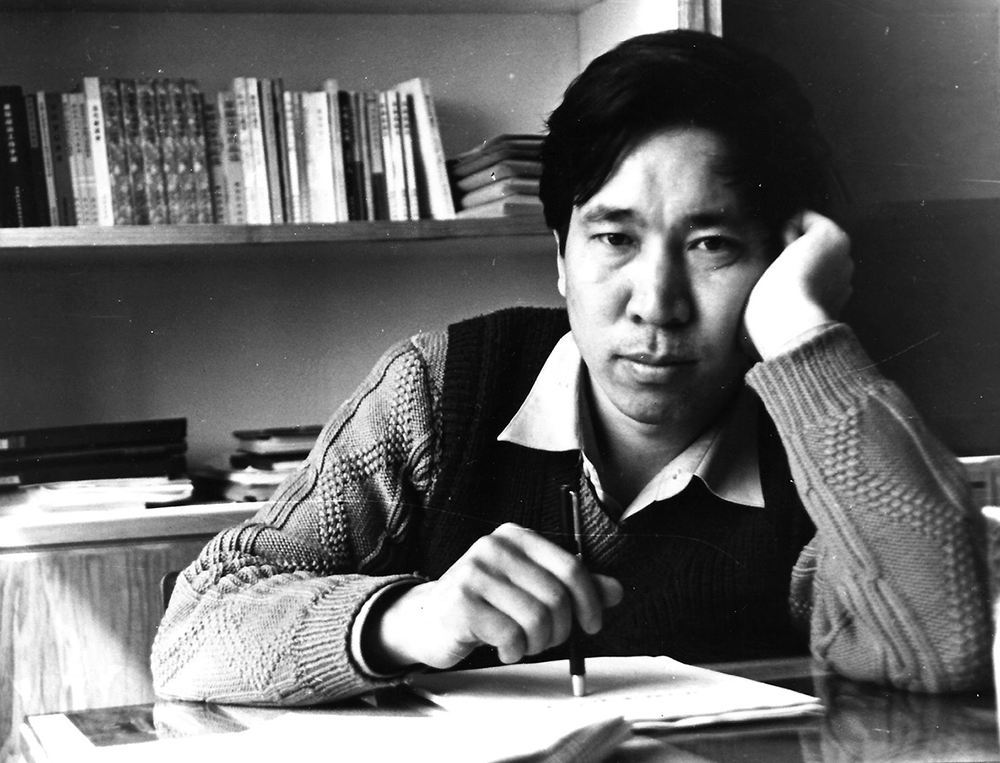
In his study in Kaifeng, 1991. Courtesy of Yan Lianke.
When I mentioned to friends in China that I would be interviewing Yan Lianke for The Paris Review, they were politely skeptical. “He hasn’t written anything in a while, has he?” one asked. In fact, Yan, who is the author of more than fifteen novels, remains tremendously prolific, though six of his most recent works—The Four Books (2010, translation 2015), The Day the Sun Died (2015, 2018), Heart Sutra (2020, 2023), The Family Plot (2021, forthcoming 2027), Liaozhai benji (Annals of Liaozhai, 2023), and Yize pangdaer angguide yanyu (A vast and expensive proverb, 2026)—were released in Chinese only in Taiwan and Hong Kong. As he likes to say, he is “the only Chinese writer living in China who isn’t published in China.” But even as his books have been removed from circulation on the mainland—in the case of Dream of Ding Village (2006, 2011), just three days after it reached shelves—his work has also been translated into thirty-plus languages abroad. He is a two-time recipient of the Lu Xun Literary Prize, one of the country’s most prestigious honors, as well as a winner of the Franz Kafka Prize; has had two books nominated for the International Booker; and is frequently cited as one of China’s leading contenders for a Nobel Prize.
Yan was born in 1958, in a small village in rural Henan, about forty miles from the nearest city, Luoyang. He is the youngest of four children, and both his parents were farmers. Much of his fiction has been set among the petty disputes and scandals of his home region; in his memoirs, including Three Brothers (2009, 2020) and The Women (2021, forthcoming 2026), he discusses his ambivalent relationship to his hometown, writing (in Carlos Rojas’s translation) that “I am this region’s unfilial son, an enemy agent, and the reason everyone still smiles when I return is that they don’t know that I’m a traitor to their land.” After joining the People’s Liberation Army (PLA) at twenty, he enrolled in one of its writing academies; his literary ability soon brought him success in the army’s propaganda department, and he reached the rank of senior colonel before leaving the military in 2004.
He got his first inkling of the responses his work would provoke in the nineties, when he was still in the army and one of his stories was deemed suspiciously anti-war. He ran further afoul of the authorities with Serve the People! (2005, 2007), a satirical novel in which two lovers arouse each other by defacing icons of the Cultural Revolution, then with Dream of Ding Village, a dark fable based on the story of a real village in Henan Province whose residents were left HIV positive after selling their blood to unscrupulous blood merchants. In the years after that, it became steadily more difficult, then impossible, for Yan to be published in his home country, although no official ban on his work exists.
That obstacle has spurred him to become more daring, both formally and politically. The Four Books is set in a labor camp during the famine of the Great Leap Forward, and is told through a collage of text fragments written by different prisoners: a diary, a philosophical treatise, notes for a novel by “the Author.” Yan often writes himself into his works, winking at his own predicament. In The Explosion Chronicles (2013, 2016), the famous author “Yan Lianke” is personally invited by the mayor of his (fictional) hometown of Explosion to write a book documenting its transition from a small village to a metropolis—only for the writer to reveal so much of the city’s dirty laundry that the local government labels him persona non grata.
I spoke with Yan last autumn in his rather austere office at the Hong Kong University of Science and Technology, where he serves as visiting faculty, and then again this spring, in his much cozier apartment near Renmin University of China in Beijing, where he teaches creative writing. (He has lived in the city since 1994, when he arrived with his wife, Zhai Lisha, and their son.) During our conversations, he offered me tea and a selection of dried fruit, nuts, and pastries; when he heard that I was staying with my friend the author Zhang Yueran, he insisted I take her a special bag of red rice, known for its health benefits, to pass on to her father, who wasn’t well. We met in the afternoons so that he was able to write in the mornings, on the easel-like setup on which he pens two thousand characters by hand each day. Yan speaks in a placid tone, even when talking about his terror of death, and always in complete paragraphs, in a Henan accent undiminished by his decades in Beijing. Every so often, he would slip into the third person, as if describing himself as a character in his fiction, or sometimes into the second person, as if addressing his past self.
INTERVIEWER
Thanks for meeting me, Mr. Yan. Tell me, do you find the environment here in Hong Kong more conducive to writing than Mainland China?
YAN LIANKE
First, thank you for coming all this way. I’ve been teaching here for twelve or thirteen years now, every other semester, for half a day a week, which leaves a lot of time to write. The longer I spend on the mainland, the freer I feel here. It really does seem as though I could write anything I like with no worries. I’ve written a great deal in the past decade or so, and that’s in part because I know that my books can’t be published in China. You have to understand that China has an enormous market for books. Almost every year there are books that sell a million, maybe two million, copies, which is a huge incentive. Say you earn six yuan per book—that’s six million yuan if you have a million sales, more than most people can earn in a lifetime. I don’t think I could resist that either. But when you write with the hope of being published in Chinese, you’re entering a state of constraint, because the market is subject to China’s legislation. I often say that the frightening thing isn’t official censorship, it’s self-censorship. When you censor yourself, that’s far more serious than someone else censoring you. But if I don’t have to think about being published, then I can write anything I want, without any restrictions.
INTERVIEWER
Have you always been so sanguine about being banned?
YAN
The thing is, I was publishing at a time when China was more liberal than it had been before or has been since. My novels Riguang liunian (Streams of time, 1998), Lenin’s Kisses (2004, 2012), and Hard Like Water (2001, 2021) were widely read and talked about. Huang jindong (The golden cave, 1995) and The Years, Months, Days (1997, 2017) were recognized by the Lu Xun Literary Prize. I also won army-wide prizes for literature and playwriting. The military came to value Yan Lianke, someone who’d won four national prizes and never asked for a single thing. My attitude was, Just let me write, don’t bother me—that’s all I want. It’s not that I was particularly courageous but that China was more tolerant then. Yes, Serve the People! was criticized and censored, but the fact that it got published speaks for itself.
I was slow to realize it when the walls started closing in. I thought I would be fine publishing Dream of Ding Village, but I got into trouble. Then I wrote Feng yasong (Ballad, hymn, ode, 2008) and spent half a year revising it through various rounds of censorship, which was all wasted time. I must have rewritten it six times and gone through four publishing houses. Just as one publisher was preparing to bring it out, their friends would call them to say, “Don’t touch Yan Lianke’s books, you’ll be censored by the authorities.” I was pushing fifty at that point, and I realized that my life was slipping away, and that it wasn’t just other people who were unhappy with my writing—I didn’t like it either. I thought, If I’m never going to be able to write something that other people approve of, then at least I can make sure I’m happy with what I write. My mind was completely clear when I began The Four Books. From then on, I’ve spent a lot of time thinking about the form of the novel. You can see from The Explosion Chronicles, The Day the Sun Died, The Family Plot, and Liaozhai benji that when an author is no longer working toward publication, he has the greatest freedom.
INTERVIEWER
Why is it that, with the freedom to write about anything, you’ve so often chosen to write about rural villages that resemble your own hometown?
YAN
I started writing about rural life when I was in the army. I’d read a lot of revolutionary rural literature of the kind that came into vogue after 1949, but the characters in most of those books—Zhou Libo’s The Hurricane, Ding Ling’s The Sun Shines over the Sanggan River, or Liu Qing’s Chuang yeshi (History of entrepreneurship)—had very little in common with the villagers I knew. Nor did I see them in the wave of so-called scar literature published in the seventies and eighties, which dealt with the aftermath of the Cultural Revolution, much of it written by the “educated youths” who were sent down to the countryside. I had nothing in common with these educated youths who were billeted to the village where I grew up, and who, from what I could see, were all better off than us. I envied them deeply. They didn’t have to do farmwork like we did. We fed them our best food even though we barely had enough for ourselves. I can see why those authors—Wang Anyi, Han Shaogong, Li Rui, Liang Xiaosheng, and so on—would write about their years of hardship, being separated from their families and sent away from the cities, but not a single one of them considered that the farmers in whose villages they were living had endured injustice and suffering for two or three thousand years.
So I want the books I write to be quite different, to be the kind of writing that only someone from the countryside could have come up with. Wherever I find the seed for a story, I try to plant it in familiar soil. Something from the countryside can’t be planted in Beijing.
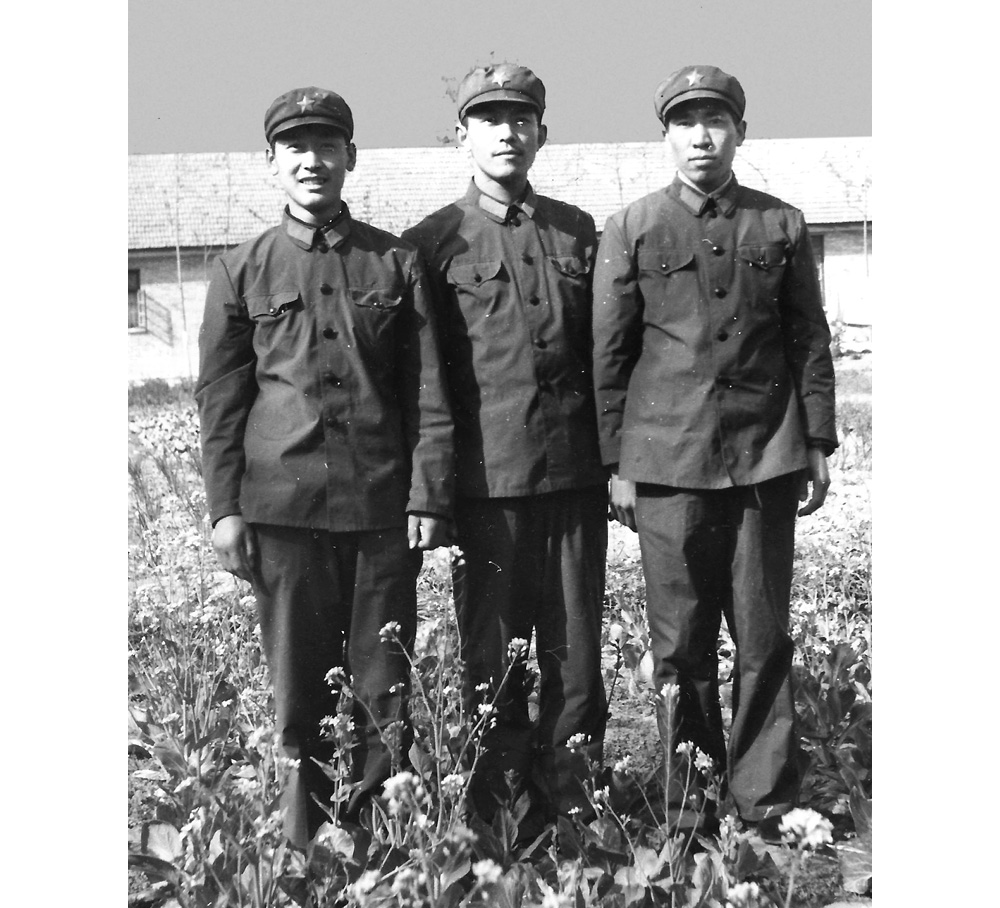 At right, as a new recruit in Shangqiu, Henan, 1978. Courtesy of Yan Lianke.
INTERVIEWER
Is it a kind of nostalgia or homesickness that keeps you returning to the subject of where you come from?
YAN
I don’t think there’s any homesickness in me at all. Chinese writers love to imagine themselves as Odysseus, yearning for home, but I’ve always wanted to get as far away as possible. Even as a child, I longed to leave my village and go to the big city, which at the time meant Luoyang. As the Cultural Revolution was winding down, when I was fourteen or fifteen, and the educated youths were returning to their cities one by one, I started riding my bicycle the sixty kilometers there for a part-time job. It was the first time I’d seen such tall buildings, three or four stories high. I marveled at the buses and the way every window was lit up at night. Much later, after studying for two years in Beijing, I decided I had to find a way to stay. Then, after moving to Beijing permanently, I had a hankering to go abroad, like the young people in The Family Plot who want to move to America, lured by a certain sophistication. Most of the stories I’ve written recently are about people wanting to leave the place they come from. They don’t know where they’re trying to go, but they need to get out.
INTERVIEWER
You talk about the lure of the city, but don’t The Explosion Chronicles and The Family Plot suggest that, as rural villages expand and become wealthier, their inhabitants tend to lose their moral compasses?
YAN
I’ve written about all the problems wealth brings, but also about the difficulties of being poor. Humankind lives in an eternal dilemma. You’re in a terrible situation either way.
INTERVIEWER
Could we say that your real subject is power, then? People are powerless when they’re poor, and after gaining power, they use it to oppress others.
YAN
Gaining the power to control others is a terrifying business. I’m currently writing a novel that includes all the revolutionaries who emerged after the Qing dynasty—Sun Yat-Sen, Chiang Kai-Shek, Mao Zedong, Zhou Enlai, Deng Xiaoping, and so on, along with fictional characters from other people’s work, as well as Lu Xun, Hu Shih, and virtually every other Modernist writer. And the writers who killed themselves during the Cultural Revolution, like Lao She and Fu Lei. Obviously, the novel is unpublishable, but I’m strongly drawn to writing it. If only there were no such heroes and we could all calmly live our lives. In any case, I won’t discuss the plot in this interview. Let’s just say that I’m writing a book that I plan never to publish. I’ll leave it to my son, and maybe he’ll pass it on to his children. Maybe, far in the future, people will read it and know that their ancestors once thought and wrote in this way.
INTERVIEWER
Did your parents pass books on to you? What did you read as a child?
YAN
My parents were illiterate, but my eldest sister was a big reader, partly because she was ill and spent a lot of time in bed. I don’t know where she borrowed all those books from, but I liked to say that her bedside table was my personal library. These were all revolutionary novels—what China calls red classics. When I was sixteen or seventeen, I came across Zhang Kangkang, whom you might not be familiar with—the 1975 novel she’s best known for, Fenjiexian (Boundary line), isn’t much talked about today. It’s a revolutionary novel about class struggle. I can’t remember how I found out that she’d been sent down from her hometown of Hangzhou to a farm in Qiqihar in the Northeast and that, after writing the novel, she was transferred to the city of Harbin. That got me thinking—if writing a book could take you from the middle of nowhere to a big city, why shouldn’t I write one? I was at school during the day, and on weekends I had to work in the fields, so I could write only at night—by the light of a kerosene lamp, because we didn’t have electricity back then. After two or three years of this, I’d produced my own novel of three hundred and ten thousand characters, all handwritten.
INTERVIEWER
What was the novel about?
YAN
My mother was married off when she was sixteen or seventeen—back then, families would adopt young girls and raise them as future daughters-in-law. She had no father and lost her mother when she was an infant. I took my mother’s story and borrowed liberally from the revolutionary novels I’d read to write my own novel of class struggle. A film came out a few years later called The Little Flower, about a young woman, played by Joan Chen, whose brother goes missing during the revolutionary war. I saw it when I was in the army, and thought the plot was quite similar.
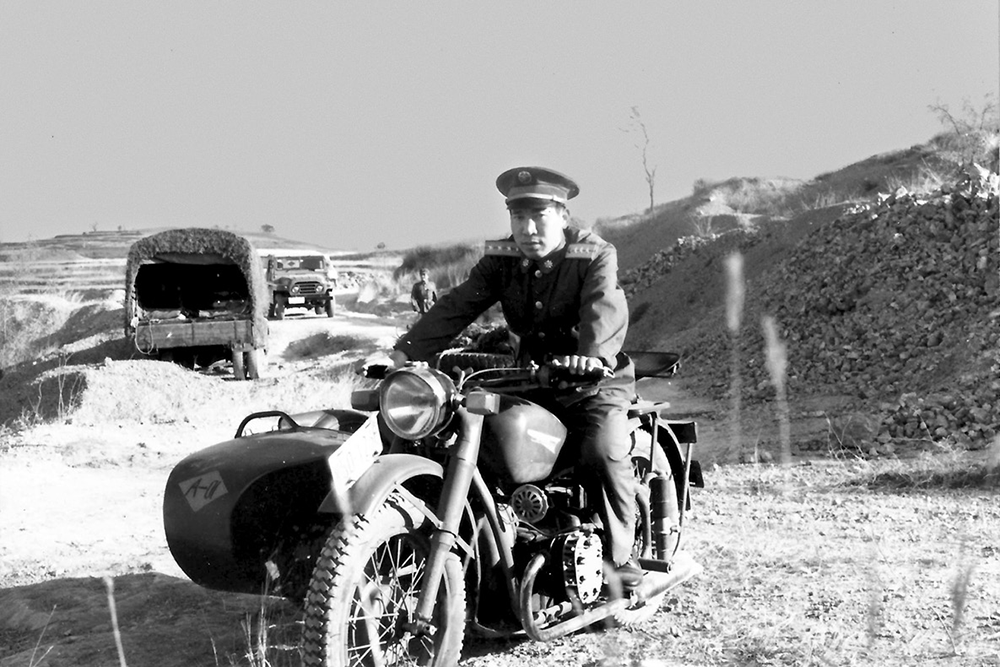
During field training in Shangqiu, Henan, 1983. Courtesy of Yan Lianke.
INTERVIEWER
Were your parents supportive of your studies, and of your writing?
YAN
Because the Cultural Revolution shut down all the universities and frequently disrupted high school classes, I got through only one year of senior high. When they brought back the university entrance exams, I was working in Xinxiang, and my parents summoned me home by telegram. This was in 1977. They said, “You did quite well at school. Why not give it a try?” So I studied for a few days, and sat for the exam. I didn’t get in, as you know. Having failed to get into even a vocational school, I tried to join the army. I knew that being a high school graduate would give me an advantage, so I went to visit my old physics teacher, who was the academic supervisor of my school—something like the deputy principal. I told him I wanted to join up, and he reached into a drawer, pulled out a high school diploma, asked me to remind him of my name, and wrote it on the diploma.
At first, when I was writing at home, my father thought there must be something wrong with my head, because I would stay up late writing instead of going to sleep. My parents had no idea what I was trying to do. But in 1981, I published a short story in a Henan magazine called Baihuayuan (Garden of a hundred flowers), and by the time of my first visit home, I’d published a few more. Back then, the Henan ribao (Henan daily) would publish listings of all the stories and authors that had appeared in various literary magazines. It was common in farming villages to paper our walls with old newspapers, and to my surprise, I saw my name on the wall, on such a listing, completely smudged. My mother or father had pointed it out to visitors so often that the ink was smeared. Even now, I feel a bittersweet twinge thinking about it.
Later, when I got promoted for my writing, my parents were delighted. “Who’d have thought you could do this on your own? Without any help from your family, without anything at all, you managed to become an officer!”
INTERVIEWER
How did you feel about the prospect of serving on the front line?
YAN
The army felt like a way out. Enlisting came with the possibility of getting commendations, joining the party. At that time, when someone left the army, the local government would take care of them, find them work, and so on. In China we have two kinds of hukou, or household registrations—rural and urban. Farmers had rural hukou, but only city folk had jobs arranged for them. I thought there’d be hope for me if I joined up.
But just think—I joined the army at the end of 1978, and in February 1979 we went to war with Vietnam, before I’d even finished my three months of basic training. The worst thing was, I was the best shooter in my regiment. It sounds silly, but I really did score a hundred points with ten shots from a prone position. I was sent to represent my unit in a tournament, where I scored ninety- nine. But being a good shooter meant you might get sent to the front line at any moment, so I was barely sleeping at night. One by one, my fellow soldiers were called up. That’s the absurd situation I found myself in.
The new recruits were led by what we called instructors, who were responsible for our political education—these days they’d be called section leaders. Our instructor gave each of us a piece of chalk and told us to write our names on a blackboard. Only later did I realize that he was trying to see which of us had the best handwriting. As soon as I’d written “Yan Lianke,” he called me over and wanted to know how much schooling I’d had. I told him I’d finished high school, which made me one of the more learned recruits—due to the Cultural Revolution, very few people had managed to do that. I hadn’t either, of course, but I did have my fake diploma.
The instructor told me that, from then on, I’d be the blackboard monitor. There was a stretch of concrete wall near the entrance to the new recruits’ building that they’d painted black, and my daily task was to write encouraging slogans and other propaganda there. It was the first time I’d seen chalk in different colors, not just white. Instead of attending training, all I had to do was come up with prose poems and slogans. Not long after, another instructor showed up and wanted to know who’d been writing these verses and essays. I was summoned, and he asked, “What else can you write?” He was flabbergasted when I told him I’d written fiction. “What kind?” I said a novel, and he asked if I could send it to him. Later, I learned that he was from Hangzhou and had served as the secretary of the army’s party committee and once wrote a speech for Madame Mao. When the Gang of Four fell, he was demoted and ended up as our camp instructor—that is, the person responsible for the political thought of the entire camp. He enjoyed writing classical poetry. I rushed to the phone and gave my brother a call, telling him to put my novel in the mail. He said, “You’ve been gone all winter, and Ma had to cook dinner, didn’t she? She needed paper for kindling to light the fire.” I’d left the manuscript in a box, and my mother found it and thought it was scrap paper. My brother said there were only sixty or seventy pages left, so I asked him to send those over and passed them to the instructor. When wartime assignments started coming in 1979, I was tasked with being his messenger. Eventually, I ended up writing dispatches and producing reports for newspapers.
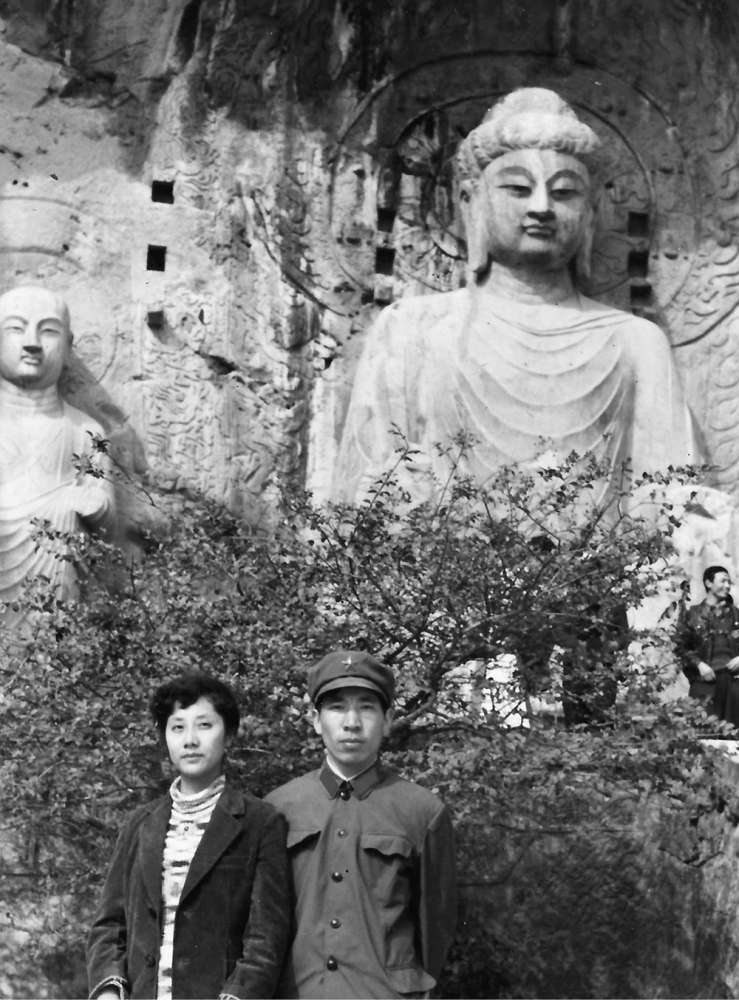
With his wife, Zhai Lisha, at the Longmen Grottoes near Luoyang, 1984. Courtesy of Yan Lianke.
INTERVIEWER
How was it to write propaganda? Were you good at it?
YAN
I wasn’t the best at it, but I was fast. I’d write a piece for the Jiefang jun bao (PLA news), then one for our internal newspaper, then one for Henan ribao, all of them carrying the byline of a different company. It was the regulation at the time that every company had to produce at least one article each year or they would be criticized. When it came to a special event such as Army Day, on August 1, I would write odes to the occasion and send them to the papers ahead of time, so that they could appear on the day itself. That’s how I got a commendation in my first year.
INTERVIEWER
Were you writing fiction, too?
YAN
At the time, the Wuhan Military Zone, which comprised both the Hubei and the Henan Provinces, had a creative writing program. The instructor told me he’d recommend me for a workshop on the Henan-Hubei border in Xinyang, far from where I was stationed. Back then, the army held culture and literature in very high esteem. Just as every province now has professional writers drawing a government salary, with housing and benefits, every military zone—I can’t remember how many zones there were, maybe seven or eight—as well as the air force and navy, had its five or six professional writers. So that was perhaps fifty or sixty salaried authors in the armed forces at any one time.
All the zones had writing workshops, led by established writers who’d already received national awards, as well as magazine editors. There were more than twenty people at the workshop I attended in Xinyang, but I was the only new recruit and the only one from the countryside. I just listened in. I didn’t know there were magazines called Jiefang jun wenyi (PLA literature and art) or Renwen zazhi (People’s literature). I didn’t even know the difference between short stories, novellas, and novels. That’s when I learned that not all fiction had to be book-length, and that it was okay for me to write short stories instead.
INTERVIEWER
How did your writing compare with what your peers were doing? Who were your influences?
YAN
Most of the others in the workshop were into characters who were patriotic, courageous, eager to make noble sacrifices. Their writing was colored by their time on the front line, and by the Chinese revolutionary literature and the Soviet literature they had read—The Dawns Are Quiet Here, The Forty-First, Live and Remember. That’s all that was available to us, and I just thought that’s what fiction was.
It was only after the workshop that I picked up Gone with the Wind. It was the first time I’d stepped into a library, after China began opening up. The Chinese edition had a picture of Vivien Leigh as Scarlett O’Hara on the cover, and I thought, So that’s what foreigners look like. I had no idea they could be so beautiful. The novel had been published in three volumes, and I read them on three consecutive nights. Reading Gone with the Wind made me realize I had no idea what I was doing. How could I know what good literature was when I’d read only those few revolutionary novels? I started reading the nineteenth-century classics—Tolstoy, Balzac, Hugo, Stendhal. The people in these books seemed real, unlike in our own novels. I thought I could write about soldiers like that. The war in 1979 made me understand that revolutionary literature was false or, let’s say, romanticized. The people around me were terror-stricken at the prospect of battle, but there was not one hint of how they were feeling in the military narratives I’d read up till then.
I wrote one short story, and then a second, influenced by Turgenev’s “Bezhin Meadow” from A Sportsman’s Sketches, which contains especially fine descriptions of the landscape. I’ve always said that Russian writers are the best at depicting nature, and none more so than Turgenev, who grew up in the countryside. I thought I could write like that too. My story described the vegetation in and around the army camp, the sky above, and so on. The editor of the Wuhan Military Zone’s Zhandou bao (Combat news) was moved and agreed to publish it in their literary supplement. Everyone in my company was wildly impressed that a new recruit had gotten a story accepted that took up a whole page.
INTERVIEWER
What was your next writing success?
YAN
That was my first novella, Xiaocun xiaohe (Little village, little river, 1985). I remember weeping as I wrote—I thought I was doing such a great job. It was about a soldier on the front line who misses his wife, child, and mother. When I finished it, I picked up a magazine called Kunlun, flipped through it looking for an editor’s name, and mailed it to them. I told all my friends that I’d put a dab of glue between two pages to see if the editor would read that far. When I got the manuscript back a couple of months later, the two pages were still stuck together.
I was promoted in 1982 to a department-level cultural cadre in the propaganda department. The following year, the editor in chief of Jiefangjun Wenyi Publishing House was retiring, and he wanted to come back for one last look at his old barracks. He brought with him a young writer who’d won a national award. I spent three days showing them around. When they left, at noon, I gave my novella—which by then had been languishing for two years—to the writer, who was also an editor at Kunlun, and watched as he tossed it into the trunk of his car. I went back to work at two, and at three o’clock, the writer phoned me and said that, as he was passing through Lankao County, he’d stopped for a piss and thought he’d glance at my story. “It brought me to tears,” he said. “Have you been to the front? I haven’t even finished reading it and I’m already crying. I want to publish this.” I told him I hadn’t seen any action, but surely that didn’t mean I wasn’t allowed to write war literature. “That’s no problem,” he said. “I just wanted to know. Let me finish reading it. If the ending doesn’t work, I’ll call you from Beijing and you can fix it.” It took another two years for the novella to be published, because we were still at war and they said the anti-war sentiments were too problematic. I personally didn’t think there was anything anti-war in writing about how an individual might be terrified of battle. I was really writing about my own fear.
Then Kunlun put out a special issue commemorating the fiftieth anniversary of the Long March. Only then did they dare to publish Xiaocun xiaohe, camouflaged within an entire issue of stories, essays, and poems lauding the Red Army and extolling heroic revolutionary values. Someone from the Yunnan Military Zone later told me that one of their commanders had noticed that all the frontline troops were reading Kunlun, and, when he asked about it, they said they were captivated by my story. The commander summoned all the writers in his unit and yelled at them. “I phoned the Kunlun editorial department in Beijing,” he said. “That story all our men are reading in the trenches was written by someone who’s just turned twenty-seven and has never seen battle. You’ve all experienced life on the front line, so why haven’t any of you produced a publishable story?” Of course, he hadn’t actually read my novella.
By that time, I was married and living in the city with my wife and newborn son. Xiaocun xiaohe earned me eight hundred yuan, which was a lot of money at the time. My mother, who was staying with us to help take care of the baby, said, “If they’re paying you that much for doing just a bit of writing, you ought to do more of it in the future.” Getting published and being paid for it became the most important things in my life. My wife liked to say that it felt as though whenever we were running short of cash, another payment would always arrive. By 1986 or so, my duties had continued to increase and my official salary was around two hundred yuan a month. Publishing a novella or a couple of short stories every so often earned me around the same amount. I kept this up for another five or six years, after I’d transferred from Shangqiu to Kaifeng, where I was a cultural cadre responsible for literary production across the entire army. Looking back, I see that we had an enviable lifestyle, especially since I was able to take care of my family in Henan. Money and getting published were no longer the main things, though. I was starting to dream about fame. It had become easy to get published and I kept getting commissions, so I just pumped them out—eight to ten short stories and novellas a year. The quality didn’t matter, they were just scraps of narrative with nothing to them. In 1995, I reread everything I’d written up till then for a planned five-volume collected works, and I realized it had all been a sheer waste of my talent, repetitive and overly reliant on a sort of “Chinese realism.” Now I see this as a long period in which I was churning out nothing but trash.
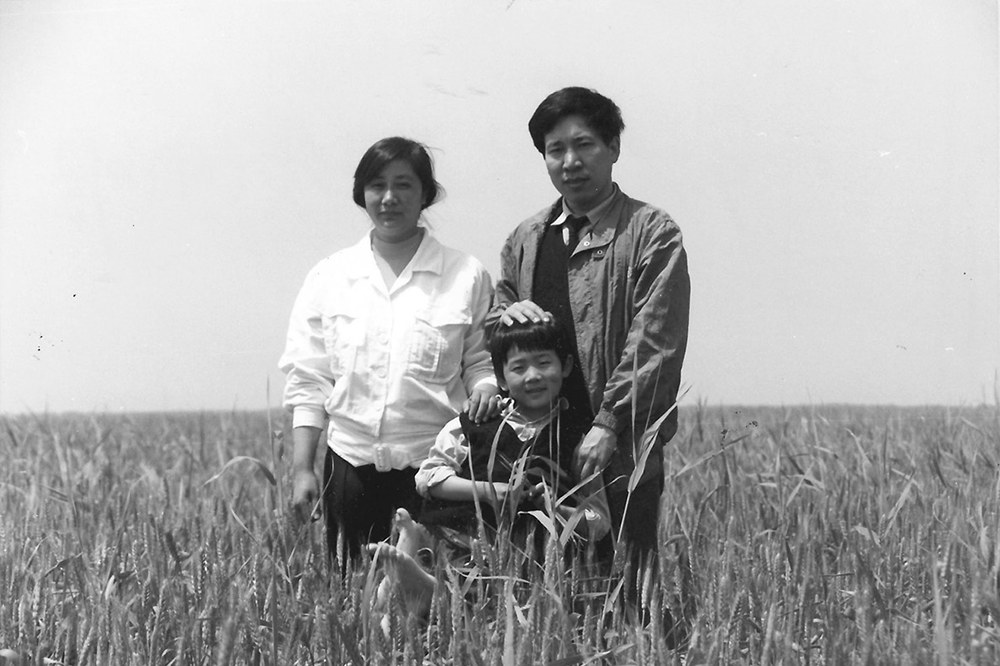
With his wife and son near his hometown in Song County, Henan, 1987. Courtesy of Yan Lianke.
INTERVIEWER
How did you balance your job with the writing?
YAN
I spent my days in the office writing speeches for the commanders and other materials. Whenever they needed something urgently, they’d come to me because they knew I wrote fast. I’d hand my first draft directly to our department head, who’d make a few small changes. I wrote fiction only when I got home after work—though we had a small child, so I’d often go back to the office at night to write undisturbed.
I was a divided person—writing one thing in the office and another, completely different thing at home, though the difference didn’t feel so great at the time. I just switched very naturally between these two roles. Then, in 1989, I was sent to the People’s Liberation Army Academy of Art to study writing. After that, for two years, I was basically writing all day. Xu Huaizhong had been the first head of the literature department, and by the time I got there, I was aware of alumni who’d already made their names, including Mo Yan and Li Cunbao, who was famous at the time for his novel The Wreath at the Foot of the Mountain. Most days, I didn’t need to do anything, not even go to class. I just stayed in my dorm all day and wrote. At the academy, people would joke that Yan Lianke could write a short story in a single day, and he didn’t even need a second draft. I was very confident in my work.
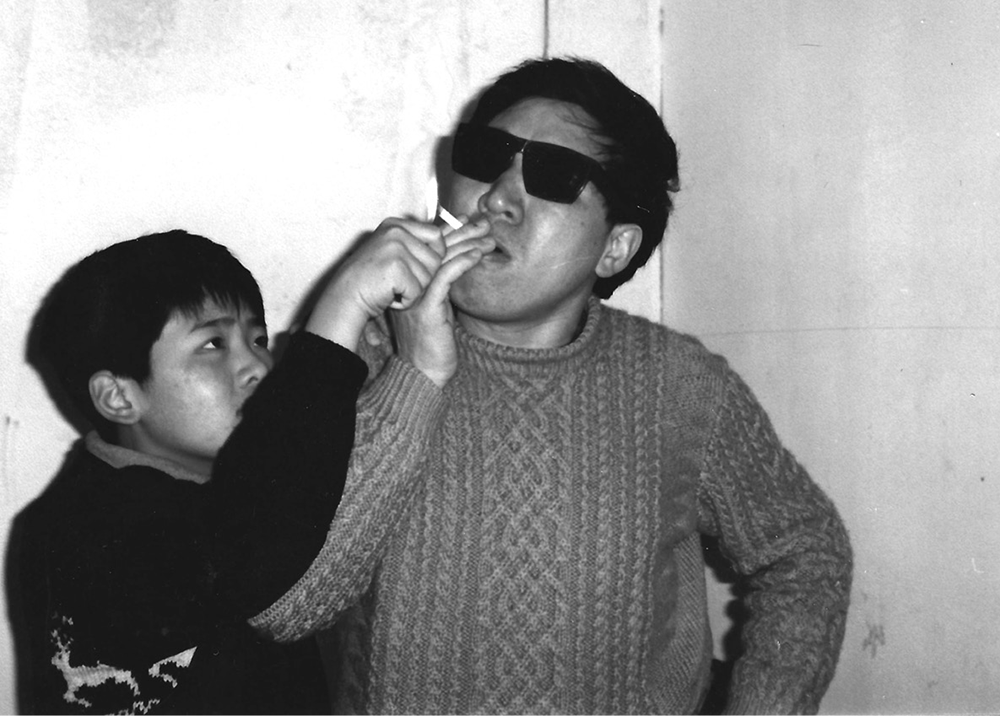
With his son, ca. 1990. Courtesy of Yan Lianke.
INTERVIEWER
Do you have any rules for your writing?
YAN
Only that I have to write every single day. If I’m not traveling, I write in the morning, read in the afternoon, and see friends in the evening. For around thirty years now, I’ve written two thousand characters every day. That’s five pages. I stop there, even if I’m in the middle of a sentence. Then the next day, I read those five pages over and continue for another two thousand characters. It used to take me two hours, but now that I’m older it’s closer to three. Generally, after finishing a novel, I’m exhausted, and before moving on to the next one, I work on something lighter and shorter—Three Brothers, The Women, Liaozhai benji, Discovering Fiction (2011, 2022). At one point I was writing a TV series for CCTV [China Central Television] between every book.
INTERVIEWER
Did writing for TV affect your fiction?
YAN
Absolutely not. The idea was just that I’d make some serious money, then go back to my real work, writing novels. The first TV series I wrote paid two thousand yuan an episode. The director put me up in a hotel and covered the bill. I ate in the hotel restaurant every day. I wrote more than twenty episodes and earned more than forty thousand yuan in total, which I used to buy an apartment and a car.
I cowrote one series, Xuebaideqiang (The snow-white wall, 2003), with Mo Yan. It was commissioned by the public prosecutor’s office, so its themes were all about upholding justice, solving crimes, arresting corrupt officials, that sort of thing. Another series, Muqin shitiaohe (Mother is a river, 2006), was set in a village during the war with Vietnam. Two men go off to the front line together, and one of them doesn’t make it back. Just before dying, he asks his buddy to take care of his wife and son. The surviving soldier helps raise the dead man’s kid, but of course he then gets together with his dead friend’s wife, and meanwhile the kid grows up and goes to school, and anyway they all have hard lives. CCTV loved that kind of show. The main thing was to make your audience cry by the first or second episode and not let up until the finale. The top brass later told me that even the censors were sobbing as they watched. People in my hometown, including officials in the local government, used to come by during the new year and tell me they were fans of mine, not because of my novels but because my TV shows kept being shown on prime time. Of course, everything changed after my books were banned. After Xia Riluo (Summer Sunset, 1992), I started to become less welcome.
INTERVIEWER
What was the issue with Xia Riluo? It describes life in the army, like your previous work. Was it because of the suicide of the titular officer, Xia Riluo?
YAN
The reason I got into trouble was that an essay in Cheng ming (Discord), a Hong Kong magazine, drew attention to it. According to that critic, this story pulled a soldier off his war horse and turned him into an ordinary man—and thus Yan Lianke’s writing heralded a fourth wave of Chinese military fiction. I had no idea what the first three waves were supposed to have been, but apparently the fourth wave was about the degradation of the PLA, as exemplified by Xia Riluo.
That article was published two years after the novella came out. The first I heard about it was when I was on my way to a hospital in Shandong for surgery on my spine—I’d been suffering from a herniated disc for two years—and I got a phone call summoning me back to camp. It turned out that Xia Riluo had been mentioned in a report from the propaganda department that listed problematic works of fiction. So I was made to write an endless stream of self-criticism. The army was annoyed with me for causing so much trouble. That whole situation lasted about half a year.
INTERVIEWER
What does writing self-criticism for the government entail, exactly? What were you confessing to?
YAN
Essentially, I had to say that my understanding of the party’s artistic policies was insufficient, that I hadn’t been serious enough in my political study, that my head was full of all kinds of nonsensical ideas. But, to be honest, writing self-criticism is a sort of ritual. The point is the process—it has nothing to do with whether the self-criticism itself is well written or not. Each time my self-criticism was rejected, it indicated only that the higher-ups hadn’t made their decision about me yet. It’s when you stop getting asked to write self-criticism altogether that you know they’ve decided you’re beyond redemption.
I hadn’t yet been able to have my spinal surgery, so I wrote while lying flat in bed. The China Disabled Persons’ Federation had helped me rig up a suspended board that allowed me to work in that position. My unit was very protective of me—my commanders explained over and over that my performance was otherwise exemplary, and that I was serious in my desire to reform. After they’d rejected my self-criticism six or seven times, I stopped. I was still in pain, and I thought that if I wasn’t going to get through this, they might as well just let me go home.
I’m not sure what changed, but at some point, the highest-ranking officer in my unit, a lieutenant general, showed up at my home with bags of fruit and other gifts. He asked after my health and so on, and eventually he said I should write more fiction and maybe try to win a national or military award, and that if my health would allow, I could come join his unit to experience life there. I felt I had to say yes. So I ended up spending a month at a missile unit in Luoyang, after which I wrote a novella called Daxiao (The senior colonel, 1993) that was deemed sufficiently revolutionary and heroic. It was published in Jiefang jun wenyi, then reprinted in various anthologies, and I did indeed win a major military award. The whole business was ridiculous. After Daxiao, I made up my mind not to write military literature anymore. Instead, I turned my attention to the countryside, and wrote Riguang liunian, Hard Like Water, and Lenin’s Kisses.
INTERVIEWER
Was that safer for you?
YAN
If you want to write about the more complex side of humanity, you can say anything you want about farmers—that’s fine. But you can’t write about the army in the same way. After I made my decision, a period of inspiration followed. I went to Xi’an for treatment, and on the train back, I started The Years, Months, Days, finished it in a week, and sent it to Shouhuo (Harvest) magazine. They responded quickly, saying I might have written a modern classic. When they published the novella, it caused quite a stir and was discussed in all kinds of places.
INTERVIEWER
How do you explain your shift away from traditional realism in this period?
YAN
When my back pain began, in 1991, I’d returned to Henan for a month or so. I went to bed perfectly fine one night, and woke up the next day unable to move. For a couple of years I was constantly undergoing treatment, still writing, heartbroken to think I might never walk again. The strange thing was, before 1991, I hadn’t been able to stomach any twentieth-century literature, not just from China, but also Kafka, or new books from the U.S. and Europe. I couldn’t even get through One Hundred Years of Solitude. But as I spent a whole month lying in bed feeling sorry for myself, out of sheer boredom I reached for whatever books I had on my shelf. I think the first one I picked up was Juan Rulfo’s Pedro Páramo. Unexpectedly, I found it to be delightful, really a pleasure to read. My novella Xunzhao tudi (Searching for the earth, 1993) was very much influenced by Pedro Páramo. It follows the spirit of a soldier after his death in battle, as his ashes are being brought back to his hometown—it’s narrated by the urn. The ghost meets his mother, his girlfriend, and the other people at his funeral.
This was when my writing started to break free from realism. From that point on, I started really getting into modern literature. Suddenly I was no longer interested in nineteenth-century novels. Instead, I devoured Latin American work and American dark humor, and the whole twentieth-century canon entered my world.
INTERVIEWER
How did your style evolve after that?
YAN
I realized that whether an author produces ten or a hundred novels, every single one has a language and structure that are right for it. So I’m always trying to transform my style, though I’m not sure I always succeed. Riguang liunian and The Years, Months, Days are maybe a bit similar to each other, whereas when I was writing Hard Like Water, which is full of the language of Chairman Mao and Communist slogans from the Cultural Revolution, it was very clear to me that this was completely different from what I’d done before.
Lenin’s Kisses was full of dialect—when I ran out of Henan phrases, I just invented my own strange lingo. Yu Hua writes very fluidly, and uses all kinds of common idioms, which makes him instantly legible, whether in Chinese or in translation. Whereas I want to defamiliarize everything, to turn familiar expressions inside out, to disrupt the reading experience.
With Dream of Ding Village, I wanted to write a novel using the language of an essay. When I looked at it again recently, I realized that I often repeat part of the previous sentence, which might be a form I took from Henan opera, where lyrics often echo a word or two from the line before.
Then there was Feng yasong, about the life of a university professor, in which I knew I needed to use an intellectual register. I remember rereading Coetzee’s and Saul Bellow’s novels to find the right tone, but I didn’t think I had the ability to accomplish what they had. And for The Four Books, I knew early on that I needed to use the language of the Bible.
With The Family Plot, I feel the weakest section is the mother’s story, because I’m not sure I found the right voice for her—I wanted her to sound a little classical, but then I’m not that highly educated myself. That’s why, when you were translating this novel, I asked you to make her sound more refined.
INTERVIEWER
What made you use the Henan dialect in Lenin’s Kisses?
YAN
The Henan dialect often doesn’t use the third tone, and it sometimes does away with the second tone, too. I think that makes us sound gentler and more straightforward. Let’s say you want to write a global story, which is no easy matter, about how the twentieth century was a battleground between capitalism and communism, which is what I did in Lenin’s Kisses. If communism created a utopia, what would happen next? Surely you’d need a quiet, gentle language to soften the hard edges of the story.
INTERVIEWER
How did you find the voice for Hard Like Water, with its “red” language of the Cultural Revolution?
YAN
On a visit back to Luoyang, I met an army comrade who told me about some Cultural Revolution–era newspapers he’d found, along with records of army interrogations. An incident he mentioned became the opening. Two political activists had gone to Beijing to attend a Mao Zedong thought-study session. They were on the same train, but didn’t speak a word to each other. On their way back after the conference, they both got off the train in Zhengzhou, and, still without a word, they went off together and had sex. The problem was, some ration coupons went missing from the man’s unit, so they took him in for questioning. When they asked him to confess to any mistakes he’d made, he didn’t know what they knew, and so he told them about the woman. The questioner wanted all kinds of details. I imagine he was curious. After all, the ten years of the Cultural Revolution were more sexually repressed than any other time in China’s history. My friend had a copy of the transcript of the interrogation, and I asked if I could have it. This was the moment when I knew that I had not only the story of Hard Like Water but also its language. Serve the People!, which I wrote after leaving the military, was a continuation of the mood of that novel. I knew someone working in the office of a mayor or deputy mayor, and he told me about some strange goings-on that sparked an idea—what if a commander’s wife were to start an affair with a low-ranking soldier?
INTERVIEWER
In both these books, there’s something transgressive about the sexual relationships that ends up destabilizing the very rigid systems they exist within. Was that your intention?
YAN
I might not have realized it at the time, but looking back, with Hard Like Water, I see that I was trying to dissolve the connection between love and revolution, to subvert the formula of those novels in which revolutionaries inevitably fall in love. In 1990, I wrote a novella with some rather racy sections, called Ziyou luoti ji (Free-fall memorial), that spilled out very quickly—maybe because of the hormones? It was thirty-five thousand characters, and for the first time I thought I’d written a story that flowed so well it didn’t need any revisions. Since then, I haven’t had to revise any of my work. I just proofread what I’ve written, adjust the punctuation, and send it off. And sex keeps cropping up—I think that has something to do with freedom. Riguang liunian and Hard Like Water were so exuberant and unrestrained. People think I write against realism, but it’s more that everything I write, from the language to the structure, is simply against what’s familiar. With Serve the People!, there was a kind of instinctive betrayal at work. That I’d read and drawn from so much revolutionary literature gave my betrayal extra force. I was no longer in the army at that point, so there was nothing holding me back.
INTERVIEWER
How did you decide to leave the military?
YAN
Life in the army was relatively stable, especially as it was peacetime, so I had no plans to leave till 2000 or so. Then, after the publication of Big Breasts and Wide Hips, Mo Yan left the army and transferred to the Supreme People’s Procuratorate to be a screenwriter at a TV production center run by their news arm. Someone from the Supreme People’s Court newspaper came to me and asked if I wanted to do something similar, and, crucially, they were offering housing. I didn’t yet have a place to stay in Beijing, and they were offering an apartment that must have been worth two million yuan, near a metro station. That’s why I asked for the transfer. Not because of literature—I did it for the sake of the housing.
My transfer request was denied for a couple of years. Then, in early 2004, after Lenin’s Kisses was published, I sat down for an interview to discuss the novel with Hong Kong’s Phoenix TV. The program aired one evening in October, and at 8 A.M. the next day, the department head’s secretary called to say I was free to go. I put in another transfer request that afternoon, and within half an hour the secretary had called again to say it had been approved.
The following year, Serve the People! was censured by the General Administration of Press and Publication, and got handed six bans—a ban on publication, a ban on adaptation for film or TV, and so on. The army was delighted that they’d had the foresight to get rid of me before this, of course.
INTERVIEWER
Was the problem with Serve the People! the scene where the illicit lovers smash a Chairman Mao quotation on the ground and have sex amid its fragments?
YAN
I don’t remember the exact wording, but they didn’t mention my treatment of Chairman Mao. It was all about how I’d tarnished the reputation of the army. Anyway, it was banned. Later, someone told me that the censorship panel was composed mostly of retired cadres trying to earn brownie points by explaining how problematic the text was. Yet when the leadership of the Beijing Municipal Committee dropped in on a Writers Association meeting, they seemed mainly concerned and wanted to have a chat with me, rather than berate me for all the bad things I’d done.
Another time, I was at an event to celebrate Zhang Jie winning her second Mao Dun Literature Prize, and when I went to the restroom, a division head followed me in. This is a horrifying scenario, but you have to imagine the two of us standing side by side at the urinals when he turned to me and said, “Mr. Yan, there’s nothing really the matter with Serve the People! It’s just that Liu Xiaobo wrote about it.” This was the first I’d heard about this. I looked up Liu Xiaobo’s essay, and found that his main complaint seemed to be that I hadn’t described the protagonist’s appearance or clothing. I truly hadn’t expected something this old-fashioned and banal, but, ludicrously, that’s all it took to draw their scrutiny.
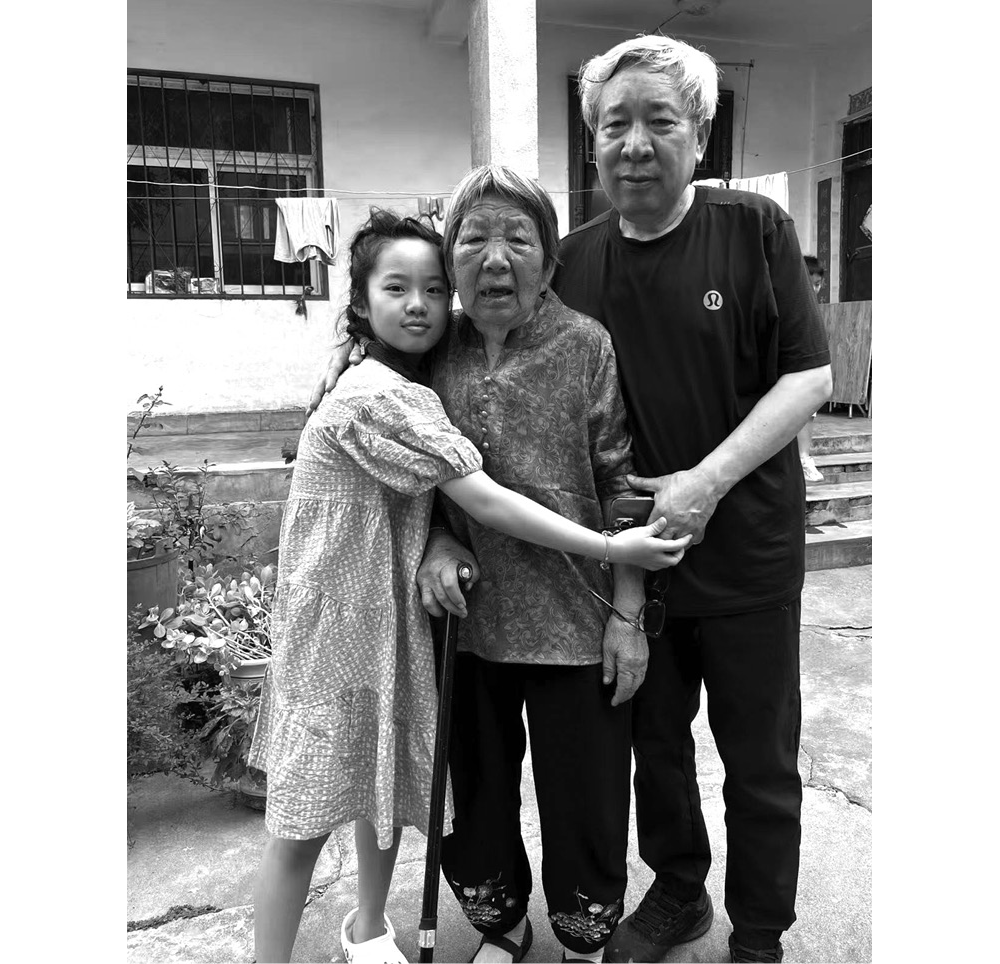
With his granddaughter and his mother at his family home in Song County, 2020. Courtesy of Yan Lianke.
INTERVIEWER
The opening lines of Serve the People!, in Julia Lovell’s translation, are “The novel is the only place for a great many of life’s truths. Because it is only in fiction that certain facts can be held up to the light.” Were you already thinking of your concept of “mythorealism” back then?
YAN
I didn’t come up with the idea of mythorealism until I was writing The Four Books. I’d gone back to classical Chinese literature and realized that these stories were every bit as absurd as the plays of Beckett, Ionesco, or Pinter. When we look at The Metamorphosis, in which Gregor turns into an insect overnight, we recognize that we’ve witnessed similar transformations in classical Chinese literature, all the way back to In Search of the Supernatural and Pu Songling. Four or five centuries ago, Chinese stories already had animals, demons, plants, birds turning into humans. When you talk about realism, we’re still being constrained by the nineteenth century. There’s one sort of reality that’s defined by our experiences, and another that’s defined by possibility, an unreal reality. That’s what I mean by mythorealism—excavating the reality buried beneath the real world.
But it’s true that as early as 2003 or 2004, after I’d finished Lenin’s Kisses, I realized that realism was unable to capture China’s reality—not because of censorship but because China is simply too complicated. It’s not just that the country is enormous, with a huge population. It’s also that the political situation keeps changing. A certain policy might be implemented in one place but only beginning to be enforced in another. One region might be relatively liberal while another is strictly controlled. There’s almost no continuity. Or take the three years of famine during the Great Leap Forward, when many people starved to death—the average person in Beijing was unaware of it. This was the same moment when many important structures, such as the Great Hall of the People, were built. The laborers had a difficult time, but no one knew how much worse it was for people in the countryside. It was like they were living in an alternate reality, the kind of reality that lies buried in our hearts.
INTERVIEWER
Dream of Ding Village tells the story of a so-called AIDS village—a settlement in which most inhabitants are HIV positive—that has been neglected by the government, via the lack of legislation that had allowed unscrupulous blood merchants to infect everyone in the first place. What first drew you to this subject?
YAN
This was at a time when China was proclaiming to the world how supportive it was of AIDS patients. Hu Jintao and Wen Jiabao were constantly talking about it on CCTV, and Xi Jinping’s wife was some kind of HIV goodwill ambassador. They had these model AIDS villages that they would take foreign journalists to, with elementary schools and care homes and medical centers where treatment was free. So the whole world thought China was very progressive on this front. But I heard about an AIDS village near Kaifeng that wasn’t a model village, where conditions were much worse. When the AIDS activist Gao Yaojie told me she’d witnessed someone there getting dizzy after selling blood and being held upside down and shaken so the blood flowed from her legs back to her head, I knew I had to go there myself to see what was going on. We were initially barred from entering by a task force, made up of county officials who’d been sent to live in one of the abandoned houses. They were afraid of AIDS but knew nothing about how it was spread. I had a Chinese American friend with me who studied infectious diseases, and with the help of a couple of pamphlets that Ms. Gao had given me, we gave talks about how to prevent HIV infection. That gained us their trust, and it didn’t hurt that we were willing to get the village connected to electricity and so on. We must have spent over two hundred thousand yuan. The task force was officially there to alleviate poverty, and we were certainly helping with that, so they let us in.
I visited that village a dozen times or so. If you gave a family a few hundred yuan and had a meal with them, they’d consider you a friend. I slowly got to know the residents, but on each visit, about half the familiar faces would be gone. By my last couple of visits, I noticed that anyone who could leave had left, especially the young people. Anyone who was uninfected was gone, and the infected were gradually leaving this world too.
I believed that writing about this place was the right thing to do—for myself, for the villagers, for the government, and for my readers and my publisher. I outlined a slim nonfiction book and also planned to write a novel that I feel would have turned out much better than Lenin’s Kisses or Hard Like Water. It would have been about a fictional country with its own language and way of life, where everyone, including the president, is selling their blood, which gives them a monopoly over the entire world, because every single nation in Europe and North America is relying on this supply, just as they rely on petroleum. If it were to be cut off, all their medical systems would collapse. But then I got into trouble over Serve the People!, and I allowed fear to stop me from writing both this ambitious novel and the nonfiction book.
This is my greatest regret. If not for my self-censorship, I could have written a great novel when I was at the height of my creative powers, one that would have expressed the complexity of Chinese life. I ought at least to have written the nonfiction book. The novel I did write, Dream of Ding Village, got banned anyway. For maybe seven years after that, my writing was shaky. I wrote Three Brothers during that time. It got published, and everyone liked it. But for me, it was all wasted time.
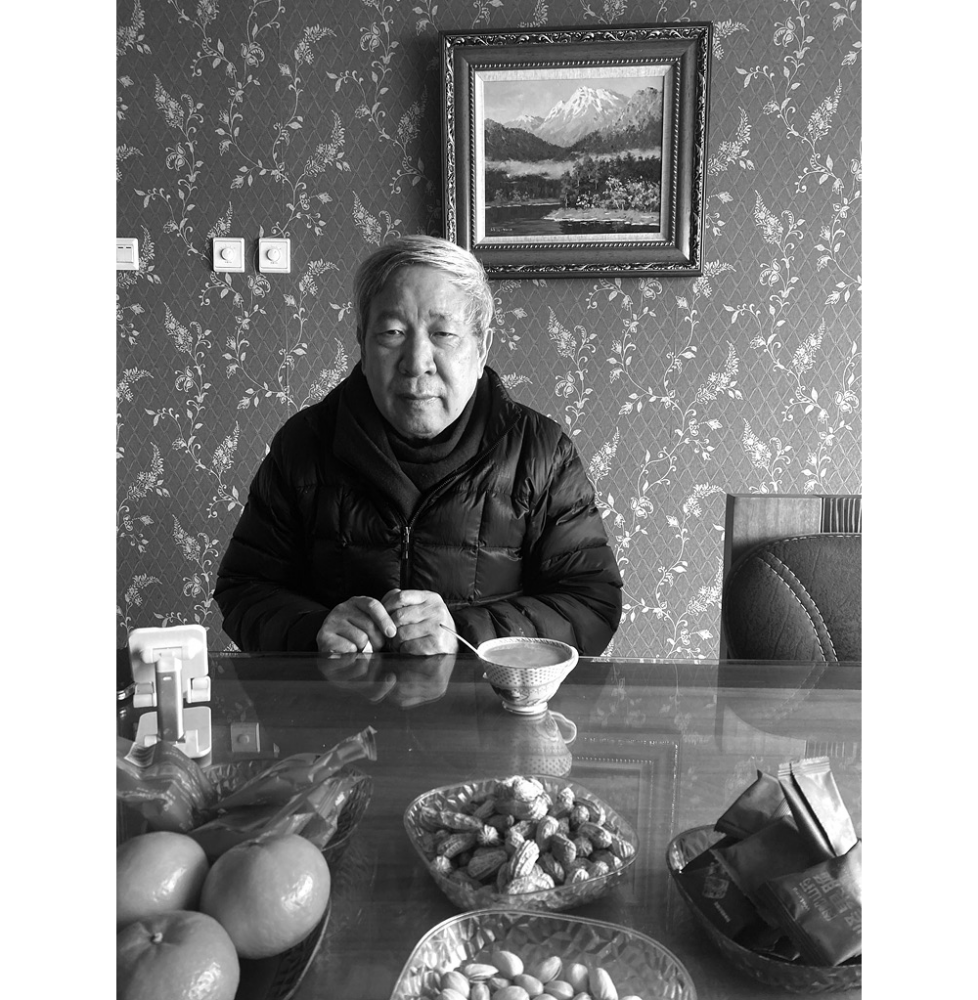
At home in Beijing, 2026. Courtesy of Jeremy Tiang.
INTERVIEWER
Why do you say it was a waste, when Three Brothers was so well received?
YAN
It sold hundreds of thousands of copies, but it all came too easily. I just sat down every day and wrote about my life in beautiful paragraphs. I want my writing to be more difficult than that. I want to climb a mountain only if it seems impossible. If I could just stroll up, then what’s the point?
INTERVIEWER
What’s the mountain that looks the most impossible to climb?
YAN
The creation of a novel that’s truly of the twenty-first century. I’ve spent many years thinking about this. When I look at the novels being published in China today, they might as well be from the nineteenth or even the eighteenth century. We talk about having entered a new century when we’ve just been marching in place. I dream of writing a novel that isn’t a novel but a kind of literature of the antinovel. That’s what I was trying to describe in my works of literary theory, Discovering Fiction and Xiaoshuode xinyang (Faith in the novel, 2025)—how to excavate the mythorealism buried within the Chinese experience. I wrote The Four Books, The Explosion Chronicles, The Day the Sun Died, and so forth with these goals in mind, to see the truth that can’t be seen. As I get older, I grow anxious that I’ll never be able to write a novel that is truly of the twenty-first century. I know this experiment is doomed to fail, but maybe I’ll at least be able to find a pathway to the first step. What I really need is for the hand of God to reach down and touch the top of my head. So many of my novels have come to me this way, in a single instant.
INTERVIEWER
When have you felt the touch of God?
YAN
Here’s an example. One day, I was walking to Renmin University when the strangest question came into my head—what if someone came up to me, handed me a gun, and asked me to shoot him? Would I be able to do it? That is how the child from The Four Books came to me. Decades ago, when I was still at the PLA academy, a classmate who was a tank driver told me a story about training in the Gansu desert and seeing a swath of bones. On closer examination, he saw that they were all human. He later found out that this area was where intellectuals from Beijing and Shanghai were sent for reeducation. I’d known ever since then that I needed to write about this, but I didn’t know how. It wasn’t till I had that vision of the child holding out a gun that I knew I’d found the way. Because how else could a small child run a reeducation camp full of adult intellectuals? He puts a single bullet in a gun, offers it to the disobedient ones, and says, Go ahead and shoot me. Of course, no one dares. Just like that, the story was fully formed.
Naturally, there are times when you have the voice all prepared, and other times when you have the other ingredients but you’re still waiting for the right words to arrive. Then the final piece falls into place, and you have everything you need. I spend my days anxiously waiting for this moment of conception. Some nights I lose sleep over it. What a terrible thing, to live in fear that God has stopped caring about you.
INTERVIEWER
But aren’t you an atheist?
YAN
I call myself an atheist, but I yearn for belief. If only I’d become a Christian or a Buddhist in my teens, or even if I’d been superstitious and believed in folk religion—so long as I had some sense of an afterlife or reincarnation, I’d feel much more secure. But science is so advanced these days. I’m very aware that death is just death, and there’s nothing beyond it. The more I understand that I will never conquer this fear, the more I long for religion.
INTERVIEWER
Have you ever felt any stirrings of faith?
YAN
We have a practice called Qigong that isn’t connected to any religion but still has a spiritual dimension. It was very fashionable in China around the time I was at the military academy. I took a class with forty other people, and when the instructor sent his energy our way, the others started writhing around on the ground. I opened my eyes and found I was the only one still standing.
Later, when I started having back problems, a friend introduced me to a Qigong master. My friend paid sixty yuan per visit, but I went for free, because the Qigong master liked my writing. In the end, he wasn’t able to help me, but he referred me to someone else.
I followed his directions and found myself on a deserted hilltop. I kept going, and suddenly there was a guardhouse in front of me. I went through the gates and saw what looked like several five-star hotels. Apparently it was some kind of retreat. I was led into a hall twice the size of my apartment. I’d never seen such a thick carpet. During each session, the Qigong master would send out his energy, and the wealthy people around me would burst into tears, but I had no reaction at all. I went four or five times, before the Qigong master told me to stop coming. The spirit just couldn’t get through to me.
Translated from the Chinese by Jeremy Tiang; interview transcripts transcribed by Vickie Wang.


Comments
Post a Comment