Alice Oswald, The Art of Poetry
Alice Oswald, The Art of Poetry No. 119
Issue 254, Winter 2025
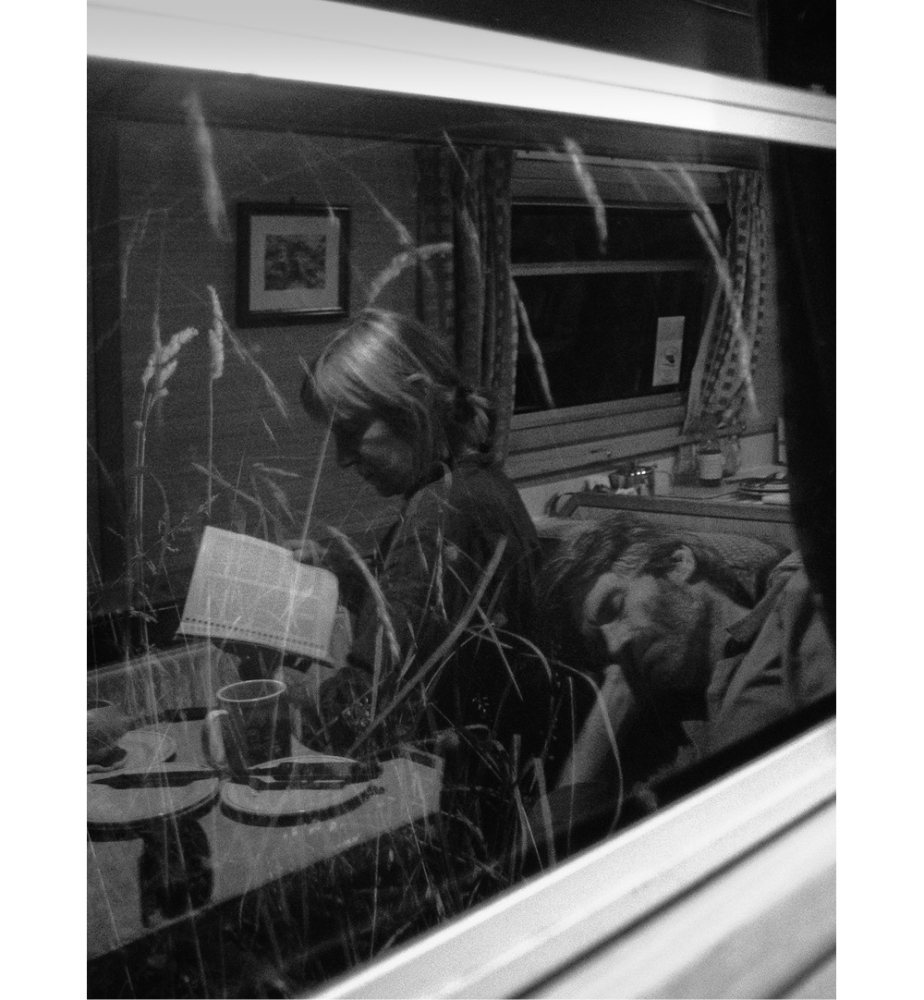 With Peter Oswald, on a rented houseboat in Wales, 2021. Photograph by Joe Oswald. All photographs courtesy of Alice Oswald.
Most of my conversations with Alice Oswald took place at her home, Adelaide, a ramshackle cottage with a red door in Devon, southwest England. This past January, when I made my first visit, Oswald came to the station to collect me and her octogenarian aunt, who’d taken the same train from London and who lives mostly in the house across from hers. On the drive, the two women discussed whether a flock of birds that had risen from a clearing we’d passed were fieldfares or starlings.
Oswald has known Adelaide all her life, having spent holidays there as a child. Her paternal grandmother first lived in the house for a few months with her family at the end of World War I; in 1940, when she was traversing the area by bicycle, looking for a refuge from the bombs targeting Britain’s cities, she remembered it, tracked it down, and bought it, by then in disrepair. Two years ago, Alice and her husband, the playwright Peter Oswald, purchased it from her relatives, and moved from Bristol to live there year-round. In the living room, a small wooden table looks out onto the long garden, which extends toward a bank of trees, and, beyond that, fields and the river Torridge. Next to the desk is a bookshelf devoted to editions of the Odyssey and critical works on Homer. We conducted most of our sessions in the dining room, lighting the log-burning stove in the cold weather. Oswald showed me the letterpress pamphlets and ephemera she has published with her friend Kevin Mount, a typographer, and we explored the woodlands, which in the spring brimmed fluorescently with bluebells. She nimbly navigated tree roots, identified birds by sound, and jumped fences to avoid farmers, accompanied by her Jack Russell–collie mix, Holly. In the summer, we swam in the river, Oswald lamenting its sickened state. During our last dip, as we observed the coffee-colored water in the late afternoon, we considered how, had we swum that morning, we might have avoided the release of the day’s farm effluent.
Oswald was born in 1966, the daughter of Priscilla Mary Rose Curzon, a well-known garden designer and writer, and Charles William Lyle Keen, a banker. She is the author of eight books of poetry, including Dart (2002), for which she won the T. S. Eliot Prize. The book-length poem is the result of two years of conversations with the people who live and work on the river Dart, including a tin-extractor, a dairy worker, a forester, a poacher, and a ferryman. She is best known for Memorial (2011), a mesmeric and undulating version of the Iliad that relies on repetition and simile to conjure the wreckage of war; the poem catalogues the descriptions of the deaths of the more than two hundred warriors who perish in Homer’s text. Memorial was short-listed for the T. S. Eliot before Oswald withdrew it from the running, citing the prize’s administration by the Poetry Book Society, who were sponsored by the hedge fund Aurum.
From October 2019 to September 2023, Oswald held the role of Professor of Poetry at Oxford; her lectures covered subjects such as the connections between water and grief and between Beckett and moonlight. But in our final meeting, she was more eager to talk about her experiences teaching English and poetry to Palestinian children over Zoom with the Hands Up Project. Being involved in their lives had, she said, made it impossible not to act when the Labour government proscribed support for the activist group Palestine Action, calling it a terrorist organization. In August, Oswald was one of the more than five hundred protesters, nearly half of them older than sixty, who were arrested for holding signs that read I OPPOSE GENOCIDE and I SUPPORT PALESTINE ACTION in Parliament Square. Shortly after our final session, she was again arrested in central London.
INTERVIEWER
When you joined the Palestine Action protest in Parliament Square, did you plan on being arrested?
ALICE OSWALD
I did. I occasionally break the speed limit, but I wouldn’t go out of my way to break the law without thinking about it. One direct consequence of allowing genocide, though, is that, in order to excuse it, you have to pass all kinds of laws that destroy democracy from the inside. I’d been angry for a while, and confused about what to do, and as soon as I was decided, I felt a relief. Still, it was disturbing to see these figures with truncheons, and extraordinary to feel that forming those words on pieces of cardboard had suddenly put us into a different category, that we were now criminals—not just criminals but terrorists. The quiet as people were making their signs was very beautiful.
INTERVIEWER
What happened when they arrested you?
OSWALD
They read me my rights and asked whether I knew I was breaking the law, and did I want to come easily or did I want to be an obstruction. And I said, “I’m happy to be arrested, because I don’t believe it’s an offense,” and that I didn’t want to come easily, and so I lay down and imagined my heaviest self. I was imagining I was made of gold or lead, just enjoying the difficulty the police were having picking me up. They drove us to some tents, where we gave our names and addresses and were given bail. There was a scene with the officer who arrested me, who kept saying that I was Section 12, and the officer who was writing it down, saying, “Are you sure?” Because Section 12 means up to fourteen years in prison. Section 13 is up to six months in prison or a fine. The officer kept saying, “Yep, Section 12,” but when I looked at my form a couple of weeks later, I saw that she had actually written Section 13. It was confusion. They didn’t really understand why they were arresting old women with signs.
INTERVIEWER
Have you always seen yourself as an activist?
OSWALD
No, but I see literature as activist, particularly the epic forms of literature. It’s great to have lyric poetry that explores the self and identity, but the voice you choose gives you what you see, and if your voice is private, your vision will be private. When we ignore the strands of poetry that are dramatic and epic, we lose sight of the fact that poetry has always been about power. Gilgamesh, the Iliad, the Bible, Paradise Lost—all the poems that profoundly shake me are really about how we manage kings. The texture of a life devoted to poetry is activist, in the deep sense. Quite often it’s not activist in the superficial sense. You come at poetry with the momentum of having failed. It’s only when other communication is absolutely impossible that a poem has to exist.
INTERVIEWER
Do you have a momentum now?
OSWALD
There are short poems that are finding their shapes, a series that’s sort of like half hearing a trial and not quite catching it all. I’m interested in the difference between domestic law and international law, because the concept of international law is based on common sense, and I think that literature is the voice of common sense—the place where, for more than four thousand years, we have been trying to work out what a human is and what the dignity of a human is. We’ve drawn on these discoveries to achieve a consensus on what we think human rights should be, which is why, when that consensus gets disregarded by our legal systems, we’re not completely lost—we’ve still got the poems out of which it originally grew.
These poems are slightly based on an image from the Egyptian Book of the Dead, in which the heart is weighed against a feather. In that tradition, the weight of the heart is a measure of truthfulness. Poems have a way of hearing the accusations that put the heart on trial. I’ve always had the question, Why does a poem begin? I like noticing the feeling that something is already interrogating me. That’s partly a response to the catastrophic situation we’re in, because the suffering has gone beyond what the mind can manage, and people are being annihilated with the support of the British government. It’s the same with the environmental question. I find that my mind is often in some kind of law court, either advocating for other creatures or things, or being tried. I’ve been connecting those thoughts to the kinds of pacts that for me are connected to this house, the contracts you make with the natural world that allow you to be in a place, the feeling of living somewhere you don’t own.
INTERVIEWER
But don’t you own the house?
OSWALD
Yes, but it’s very clear that it’s really the insects who own it, and the river that comes right up to the garden. The rain comes through the ceiling. It’s interesting, the way the dead and the natural world are sort of exchangeable. That might sound theoretical, but ancient Greek lament, and lament from everywhere, has always used birds and plants as intermediaries for communicating with the dead. And I feel, when I’m here, a deference toward my uncle and my father, who once looked after the house, that’s kind of interchangeable with the deference I might feel toward a bird or an insect.
INTERVIEWER
There are a lot of flies in Falling Awake (2016).
OSWALD
I do love flies. And grasshoppers, obviously. While writing the Tithonus section, I’d spent a long summer going out every day to be with grasshoppers. I was devastated when I went out one day and saw that the whole field had been mowed. The entire orchestra was cut off at the legs!
INTERVIEWER
Is it the choral sound that you love?
OSWALD
And the fact that they don’t speak with their mouths. I love the way insects speak with their wings or legs. For a long time, I was preoccupied with how to make my voice into a string instrument rather than a wind instrument. So beautifully monotonous, and I do quite like monotony.
INTERVIEWER
Have you always liked insects?
OSWALD
As a child I was scared of the spiders and the moths here at Adelaide, and just terrified of the barn owl. The owl’s cry was like a woman being murdered. There was a feeling that the humans, the living humans, were a little glowing light with this vast dark realm outside it, and that even that glowing light was extremely fraught and full of arguments.
INTERVIEWER
Fraught how?
OSWALD
Childhood is full of hierarchy, as I remember it. Particularly in a big family, you have to find the space that’s left, and being the third of three girls and then with a boy underneath, there was only quite a narrow crack for me to slide into. We moved house constantly—my dad worked as a local banker, and they used to move him around a lot, from Berkshire to Nottingham and back to Berkshire, that kind of thing—so Adelaide was the place that stayed constant. It was my paternal grandmother’s house originally, so the cousins would take turns being here, and I do remember the pressure of family moods on our holidays. It was quite a tense place, partly because the doorways are so low and my mother is so tall that she used to bang her head as she walked through. And there was a kind of dullness, hours and hours of competitive skimming of flat stones on the river. The sea, which is not far off, was my fullest freedom, where everyone could expand and get out their rages. To be in this house as my adult self has been a very direct experience of what it is the human goes through in growing up. It’s as if I’ve moved into the world of poetry, because I now realize that, throughout my life, all this has been what I’ve been writing about.
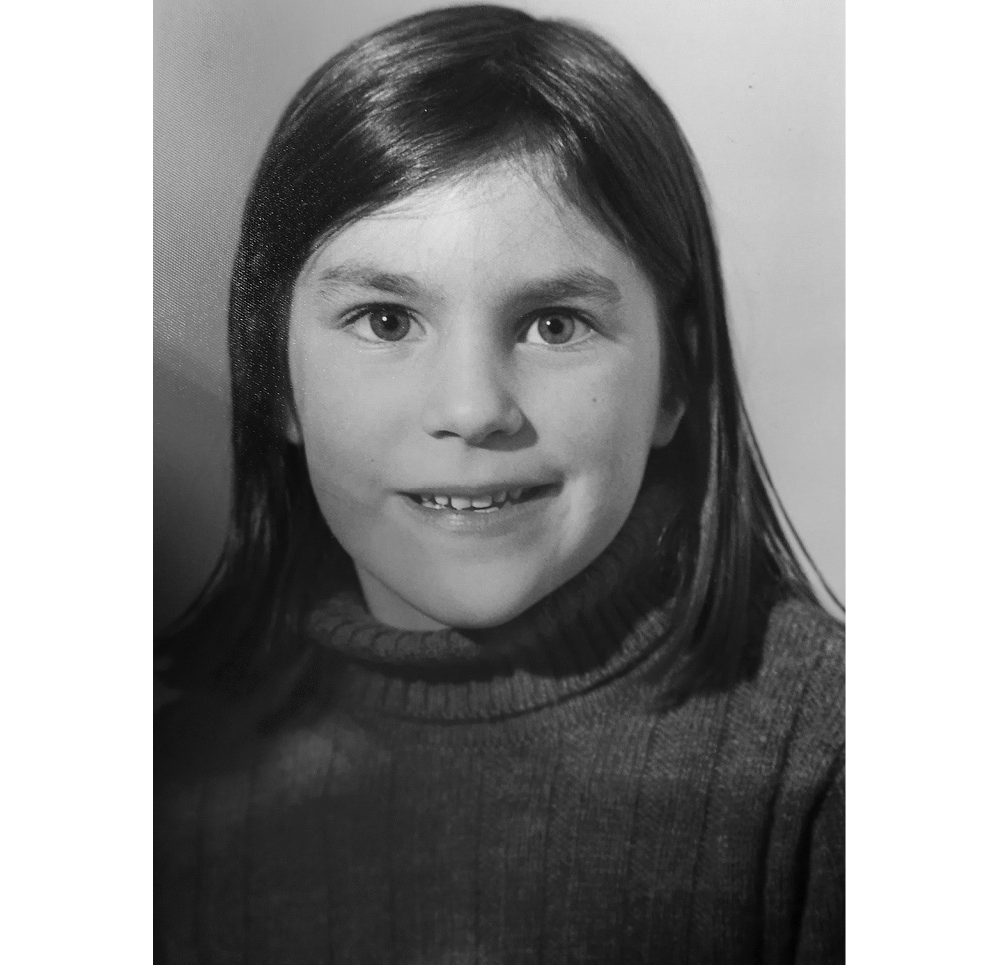 Ca. 1971.
INTERVIEWER
I remember attending a reading where you read “Village” from Falling Awake, and thinking that the place the poem is about was just like where I’m from in Cornwall—the kind of place where people live all their lives.
OSWALD
That one comes from when Peter and I lived in Ashprington, in South Devon. There was a local historian called Laurence Green, who’d write ghost stories and articles in the parish magazine, about the village’s different characters. There was an element of his storytelling that was always rather macabre, and I lifted it into the poem. But the poem also contains my memories of village life as a child. There was a woman called Miss Waters, who lived up the lane. She’d never been farther than the next-door village. She was a sort of witch, really, an angry old battle-ax, and I first met her when she was flinging flowers into the road because someone had put the wrong color flowers into the church she was in charge of. I used to go up the road just to talk to her, and during one of these conversations she broke off because she’d heard a bumblebee go into a foxglove and change the tone of its buzz. She said, “Did you hear that? I love that sound.” I remember thinking, If you don’t move away from a village, that’s the sort of thing you notice. I made a determination at that point that I wanted to be that sort of person.
INTERVIEWER
Was it hard that your family moved so often?
OSWALD
I just accepted that friendships were temporary and then you went somewhere else. But my mother made gardens wherever we lived, and their companionship was sustaining. Between the ages of about five and eight, I did a lot of sleeping outside. When I was a bit older, I used to sleep in a hammock under an apple tree. I loved being without a tent, in the tree’s world, and then wandering around, looking in at the rest of my family. I love my mother’s gardens. Many garden designers will box plants into a shape they’ve thought of, but she’s not trying to make a human mark on the landscape. There’s a sense of structure and contrast, but she grows quite light, airy plants, which are moving all the time. I have them as the feeling of what I want poems to be like.
INTERVIEWER
Your mother is a writer, too, isn’t she?
OSWALD
She used to write a column for the Evening Standard about gardens, and has written gardening books and gardening articles all over the place. And my father wrote humorous long ballads and plays. He was an extremely modest person, and didn’t feel a need to publish, but he was a very good writer, and late in his life he became a lay reader and wrote beautiful sermons. I think I always felt that what I wanted and did was in some way different. I needed poetry to be my special, secret place. I suppose perhaps it was regarded as embarrassing to take things too seriously in my family. My middle sister—who’s only just older than me, so obviously an antagonistic relationship—and I composed a book of verse full of scurrilous rhymes, and I had this absolute terror that the muses would be angry with me for writing those. I thought, If I do this, will I not be allowed to do what I really want to do?
INTERVIEWER
Were you religious?
OSWALD
It’s never been possible for me to be an atheist, though I would never claim to know what it is that I am in dialogue with. My father was properly and perhaps even conventionally Christian, and that’s not necessarily where I sit, but something about his depth I can really feel, and as a child, I became a religious fanatic. When I was six, there was a particular occasion when I demolished a room through anger, because I was being irritated by my middle sister, who used to tease me quite a lot. I didn’t own up to it, so there was an interrogation, and we had to swear on the Bible whether we’d done it or not. We were told that our fingers and toes would fall off if we swore falsely, but I swore on the Bible and had three nights of such terror. I can remember getting on my knees to say my prayers at night and just unleashing all the curses I knew at God. The feeling of vertigo and desolation that followed was unbelievable. When I woke up on the third morning with my fingers and toes, I didn’t think, There is no God—I thought, My God, that is so merciful. Once I was taught the Lord’s Prayer, I would say it every day.
INTERVIEWER
Were you drawn to the repetition?
OSWALD
I think there are places you build in the imagination that become stable. I love the metrical forms, the sonnet and the ballad, but to me the real thing is what I call patience, the idea of creating your own stability within a length of time. I responded to that when I discovered Homer. There was something in that poetry, because it was orally composed—I could feel Homer making forms of patience within the poem, lines coming back and coming back and then coming back. It makes habits. There’s something steady and reliable about its way of moving, while at the same time, it loops wherever it wants to go, and remakes itself.
INTERVIEWER
When did you first read Homer?
OSWALD
When I was fifteen. I went to a grammar school in Reading and absolutely loved Latin, the jigsaw of it. My Latin teacher offered Greek in the lunch hour, and I could feel straightaway that Homer was quite different from the other types of poetry I’d read. I can remember, when I was told that he was blind, having this dizzy feeling of what a poem would be if you were hearing it and speaking it rather than reading it. I was the only person doing Greek for A-level, so I asked if I could read the whole of the Odyssey. Every Friday afternoon I was allowed to plow a little bit further. And then at the last minute we caught up with Thucydides and all the other things I was meant to have been reading. I was never really comfortable with the grammar of classical Greek, because Homeric Greek is simpler and stranger. When I got to university I was very aware of not being someone who could tell you everything about verbs in the classical period.
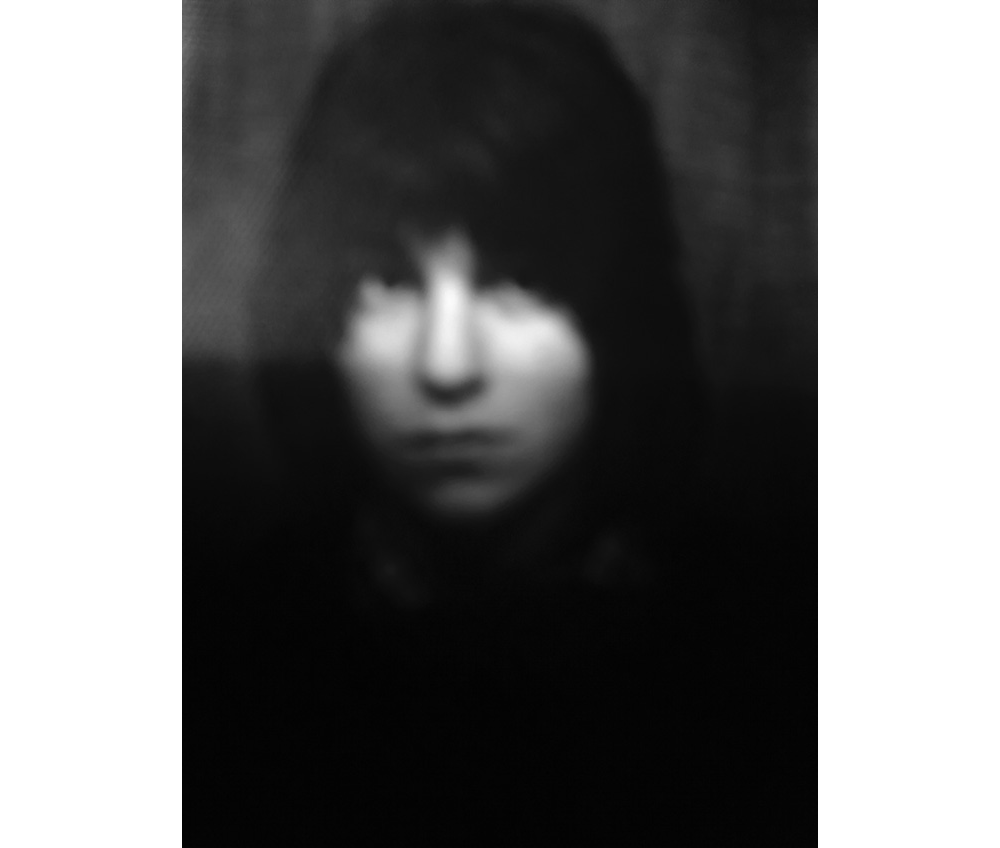 Ca. 1983.
INTERVIEWER
So it was always going to be classics for you?
OSWALD
I was besotted with English, desperate to do it, but it came up very naturally that if I wanted to try for Latin or Greek, I could do that. It was like everything in my life in those days. I wanted to play the clarinet, but there was only a trumpet free, so I learned the trumpet. But I am glad I did it, although in my second and third years at Oxford I sort of stopped going to tutorials.
INTERVIEWER
Why?
OSWALD
I just couldn’t stand the way classics was taught. At Oxford, it very much depended on the tutor you had, and mine took the old scholarly approach to teaching about orality, which had to do with the idea of the Homeric formula. The way scholars had interpreted Milman Parry’s idea that oral singers think in blocks of phrases—so that someone would always be “light-limbed” or “gray-eyed”—was to suggest that the authors were working on autopilot, that when a writer chose to say “the blood trickled into the life-giving earth,” they weren’t being ironic but choosing “life-giving” just because it fit the meter. That seemed entirely wrong to me, this habit of draining the meaning out of the poems, of seeing orality as a machinelike way of composing. I was enraged by being given statistics about how many times a certain word or simile is used. To me, it felt clear that it was a more entranced way of composing, that the poets would get into a kind of intoxicated state where they could incredibly, almost magically, find exactly the right adjective, the right meaning for the right place in the right melody.
For many centuries, Homer has been transmitted mostly by men to other men and has picked up a privileged and military atmosphere. But there are other voices in the poem, older voices. To me, being in Homer has always felt like being in a garden, full of incredible supply and variation. Because it’s not composed by one person, it just goes backward forever, and there’s always something else surfacing up through it—female song and lament, and behind that, whatever the women were listening to, birdsong and water and the elements. It made me smell, in what I had been reading up to that time, a whiff of privileged, male-dominated society. I began to polarize literature in my mind, as though the whole of literature were abusive and then there was this thing underneath, which was where something softer was happening. Of course, all that was mixed up with unsorted-out doubts about whether I could exist socially at a university like Oxford.
INTERVIEWER
And could you?
OSWALD
I mean, to a pretty extraordinary extent I had not been out in the world. I lived in a very close family, we were always quite a long way from anywhere, and my particular role in that family was to be invisible, so I was doubly underexposed, like a wood louse. I was fanatically writing really quite bad poems, and you’ve got to get through those, but I didn’t join any poetry societies, or tell anyone I was writing, or take any of the chances offered. Oxford was full of people who were very good at performing themselves. I never quite found the kindred spirits that might have made it work for me. Perhaps that was partly because I was at the same university as both my elder sisters, so I was completely held in the same family structure that I’d been in for twenty years. As a result, there was a certain amount of deliberate turning away from what was on offer. I did meet Peter there—we weren’t together until seven years after we met, but for years we’d send each other letters that would cross in the post. He asked my sister and me to be in Julius Caesar, which he was directing. He was in quite a bohemian, theatrical world, and I began to understand that the creative life is not the same as the academic life, that the academic stuff can be quite antithetical to creation. I knew, on leaving Oxford, that my priority was to inhabit this secret world of poems, so I decided to be a gardener, to keep intact this Homeric place. The day after I left, I got a job in a garden, worked through that summer, and then started at the Royal Horticultural Society at Wisley in September.
INTERVIEWER
Was gardening as Homeric as you’d hoped?
OSWALD
Well, of course, being there at seven every morning was a bit different from occasionally gardening for my mother. At RHS I started on fruit and then I went to trees and then to amenity, which was flower beds, and then to the trials, which is where they tried out all the new seeds and varieties. I was a bit shocked by the physicality of it, and I did try to escape a couple of times. I remember writing to the London Review of Books, “I’d like to do anything, I’ll even come sweep the floors.” I also applied for a gardening job with the concrete poet Ian Hamilton Finlay up in Little Sparta, his garden in Scotland, and had this very odd job interview in his rowing boat, with me rowing him backward, always about to collide with something while trying to answer some very riddling question.
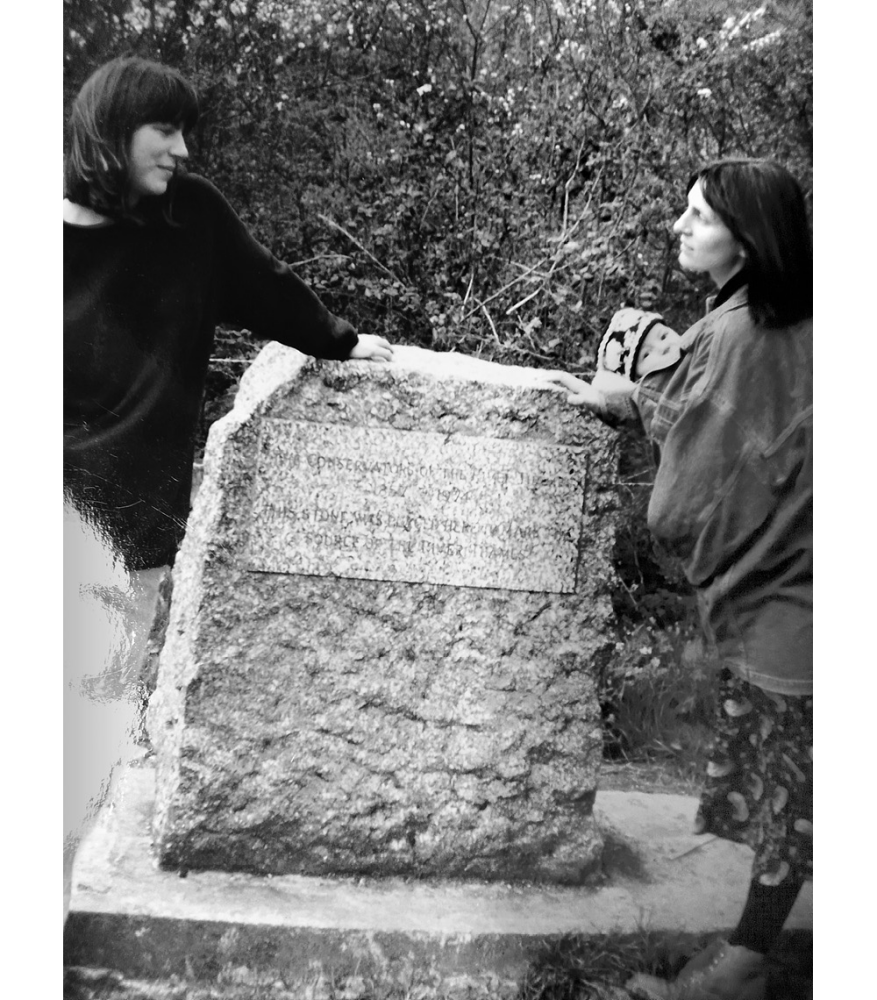 Oswald, at left, with her sister Laura and nephew David at Thames Head, ca. 1994.
INTERVIEWER
Did you get the job?
OSWALD
No, but I got a series of letters that would suddenly arrive, and quite often they wouldn’t be signed but there would be a little red paper with “The rose lets fall its parachutes” or something like that handwritten across it. That went on for quite a while.
After I graduated, the problem with my job search was that unfortunately my mother was very well known, so I kept being put into jobs with a huge amount of responsibility—head gardener at Westminster Abbey, for instance, where I was in charge of two gardeners who knew far more than me. On my second morning, I got everyone to rake the leaves, and we put them into bags and tossed them onto a lorry, and then at the end of the day I realized I’d tossed my walkie-talkie into one of the bags, so I had to order them to empty them all out. Gardeners are obsessive, and I’m obsessed with poetry, so that was never quite going to work. It was much better when I went to be an apprentice for the National Trust. I really loved those monotonous jobs where you do eight hours of hedge trimming. Then I would sit under a lime tree to have my lunch and read Coleridge’s “This Lime-tree Bower my Prison.” Once, I was interrupted by a fox. That was a good way of life.
INTERVIEWER
Were you imitating other poets?
OSWALD
God, I was always imitating. I used to read Hopkins aloud to myself, and I was in love with his syncopations, the way the verse stops, hesitates, and crashes back. I even apprenticed myself to “The Wreck of the Deutschland,” trying to write something in exactly that pattern of sounds. And I loved the way Finlay could make a poem that was no longer than a line but was also melodic, strong enough to exist in the landscape as a sculpture. Encountering that led to my first experiments outside metrical form, which were all about trying to string together a series of concrete poems, so I would never have a dead patch that was just a filling-in. One of the questions I started to ask was, What happens if I set this poem into three-word lines? Will each three words be interesting enough to stand on their own?
Spending a year with Finlay’s single-line poems made me ready to hear Ted Hughes. Crow comes from the same deep, English, underground place as King Lear. It’s almost like when you peel moss up and look underneath it. Hughes got his syntax from Hopkins and Swift. He will always go for the emphatic tune rather than the buzzing motorway tune that a lot of contemporary poetry uses. He really is the most musical poet there is. I can remember saying to Peter early on, “I don’t think we can be married if you don’t like Ted Hughes’s poems.” Peter’s fascinated by iambic pentameter, and I find free poems fascinating.
INTERVIEWER
What do you mean by “free poems”?
OSWALD
Actually, I don’t like the term, because free poems don’t really feel free. They have an openness that seems to allow for huge choice, but you just know when it’s wrong. I can remember the feeling of fear of what would happen if I stopped rhyming—I had no idea what would stabilize the poem. It was an important moment for me to step over the edge of that, to find that I could take the tunes of poems from natural sounds rather than from formalized, pre-used verses. I needed to know that whatever I made would still have that quality of a formal poem—in the way that you can’t take a word out of a sonnet because it wouldn’t be a sonnet anymore. I would prefer to say that what people call free verse is one-off verse. There is still only one way a free poem can be, it’s just that you’ve got to keep tinging it until the tinging comes out right.
INTERVIEWER
The idea of one-off verse is a very good riposte to people who bemoan the loss of meter.
OSWALD
Yeah, let them go off in their tweed suits. I can remember, when I took my first Arvon course, reading out a poem I’d written for the first time, and people saying, “Oh, I get it now.” In my experience, people don’t know how to read one-off forms. They often do it as if it’s a failed iambic pentameter kind of thing.
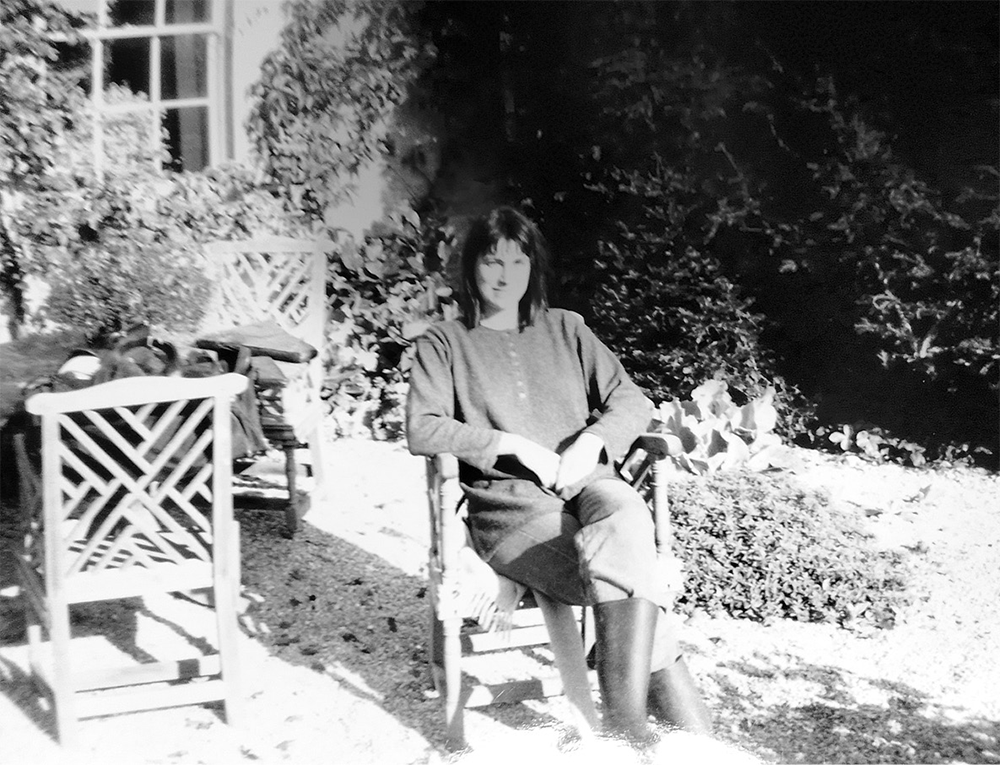 In her mother’s garden in Duntisbourne Rouse, Gloucestershire, ca. 1996.
INTERVIEWER
What made you start taking poetry courses? Were they useful?
OSWALD
At the time I took my first one, with John Barnie, I was doing eight hours of gardening, having a brief sleep when I got home, and then writing into the small hours and smoking nonstop. Poetry happened in complete solitude. I didn’t do any fraternizing with poets, so those courses were a way of finding out what contemporary poetry was, really. Then Barnie published one of my poems in Planet: The Welsh Internationalist, and that poem got put in the Forward anthology. I never apprenticed myself to any of the contemporary stuff I was shown at Arvon, but it was refreshing to see what was out there, and to learn that what you do is send your work to a magazine, and then to a competition, which I did, the Eric Gregory Awards. I did another course, with Don Paterson, after Peter and I got married and were living in North Devon, where I was gardening at Tapeley Park. We were encouraging each other to send things out. Winning the Gregory gave me the confidence to send the manuscript of The Thing in the Gap-Stone Stile (1996) to Jacky Simms at Oxford University Press. Perhaps there was something strangely public about getting married that meant I moved on from a kind of permanently secret existence.
INTERVIEWER
What has it been like to be married to another writer?
OSWALD
I’d say the income is not great, but that’s more than made up for by how stimulating it is. I spotted immediately that there was nothing pretend about his commitment to poetry. I was excited to find someone writing in the tradition of dramatic poetry, which is where spoken and even oral verse has been kept alive. Certainly when we were younger, there was an element of competition. We started off by identifying ourselves with different types of poetry so that we wouldn’t compete, but then we’d start looking over each other’s shoulders at what the other was doing and seeing that it was quite interesting. It was fertile but also stormy, as I think relationships should be. If he tells me a poem doesn’t work, I trust it, mostly, although he’s not nearly critical enough. He’s got such an oversupply of imagination, Peter, that he will quite often rewrite in his head what he’s reading and love what he’s imagined. Early on, before we were married, he sent me a long poem of his, which I remember thinking was extraordinary and infuriating in turns. I did sort of rip it to shreds, writing exclamation marks everywhere, although I thought I was also positive about it. But it really hurt his feelings, so now he quite often keeps his work from me.
Peter was always very attentive to whether I had enough time, and was really good at sharing the childcare. But having children was an absolute upside-downing of everything. I had drawn so much from the gardening world and now there wasn’t time to do that. And I didn’t want to be a writer in a writerly world. That was one of the problems that made me start interviewing people up and down the river—the wish to be talking to practical people again.
INTERVIEWER
So you always knew that Dart would require you to gather people’s voices?
OSWALD
Originally, I thought I was going to make a kind of jazz poem, where I would invite other people to compose their own poems about the river, and I would curate them. When people spoke about the Dart, they were vivid and surprising. But when they wrote poems, they immediately put on these boring voices and wrote rubbish, really. I realized the poems were much more likely to occur in what they said when I interviewed them, so I started taking around a tape recorder. That clearly put people off, and I had no experience interviewing people, so I generally held the tape recorder too far away and didn’t ask very interesting questions. Often, I would get back home and find that I couldn’t hear anything at all. I found that the best method was to talk to someone and then straightaway go and write down the atmosphere of that person, the feeling of their way of talking, and whatever I could remember of their phrases and stories. I enjoyed that filtering system of the things that you forget and the things that you slightly misremember.
It took me a long time, because I wrote half of it when I was pregnant with my second child and half of it when I had two children. I cannot tell you how difficult it was, with no car and two children, living in the countryside, to actually get myself to each bit of that river. To get to the source, for example, which is seven miles from the nearest road, I had to get a train to Plymouth and then a bus from Plymouth up to Postbridge. And then to walk it and walk it back all in one day. I remember I’d arranged a day when Peter would look after the children, and by the time I got up to Postbridge, it was definitely going to thunder. I thought, Well, do I cancel this whole thing? I’m scared of thunder because I was struck by lightning as a child.
INTERVIEWER
What?
OSWALD
Yes, with both my sisters at the same time. We were in Scotland, and we’d just been up a mountain with forked lightning coming down all around us, and amazingly we managed to get back to the house. We were on the front step, standing in two inches of rain, pouring the water out of our boots and thinking, We’re saved, when I felt I was being gripped in the back of the legs and thrown to the ground. In any case, on Dartmoor, I decided to do my thunder position, where you squat on the ground with your bottom in the air. I did that for, I don’t know, ten minutes, with the rain coming down Hollywood-style. I could see my paper map completely dissolving. I was shaking with cold, and I thought, Either I die of cold or I die of lightning. Then I stood up, and within about a minute, the sky had cleared and I was pretty well up at the source of the Dart.
INTERVIEWER
One of my favorite lines in Dart is when the character catches an eel, and the eel is “strong as bike-chain.” And then there’s this pause where the eel is looked at, and then released.
OSWALD
Actually, my children and I are the ones who caught the eel and looked at it. But it was someone else who told me the story about the heron eating an eel that chewed its way back out through the stomach. What comes across as one instant in the poem is actually the eels that I’ve seen in Totnes and someone else’s description of an eel he saw long ago, as well as a naturalist’s description of eels in general. A poem has to refind the vortex of one instant, but it can make that out of a whole series of instants and adventures. Once, the children and I slept out by the Dart on a plot of private land. I was trying to keep them quiet, and I couldn’t sleep because I was so frightened that the bailiff was going to turn up. I’d half fall asleep and hear the river accusing me of trespassing and then I’d wake up. In the morning, I tried to take down a dictation of what the river had been saying, these highly accusing and mad voices. It suited my perennial way of being, that alternation of those deep and musical moments with the research. To move from one thing into its opposite and back again. In a way, that was a response to what happens to your mind through motherhood, too—the way you turn from one person into lots of people. Dart was a reflection of the fact that my mind had been smithereened.
INTERVIEWER
It’s such a focused poem, though. What drew you to the longer form?
OSWALD
Long and small poems are very different forms of making. Sometimes a short poem can just hang around for a very long time, and, until it’s right, it feels like a physical misshape in the head—quite a horrible physical feeling. With a longer work, you invent the template quite carefully so that you can then reproduce it at speed. I didn’t research the book in the order that it appears, but it was always quite clear which order it needed to emerge in. Once I’d got down the shape of Dart, and had worked out each strand, I could plait them quite quickly. At a time when my life had become broken up by childcare, it was wonderful to not have that vertigo of asking where I’d find the next short poem, and to have some more mundane work to do. When there was a free half hour, I’d be fixing up an appointment with the manager of the milk factory. There were a lot of tasks that could be done with only part of your attention.
I got to the point where I could trust my luck. Somehow, everything I did, I was introduced to the next stage of the poem. At one point, Peter was writing a version of the Ramayana and got free tickets to India, which I couldn’t turn down. When the airplane to Dubai was delayed, I found myself speaking to another passenger about a poacher he knew on the Dart. And in Dartington, where we were living, I made friends with John Drever, an electroacoustic composer who taught me to suffer the voices of a place in an acoustic way, rather than feel that you’ve got to construct sentences about them. He was always wandering around with a tape recorder, taping odd sounds. He had a beautiful piece called “Cattle Grids of Dartmoor,” where he’d recorded the noise every cattle grid on Dartmoor makes when you drive over it, and made them into a kind of symphony.
INTERVIEWER
What took you to Dartington?
OSWALD
It was a real gift that, right after I had my first child, I was given a job by the Dartington Trust and a free house on the estate.
INTERVIEWER
As a gardener?
OSWALD
No, no, Peter and I were writers in residence. We weren’t expected to produce anything, and consequently we produced a great deal. For two years we were on the grounds of this medieval castle-house, one of the most beautiful places in Devon and probably the world, in the middle of this very energetic community. We left for a few years once the residency was over—to live in Totnes, then in Gloucestershire with my parents, then on this very beautiful estate called Sharpham—but we ended up in Ashprington, which is just a few miles downriver from Dartington, and we lived there for the next ten years. Dartington is the other place, next to Adelaide, that got inside my soul. It had this very weird avant-garde college of arts, which was at permanent war with the trust, and then, at Schumacher College down the hill, there were experiments happening in permaculture and forest gardening, holistic science. All the cultures there were at odds with one another, and I think that poetry is about that kind of friction. There’d been, throughout the twentieth century, the most extraordinary people passing through, like Stravinsky and Arthur Waley. I can recognize someone who’s been through Dartington from a mile off—that flavor of a combination of something kind of earthy and grounded and quite modernist and risk-taking. Every time you walked through the garden there’d be someone naked in a tree performing something, or rubber gloves all along the border. My children used to say, “Is that real or is it art?”
INTERVIEWER
Did you have to teach?
OSWALD
Nothing formalized, but throughout that whole period in South Devon I would put on some kind of four-dimensional poem every year or two—an overnight reading of Ovid’s Metamorphoses where people could bring sleeping bags, the whole of Paradise Lost in the church, a roving performance of Gilgamesh with people on the estate. After Dart, I wanted to shift my interior performance space. I wanted poems to shape themselves for public places rather than for poetry venues. Of course, there was a neurotic aspect to that because, as long as it was happening in Devon, I felt it was still my private world.
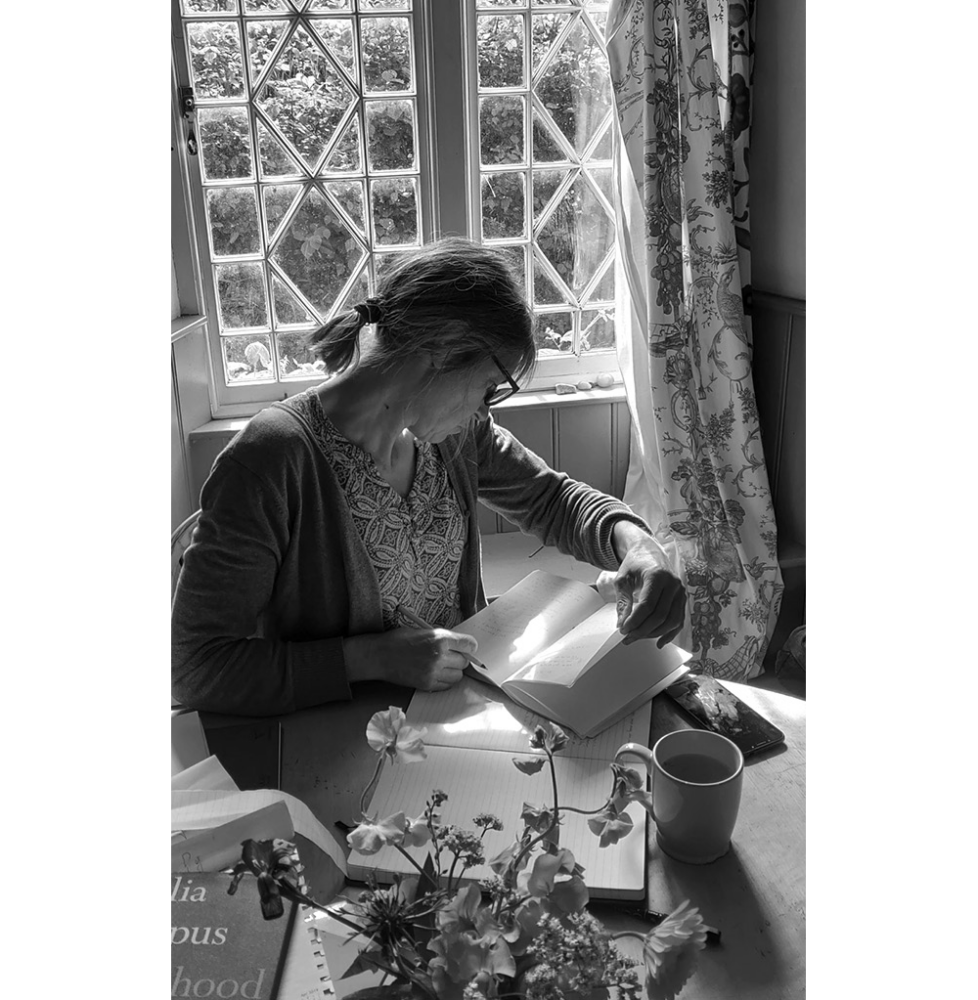 Ashprington, ca. 2016.
INTERVIEWER
Can that kind of collaborative project be a distraction from the writing?
OSWALD
Not really. It’s nice having multiple chambers to live in, in your head. I had a chamber where I would be with my family, and then another chamber where I might be doing poetry readings, and another for the poems. These days, I have a kind of rule that I don’t speak to people in the morning, so I get up at five or six, have coffee, and write for three or four or five hours, if possible. Living here, I’m in an agony because quite often I want to go down and swim in the river, but if I do that, I’ll probably bump into someone and have to say hello.
INTERVIEWER
Is swimming important to you?
OSWALD
It was probably when I took up gardening that I discovered that being was better than thinking—that actually you don’t have to think things through, you can garden all day and your mind will have been moved by the gardening. And it’s the same when you’re in water. You’re thought through by the water rather than having to think.
INTERVIEWER
Would you say that the river has been the guiding principle through all of your books?
OSWALD
Well, I tried to write about the sea and it drove me mad.
INTERVIEWER
You’re talking about Nobody (2019), your sea hymn?
OSWALD
A lot of people, most people, didn’t get that book at all. Which is sort of deliberate because we don’t get the sea. I’d been asked to do a project with William Tillyer, the abstract artist. He’s in his eighties, and we had very little in common apart from that I wanted to find a linguistic equivalent to the splodges he makes when he drips water onto absorbent paper. I started from all the adjectives Homer used about the sea, how it’s fenceless and unmeasurable and unbounded. I wanted to unfence the grammar—and it was exciting, to smash into a different way of thinking. It became, for me, a sort of ecological poem. A feeling of surrender to the sea, of the human voice being overwhelmed by water. But to be honest, I sometimes wonder whether Nobody wasn’t too open. It did feel, appropriately enough, like I was out of my depth. Whereas I know how to follow a river. I’ve always loved the thing that rivers do, where they bring elsewhere into a place and then carry things out of a place.
I can remember, from when we were living with my parents in Gloucestershire, the intense pain of not being near the Dart. I don’t suffer from depression, but there was a year when I went into a state of intense indecision about how to manage the different strands of my life. Gloucestershire was good for the children—the schools were better and they had a wider family—but I was really, really missing the Dart. I used to imagine a metal spike that I was banging my head onto—that was the only image sharp enough to cope with my thirst for the river. There was a little stream running through my parents’ field called the Dunt, which made me feel like I was being demoted. A Sleepwalk on the Severn (2009) and Weeds and Wild Flowers (2009) were hatched there.
INTERVIEWER
Where does the joyful humor in Weeds and Sleepwalk come from?
OSWALD
I’m interested that you call it joy, because I became worried that it had become a kind of shallowness or caricature. You can see, in Weeds, a light and sociable way of speaking, but with these appallingly unacceptable characters showing forth. Stinking Goose-foot is the kind of person I always felt like in the world I grew up in. I do think that my core impulse is the impulse of feeling a fool. But when you look at that foolishness there is also a sort of upspring of hope there somehow. Language itself has humor in it. I really like that flapping of words, where it’s like the wind gets into them and they kind of flap between meanings. As much as you can get serious and grief-stricken about what it’s like to be human, there’s something very light about how words just flip over and rhyme, and then kick you in the face. I think Memorial was partly a response to thinking, I love writing about humans, but why am I keeping them at arm’s length? Is this too mocking? What happens if I really take humans seriously? It spun quite out of control when I made myself think of those Greek and Trojan soldiers as real people.
INTERVIEWER
When I heard you read Memorial, it felt almost resurrectionary. And I was amazed that you’d memorized it.
OSWALD
It’s quite easy to memorize something, particularly a longer work. It’s just what humans do. There was a one-hour walk I did every day along the estuary, and I could recite the whole of it on that. I memorized a little bit more each day. It took a month to lay it down, and then I could revisit it and top it up. I got to the point where the twiceness of the similes was embedded sonically into my body, and my body knew the sound of the few similes that don’t get repeated. I tend not to be satisfied with reading from a book if I have to perform a poem—because once you’ve tasted what it is to memorize something, it’s quite addictive. In order to remember something, you have to bring it into the room and be in the space of it. For an audience, it’s the same as witnessing someone composing, when they read off the imagination. There were traditions in ancient Greece not to name the dead because they’d turn up, so they found all these circuitous ways of talking about them, and I did find that every time I performed Memorial, I would feel this crowd of people. I almost had to stop performing it, because it became too much of a pressure.
INTERVIEWER
How did Memorial begin for you?
OSWALD
I was always imagining this vast work that would express everything I think and feel about Homer—but it’s the things you do when you’re not looking that enable all your thinking to go into them. I started translating a passage—I think it was the poppy simile—almost inadvertently, to see what it was, and then another. I thought, Well, if I can get the poppy, maybe I can collect all the similes into a hallucinated poem that’s underneath Homer. I was involved with the Stop the War movement in Totnes, until it just turned into bickering between people on committees, and I remember being baffled by those spreads in the newspapers of the faces of people who’d died in Iraq, thinking, What is this kind of convulsion that we go into, where we just suddenly start killing everybody? I found myself going back into the Iliad to pick out all the ordinary people, both the named characters and the people within the similes—the shepherd on the hillside, the man building a boat, the woman dyeing the cheek guard of a horse. Gradually, I began to feel that the meaning of the similes has to do with the humans you’re grieving each time.
I should also add that I’d applied for a grant from the Arts and Humanities Research Council, but I’ve always been bad at applying for things like that and I got turned down. I’d become so excited about the proposal, though, that I just started writing it, working in a blind fury, almost in one sitting.
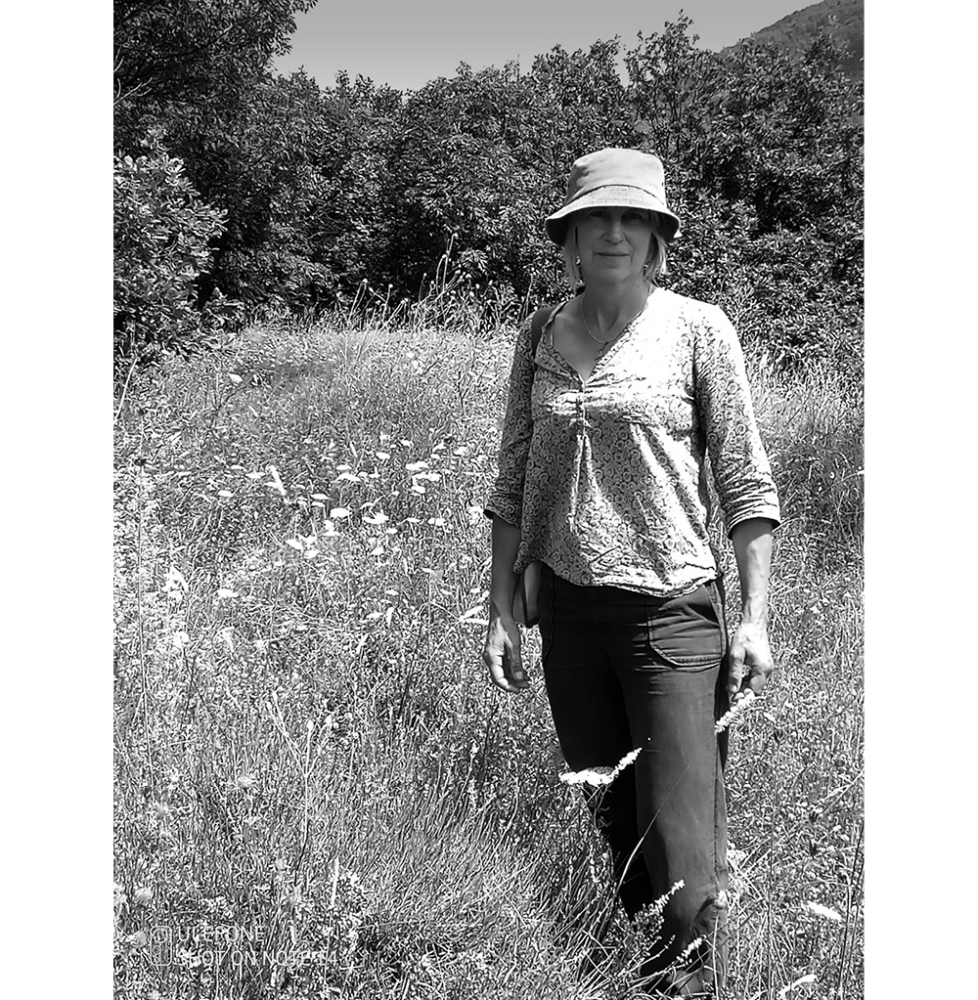 Bulgaria, 2023.
INTERVIEWER
Not the whole book, surely?
OSWALD
I mean, no. But the momentum of it really took me over. Halfway through the writing, I went to Greece for the first time, for ten days, with my sister and her partner, who had made a living out of showing people around the country. When I got home, I could feel the poem backing up inside me. I remember once, when my daughter was ill and said she needed to stay home from school, I had the thought, That’s actually impossible. Thank God that Peter in all generosity stepped in. I knew I would go mad if I couldn’t write it down.
INTERVIEWER
What was it that Greece had given you?
OSWALD
One thing that really struck me were the tombs from times when they didn’t really have writing. I connected that with the descriptions of burial mounds in Homer, and this feeling of having to generate the poems that will remember the people. My sister’s partner also took me to a cave near Pylos, where part of the Odyssey takes place. I remember going into it, and it being totally dark, and then an owl suddenly hooting at me. I used to be obsessed with Athena when I was a teenager—she’s this incredibly powerful woman who emerges out of Zeus’s brain and doesn’t seem to need men at all. She’s a warrior and very funny, an intellect but also elemental. And she always comes as an owl. So, there she was. I love the way that happens, when you make a gesture toward something—whether it’s getting on a plane or sitting for two days by a waterfall—and it brings something back to you.
INTERVIEWER
You write in the preface to Memorial, “I write through the Greek, not from it.” What did you mean by that?
OSWALD
I’m really horrible about translations of Homer—I cannot stand them. There’s something clotted and hierarchical about so many English versions, where they’ll stretch some complex piece of syntax across a paragraph and put too much weight on the adjectives. Homer has this really light democracy of phrases, where each phrase weighs as much as the next one, and then moves on, and then moves on—this endless feeling of “and,” which English translations will twist into a complicated dependent clause or subordinate something. But there isn’t much subordination in Homer. There is something palpably just and generous about every phrase, which is allowed to have its own way of being. I could never find that in literary poems, as if the literary persona is just too self-conscious. I used to be confused by moral philosophy and interested only in epistemology. As I get older, I find I’m fascinated by the point where those cross over, so that your perceptions are altered not only by your state of mind but by your state of generosity. If you want to imagine well, you can’t do it selfishly.
INTERVIEWER
Can someone learn to imagine unselfishly and generously, do you think?
OSWALD
There’s a real closeness between imagination and forgiveness. I mean that in a phenomenological way. If you notice where you go when you have to forgive someone, it’s the place of supply, the place of extra. I think it’s worth spending a lot of time attending to that, so that when chance or fate or whatever it is knocks a poem your way, you’re ready. That’s why I’m quite often driven to say that it’s more important to do the work on one’s character than on the words. Don’t surround yourself with dictionaries. What really is nauseating in a poem is when you smell somebody trying to be a poet, and when it’s yourself, that’s just the worst of all. But a voice is such an incredible thing. When you think of how each person resonates differently and their physical voice comes out of this space that is tuned by tension and confidence and generosity—that’s the best thing you have.
Correction: The print edition of the introduction to this interview incorrectly states that the T. S. Eliot Prize was sponsored in 2011 by the hedge fund Aurum. Aurum sponsored the Poetry Book Society, which at the time administered the T. S. Eliot Prize.


Comments
Post a Comment