Michael Hofmann, The Art of Translation No. 6
Michael Hofmann, The Art of Translation No. 6
Issue 230, Fall 2019
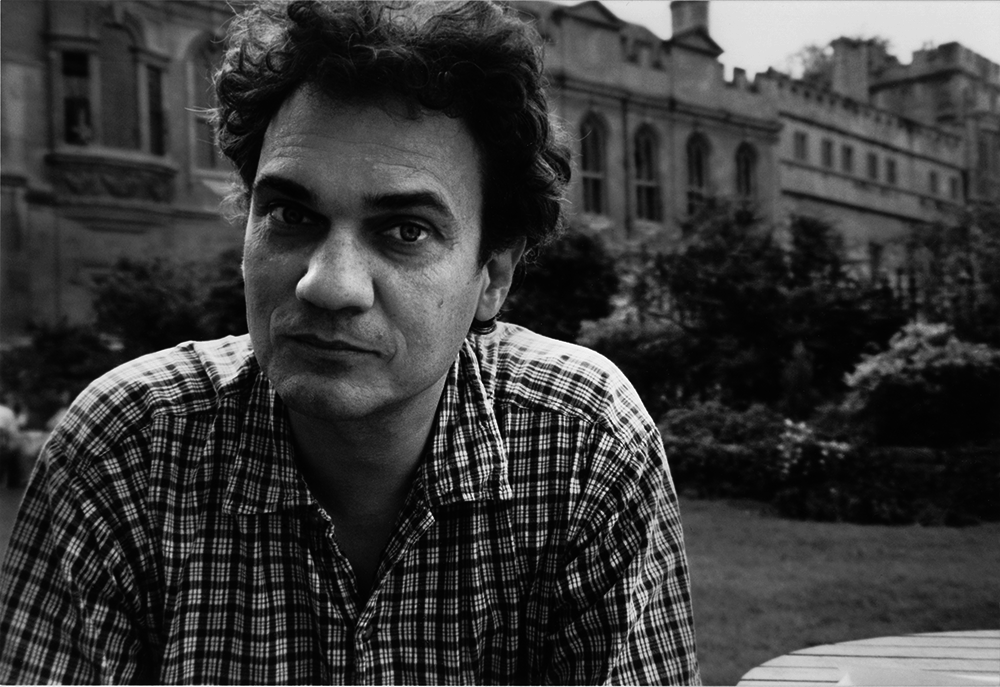
Photo courtesy of Barbara Hoffmeister
It’s a little strange to encounter Michael Hofmann in Gainesville. He has taught creative writing for over twenty years at the University of Florida, whose sprawling campus is dominated on its northern edge by a football stadium, the Swamp, where orange-and-blue Gators chomp their unlucky opponents. A short drive from there, you can pick your way past dozens of real gators, dusky green and preternaturally still, in the Paynes Prairie Preserve, which is also home to herds of wild horses and bison. How the bison got to Florida, and why they stayed, must be an interesting story. In one of Hofmann’s few Gainesville poems, “Freebird,” written after his first visit in 1990, he quotes D. H. Lawrence: “One forms not the faintest inward attachment, especially here in America.”
Hofmann’s native ground, in his translations as well as his poetry, is Europe: everywhere German is spoken, plus the seedier and derelict zones of Britain, where he arrived at the age of four and stayed for thirty years. Hofmann is the translator of over seventy books from the German—“a one-man Bibliothek,” in Adam Thirlwell’s words—ranging from the novels of Franz Kafka, Ernst Jünger, and Wolfgang Koeppen to the poetry of Gottfried Benn and Durs Grünbein. He is largely responsible for the rediscovery of the Austrian Jewish writer Joseph Roth, for a long time known to anglophone readers only for his historical novel Radetzky March. In one buoyant translation after another, Hofmann has brought out many other works—fables, novellas, realist fiction, sharp-eyed journalism—confirming Roth as one of the signal writers of the entre guerre period. Hofmann is also a prolific critic, whose reviews—stylish, unpredictable, occasionally ferocious, but just as often celebratory—have been collected in Behind the Lines (2002) and Where Have You Been? (2014).
Hofmann is the author of five books of poems, including Nights in the Iron Hotel (1983) and Acrimony (1986), which roam the wastelands of Thatcherism in a mood he calls “disconsolate punk.” The latter collection dissects his relationship with his father, the German writer Gert Hofmann, whose last three novels, The Film Explainer (1990, translation 1995), Luck (1992, 2002), and Lichtenberg and the Little Flower Girl (1994, 2004), Hofmann translated after Gert’s death in 1993. In 1990, the BBC made a documentary about Hofmann and his father, in which they travel from Bavaria across the newly opened border to Gert’s hometown of Limbach in the former East Germany. The father-son relationship, as depicted in the documentary, is full of silences and miscommunications; books and poems take the place of face-to-face exchanges. At one point we hear Hofmann reading a poem that evokes his father’s protagonists: “Maniacs, compulsive, virtuoso talkers, talkers for dear life, / talkers in soliloquies, notebooks, tape-recordings, last wills.”
Hofmann is not a virtuoso talker. His speech is soft and comes in short bursts, followed by intent silences. He rarely uses his hands, but his face is alive with an almost disconcerting variety of expressions, which an ideal transcription of our talk would have included. This interview took place over the course of two afternoons on the shady front porch of Hofmann’s small twenties brick house, a bike ride away from the university. Inside, papers and books, in German and in English, covered all the available surfaces. In the backyard were a grapefruit tree and a lemon tree, both heavy with fruit, in which Hofmann took obvious pleasure and a shy sort of pride.
INTERVIEWER
How did you discover Joseph Roth?
MICHAEL HOFMANN
The TLS assigned me a book of his in 1982, one of the first reviews I wrote. Weights and Measures. I liked it very much and said so. A bit later, I was asked to write an introduction to another one, Flight without End. Then John Hoare, his translator, died, and Chatto asked whether I’d do the next translation for them, which was The Legend of the Holy Drinker. They had heard that Ermanno Olmi was making a film of it, so they imagined there was a novel. Actually, it’s more like a parable. Twelve thousand words, something like that. When I delivered the translation, they went into a panic. How are we going to publish this?! They made me write a foreword. You couldn’t publish single novellas in English at that time. I felt I’d done something wicked.
INTERVIEWER
Did you feel right away that this was a writer you wanted to spend decades with?
HOFMANN
If I dared, yes. Even though everything seemed to have been done already, in the thirties, and then again in the seventies. But then we found more, and I redid some that had been done previously. I joke that I’ll end up redoing some of my own. Probably not a joke . . . I liked that he always seems to be in a hurry. Almost all the books are small—short and sweet and soon over. That’s agreeable for a translator. Even nicer is the speed at which things happen in the stories. A typical day’s work will include a marriage and a death and two murders. It keeps you interested. There’s so much glamour, so much drama, so much intensity, so much event. And a largely unfamiliar world. In the nineties, Eastern Europe was just coming out of the communist refrigerator where it had been since 1945. Suddenly, here you were reading about these towns and provinces that were once part of Austria-Hungary, which at the time seemed like an absurd construct. In the end I came around to thinking that what the world needs is Austria-Hungary. It was much better than our Common Market.
INTERVIEWER
A mongrel empire, you mean?
HOFMANN
Yes, how do you transcend nation and nationalism? Not by capital, that’s for sure. The Hapsburgs did it . . . Roth’s books are a love affair between the Jew from the borderlands and the doddering or cynical empire in the capital, in Vienna. That seemed worth espousing to me. I didn’t like the actual Austria of the seventies and eighties, but then I didn’t much like Germany, either. I was always ashamed of being German, growing up in England. It was grim, and why not? Germany has emerged as a respectable, even admirable—well, semi-admirable—country only in the past couple of decades.
INTERVIEWER
It’s become European, which is also how Roth styled himself.
HOFMANN
Roth calls himself a Parisian from the East. He sees himself as coming from a part of the world that never really had its time in the sun. When you think of Europe, you think of Italy and France, not Slovenia and Moldova. The edge of the world was the line between Austria and Russia. Perhaps it still is. And that’s where he comes from. Once or twice he pretends to be from the other side, but really he’s a product of that line. I’m not sure it doesn’t still exist, only now it runs through the middle of Ukraine. I liked the idea of trying to force a change in the reader’s sense of geography.
INTERVIEWER
Is there a political argument here, too? It’s a commonplace to think of German history, at least since the nineteenth century, as being basically schizophrenic. One Germany is cosmopolitan, civilized, inspired by French rationalism and the Enlightenment—Goethe’s Germany. The other Germany is deep, mythic, closed in on itself—the Germany of Wagner and the Black Forest. Your sympathies as a translator seem to lie with the cosmopolitan version.
HOFMANN
I think that’s broadly right. It’s Nietzsche, isn’t it, who changed sides and tried to take Germany with him? I like writing that has some lightness and style, some quality of the Mediterranean, rather than things that are ineffable or dark or sublime. I’m not sure there is any politics to that—it’s more a matter of taste. I don’t have any confidence that the ineffable stuff is translatable, or that it travels, or needs to travel.
INTERVIEWER
You translate a lot of authors who write in German but are not themselves German. Roth, Kafka. Thomas Bernhard, an Austrian. Peter Stamm and Markus Werner, both Swiss. Herta Müller, a Romanian. As if to remind us that German is an international language, rather than a national one?
HOFMANN
It’s more about the variety of individual destinies or perspectives. Those other German territories are more interesting to me than the little rump of what was then West Germany.
INTERVIEWER
The margins.
HOFMANN
Yes, including the East. My parents were both from Saxony—they were refugees, they fled before the Wall went up. I’ve always identified with that place. East Germany has always seemed to me the older, truer part of Germany, the part that didn’t modernize itself and start exporting cars and get enormously rich. It’s the part that had cobbled streets and smelled of lignite. Which also appealed to my taste for crumminess and decrepitude, acquired in England.
INTERVIEWER
Your parents came to Britain when?
HOFMANN
In 1961. They were thirty, students. I was four. My father finished an impressively skinny doctorate on Henry James and got his first job as a German lecturer in Bristol. We were there, then Edinburgh, then the U.S., then Edinburgh again. We were supposed to go to Beirut in 1967, which I was all in favor of, but we went back to Edinburgh instead, for the sake of my blessed education. I ended up in Winchester, while my father went on to Slovenia. Apropos Roth.
INTERVIEWER
What was Winchester like?
HOFMANN
It was uncomfortable, arduously uncomfortable. Cold, wet, bad food, no privacy. Plumbing. Bells. Six hundred years old. There were interminable services and much singing of psalms. The religion offended me. I acquired a taste for playing fields.
INTERVIEWER
What did you think of the other boys?
HOFMANN
Some became lifelong friends. Others were as bad as girls are said to be—unkind, catty, competitive. Bullies and introverts. To be honest, I’ve suppressed most of it. The whole culture of England was still utterly postwar into the seventies. It felt like it might have been 1946. But some of the teaching was wonderful. I had good teachers in French and Latin and English. I remember Peter Partner, a papal historian and lover of Proust. We read Pound’s Personae one term, one of my earliest encounters with poetry. Partner predicted that I would end up doing something involving explaining or popularizing. I suppose he wasn’t wrong . . . And then there were those stunts that I wasn’t good enough to do myself—translating Times editorials into Latin, or paragraphs of Jane Austen novels. I believe in those exercises. An education ought to be useless, or at least have a component of uselessness. I was just about at the shallow end of those things, though I could at least read Horace and Propertius and Tacitus and so on.
INTERVIEWER
You often use French and Latinate words in your translations, even with Roth, whom most people think of as a simple or straightforward writer. You give him words like clochard and rendezvous and confrère.
HOFMANN
Well, that book—The Legend of the Holy Drinker—is set in Paris, and that’s a bit of a misconception about Roth anyway. He’s not that simple. If Roth had written in English, he would have used such words, too—without them, English would’ve seemed to him too threadbare and inexpressive. Unaromatic. This is an old argument of mine, stemming from a helpless adoration of the French and Latin parts of English. I understood these words were actually doomed, people no longer had the etymology. They were being used more and more approximately. One day someone will use the last surviving Latin word in English to say something like, This sucks.
INTERVIEWER
Latinate words can sound, in English, a little bit on stilts. A lot of translators from Romance languages rough up their English with Anglo-Saxon words—to make things colloquial, vivid, concrete. What you’re describing is the opposite—roughing up the English with Latin.
HOFMANN
Yes, I suppose I take the smooth with the rough—part of my quixotic campaign toward Latinity in English. Roth handles his characters with so much affection and irony, and Latinate words and constructions help with that. They help with Brecht, too, who is of course a dandy. Maybe he’s a boilersuit or a Mao jacket, but he’s a silk boilersuit or Mao jacket. Translating Kafka took me straight back to translating Cicero when I was at school—those complicated sentences that carry on and on, the ones that double back and continually qualify themselves. The flows of logic, going in zigzags. All these works are more than basic English can handle.
INTERVIEWER
After Winchester you went to Cambridge, to Magdalene College?
HOFMANN
To read English, alas. The semi-nice thing about Cambridge was that they left out the present and the recent past. Saintsbury apparently said—and I agree—that anything after 1910 a gentleman can do on his own. It doesn’t need teaching. Anytime you’re taught anything, at least as much is lost through the fact of your being taught it instead of coming across it yourself. The curriculum ended with Lawrence and Hardy. Everything later I navigated by myself—the world of poetry and poetry magazines. Reading Ian Hamilton and Sylvia Plath, then Lowell and Berryman and Jarrell. I heard Brodsky and Enzensberger read in the Cambridge Poetry Festival in 1979 or 1980. My first poem appeared in London Magazine, which I came across in the faculty library. It was all what the Germans call an Eigeninitiative—spontaneity, freelancing. A budding cottage industry.
INTERVIEWER
Were you also reading Germans, along with all the Americans?
HOFMANN
Yes, some, though mostly when I had to. I remember liking Günter Kunert and Sarah Kirsch. I did A-level German, with Schiller, Fontane, Büchner. Everything pre-1900 seemed rather hard to imagine. I begin in 1900.
INTERVIEWER
Why 1900?
HOFMANN
That’s as antique as I need things to be. Before that, Germany doesn’t really exist. It’s just a patchwork of statelets. Before 1900, you’re in the world of seventeen types of carriage and a stratified feudal society. Kind of remote, if you’re not an antiquary and it lives in your imagination. After World War I, Germany slipped the leash, and suddenly becomes supermodern—the expressionists, twenties novelists, music, cinema, the boom of Berlin, the cleverness of Brecht, politicians trying to hold things together with no success.
INTERVIEWER
The great novel of Berlin in the twenties is Döblin’s Berlin Alexanderplatz, which you’ve just translated, though Ian Buruma once called it “pretty much untranslatable.” Everyone talks about the problem of getting Döblin’s Berlin argot into English. How did you think about it?
HOFMANN
It’s true, the whole book is in that argot—even, at times, the narration. It isn’t reserved for certain characters. The whole thing is drenched in it—which, in a sense, makes it not matter that much. Once I saw the argot being used everywhere, I was no longer so afraid of it. Besides, isn’t everything untranslatable when you come down to it?
INTERVIEWER
Since the speech doesn’t indicate class and status, if you don’t get it “right,” you aren’t necessarily misleading the reader.
HOFMANN
That’s right. Döblin was a doctor and people spoke to him, he has their voices in his ear. He knows how they talk. I have no idea how people talk. I’m just—help. On the other hand, he apparently studied out of books. Rather shocking. There are books of Berlin slang that he used quite extensively.
INTERVIEWER
Did you also use slang dictionaries?
HOFMANN
I have an American slang dictionary and an English slang dictionary. I use them both, fairly interchangeably, of course. I try to find words for prison and things like that.
INTERVIEWER
There are a thousand slang words for prison.
HOFMANN
I know. I try to mix them up a little bit. But look, there’s no Berlin slang in English, so the first thing to stop worrying about is authenticity. That’s true of any translation. The characters are Berliners, they like to talk. Speech is power. But that’s not necessarily how English works, where often silence is power. In English, saying things pithily and once is more powerful than saying them at great length three times. So I’m not going to be too fussed about making sure a five-line speech comes out as a five-line speech. I’ll shorten it and make it more anonymous, less characterful, but pithy in some way. More is more, but less is more as well. If you read Penelope Fitzgerald, her novels have such a strong sense of German life or Russian life, or whatever. And with very, very sparse means. That was my hope. It’s not sensible to try and copy the timing of another language.
INTERVIEWER
Do you think, in retrospect, that your translations have helped to make a kind of counter-canon in German? You haven’t done Musil and Mann, but Roth and Döblin. Not Günter Grass, but Wolfgang Koeppen and Hans Fallada. Stamm, not Sebald.
HOFMANN
You make it sound like wisdom or calculation. I would’ve been happy to try to translate Musil. And I like the early Thomas Mann, the stories and Buddenbrooks. I grew up on both. My father read them aloud to us. So that’s not a decision on my part. If there was a decision, however passively arrived at, it’s that the twenties and thirties are really where it’s at, the period the Germans call die klassische Moderne. The decades since weren’t necessarily an advance. The poet Weldon Kees says, Back to the twenties—or even earlier! The twenties and thirties are when Germany was in the middle of Europe, between one war and the next, Russia and America, Left and Right. Cinema was just getting going, and that changed what writing needed to do. It was before German found itself eroded by English and computer terminology and god-awful German slang. Koeppen and Benn I would go to the stake for, those are books I’m really proud of and really attached to. But overall, between the wars, as you say, when there was still correct expression and good vocabulary—those are things that interest me.
INTERVIEWER
Can you say more about die klassische Moderne?
HOFMANN
It’s classicism in Brecht’s sense—something with pace, wit, correctness, intelligence. But also a kind of openness to the world. In that sense, you’re right about German schizophrenia. The heavy German interiority thing is not mine. I’d rather make something with a kind of documentary value—something English readers can learn from, extend their sense of the world. Roth is very interested in how you cope with the loss of an empire, when you’re reduced to being a country of, as he says, Alpentrottel. Trottel means “cretins.” That’s the German element of Austria he always hated.
INTERVIEWER
Almost all your authors hate the places they’re from.
HOFMANN
Probably not an accident.
INTERVIEWER
I’m struck by what you said about German as a kind of mongrel language.
HOFMANN
Maybe not so much mongrel as just vulnerable.
INTERVIEWER
You seem to think the same of English. You inject a lot of Latin and French into your translations, but also lots of Irish idioms, Australian idioms. American critics sometimes accuse you of adding too many Britishisms. “No smoke after the horse is gone,” “gobsmacked.” Is that something you do consciously?
HOFMANN
Consciously-cum-haplessly. I like interesting language. Everything flows. The idioms or words are like particles taken from one place and put down somewhere else. They don’t come to me flagging their identity and their origins, although maybe they do for some people. It’s like someone’s theory that the air Alexander the Great breathed is still around. Nothing is ever entirely lost, nothing is exactly isolate. America absorbs so much, why on earth shouldn’t it absorb a few quaint British or colonial expressions?
INTERVIEWER
Do you think you have an ear for non-British English?
HOFMANN
I wish I had more of an ear for it. I have an ear for impurity, perhaps. Purity is not a value, not an imperative for me. I suspect it doesn’t really exist, and if it does, then it’s not interesting. If I can mix things up, I will. How am I going to learn to be echt, someone like me?
INTERVIEWER
In your collection of essays Where Have You Been?, most of the poets you write about are what you might call non-British poets: Bishop, Lowell, Schuyler, Seamus Heaney, Les Murray, Karen Solie. Your favorite poets aren’t from the metropole.
HOFMANN
I hadn’t thought of that. But yes, German is multitudes and English is more multitudes. Schuyler the New York School poet via West Virginia . . . I sometimes think the fittingest anthology I’ve ever appeared in was the one edited by Caryl Phillips, a book of British writing by people not born in Britain, called Extravagant Strangers. I felt very much at home in there with Conrad and Thackeray and Jean Rhys and George Szirtes and Caz himself. At its best, England has been a kind of odd trampoline. We got bounced.
INTERVIEWER
You’ve been accused of being too extravagant. In your poetry translations, for example, you often avoid the obvious equivalent—the cognate expression—in favor of something fancier. I think of that wonderful Durs Grünbein poem “Variations on No Theme,” in which the poet goes into a phone booth and describes himself as ein Objekt. He’s imagining himself being looked at by passersby. You translate that fairly ordinary German word as “cynosure” and “dead ringer.”
HOFMANN
It’s a joke, I’m thinking of him telephoning . . . Cognates don’t cut it. I prefer to go the long way around, to strike out on my own. More words, more syllables. I suppose I’m trying to accommodate more of what Grünbein is doing. I don’t believe you should happily or miserably mimic what you’re given. You want to make something that stretches as far as the edges of the original. In any case, words don’t come singly, sentences don’t come singly. It’s a redistributive art.
INTERVIEWER
How much are you thinking of the reader?
HOFMANN
All the time. English, the reader, my originals. In that order. I want to offer an English version with as much internal dynamic or internal playfulness as the original. I’m not there to say, Too bad you don’t know German, because here’s this guy you might have enjoyed. I don’t like the idea that a translation has to be automatically crippled, or lessened. I want to make something with vibrancy and presence, something that uses all the registers of the language.
INTERVIEWER
Was it hard, given that urge, to do Fallada’s Alone in Berlin (1947, 2010)? That’s a compulsively readable book, but it doesn’t use all registers of the language.
HOFMANN
Translation is always casuistical. With Fallada, the most I could do was not give the reader too many distractions, not fanny about too much, because it’s such a gripping story. You have to carry a plot in dialogue scenes and simple narrative over six hundred pages. So you always have to gauge the urgency or volume. You can’t go off the scale on page 50 when you have another 550 to go. There’s a management of expectations. And there was also the fact of doing it very quickly. At first I thought I might do it as a sort of performative translation—he was a madman and wrote it in a month, and so I thought, Perhaps I’ll try and match him. Twenty pages a day or so. In the end, I took maybe twice as long as he did, but it was still very quick.
INTERVIEWER
James Fenton reviewed your Grünbein book in the Guardian and objected to what he called the “willfullness” of your translations. He meant that you added things that weren’t in the German. For instance—my example, not Fenton’s—in one poem you translate die Klinke—“doorknob”—as “laconic doorknob.” The German has no adjective.
HOFMANN
I’m vulnerable to that kind of criticism—everyone is—but I don’t translate for people with a checklist. I like how the sound of Klinke comes into laconic. How can anyone think doorknob, with its one silent k, can transact Klinke? More fundamentally, the world of Durs Grünbein is the world of laconic doorknobs. His poetry has so much to do with the negotiations between people and objects, whether it’s a telephone or a bathtub or a shower. It’s all about the responsiveness—or unresponsiveness—of things. The imp of the perverse. Durs calling himself “an object” in his negotiations with actual objects is itself priceless and ironic.
INTERVIEWER
You’re being true to something that goes beyond the words on the page?
HOFMANN
Yes and no. I follow the text and try to help it into English. Roth says somewhere that you translate the whole person, not just the language, and I like that. Translating Durs was a work of persistence and friendship. That’s what kept us going. And my knowing him as I did came into the translation—knowing his way of giggling, for example. I thought I had to get his giggle into the poem, even if he’s somebody who works to keep his giggle out of his poems. So I sometimes give him little flourishes, little sillinesses.
INTERVIEWER
Although you also note his “formidableness,” as a way of drawing a distinction between his disposition and yours.
HOFMANN
There’s a point to being formidable in German—there’s more interest in it, it makes more sense. But I’m at least in part reimagining Durs as a British writer, and they don’t really make marmoreal poets anymore. There’s talk of poetry as the new stand-up comedy. Durs qua Brit would certainly have done his share of snickering.
INTERVIEWER
You translated prose for almost twenty years before you did your versions of Grünbein, and you say in the introduction to Ashes for Breakfast (2005) that rhyme was always a stumbling block for you. Why is rhyme such an obstacle?
HOFMANN
It’s not in my gift. I’m not being willful, I can’t do it. I can’t do it for myself, and I can’t do it for other people. At the same time, anything offered in lieu of rhyme is a kind of pis aller, and I know that. In losing rhyme, you lose a whole concept of order. It’s why I haven’t translated Rilke. You can’t have Rilke without rhyme.
INTERVIEWER
And Brecht? You say in your Twentieth-Century German Poetry: An Anthology (2008) that twentieth-century poetry stems from Brecht. If he’s that good, why not try some? Is rhyme part of the answer?
HOFMANN
It is, but Rilke and Brecht are different cases. With Brecht, there’s a kind of ironic correctness that goes abab, even though the world is utterly contemporary and obviously going to hell. There’s something superb and dismaying about that. If you don’t go abab yourself, you’re wrecking the whole sprezzatura of the thing. I had a go at translating “Of Poor B.B.,” a rhyming poem, and I compensated by trying to make some of the diction a little bit memorable, a little bit pointed, but I’m not really happy with it. Brecht is so intimidatingly clever—so effortlessly correct and concise. You would have to be James Fenton or Don Paterson to bring it off in English . . .
INTERVIEWER
“Of Poor B.B.” is a poem where Brecht has pine trees “piss,” though you have “micturate.”
HOFMANN
Exactly. If something travels further, it will be better. “Pissing” is actually less shocking in English. Don’t accept legs up from the original. All friends are false friends.
INTERVIEWER
Do you approach translations of poetry very differently from prose translations?
HOFMANN
The novel is always the other, so by inference poetry is always me. Is it that I can translate only poetry that really strikes me as being substantially me, or unusually me-like? Including the marmoreal Durs? I’m not sure. Every page is me, and yet I’m forever trying to stretch myself, to get myself into a position where I might say things that I actually don’t know how to say.
INTERVIEWER
Is it like what Lowell says in Imitations, his anthology of translations—“one voice running through many personalities”?
HOFMANN
Or perhaps like a radio—different stations, one dial. You can’t put Pound back in his box. And I do agree with Lowell about voice. That’s what I like in everything I translate.
INTERVIEWER
What are you listening for?
HOFMANN
Anything consistent. Anything unmistakable. Anything individual. I like to hear the air coming out of someone’s throat. Something as close, as physical as you can get in writing.
INTERVIEWER
How do you get that into your English?
HOFMANN
There’s no rule, of course. You break lines, or use a long word, or an odd word in such a way that it comes out as inevitable. Little bits of sentimentality, little bits of tenderness. You make a smear or smudge. You indicate presence. I’m thinking of Benn. In a poem he wrote about all the things that happened in the year he was born, “1886,” Benn mentions that it’s the year the Hawaiian sunbird went extinct. I call it “the little Hawaiian fellow.” Things like that. Stylistic capers. Something sweet that makes you choke. That’s my shot at logopoeia—Ezra Pound’s category, which he never really explains, but which has come down to mean voice. There’s phanopoeia, the ability to paint a scene, and melopoeia, which is making things sound pretty. Logopoeia is doing something with words. It’s always been a concept that haunted me.
INTERVIEWER
Doing what things with words?
HOFMANN
Mixing registers, I think Pound means—using a kind of signature language. Punning, signaling. Creating layerings and depths. Forging new combinations. Lowell has a description of himself as a young man whose shoestrings write his name in the dust. Every line sounds like you, but also effortful, hoarse. Like with Muldoon, you wouldn’t think a single line of his could have been written by anyone else—the shifting of register, cliché, blunders, flippancy, musing aloud, taking things back, the use of odd or technical words. Something cavalier or baroque. As a translator, I’m mostly drawn to things with a vocabulary. I also happen to think that’s what English has to offer—it has that phenomenal vocabulary, and you should exercise it. Picking your way among many words. High and low, Latin and Anglo-Saxon, as we were saying. William Arrowsmith, the classicist and translator from the Italian, says somewhere that if Montale uses the standard Italian word—say it’s magro—then his English will say thin, not exiguous or famished or anything else. Do you arrive at superior accuracy, feeling, verisimilitude, expression, that way? I’m not sure.
INTERVIEWER
Is that wide vocabulary something you have at your fingertips?
HOFMANN
I’m not a Roget’s man, like Sylvia Plath. Besides, the reader can sense whether a word is borrowed or it belongs to you.
I imagine it must be something to do with the oversupply of English, and feeling obliged to learn it. I never thought, This much and no more. When I learned to read and write when I was four, the language I learned to read and write in was English. In that sense it is my first language, even if I was speaking—and singing!—German for years before that. Which means, maybe, that the energy that had been going into German suddenly gets blocked off and goes into the new language. Perhaps there was a big psychic surge that my English benefits from. My favorite writers are severely verbal. The logomachists, the dandies, the depressives—Koeppen, Benn, Markus Werner. I feel effortlessly close to them. With others, it’s more like role-playing.
INTERVIEWER
You write that translating Benn in particular has changed the way you write poetry. How so?
HOFMANN
I admire the jumpiness of his sentences. You begin one and you don’t know how it will end, or even whether it will end. He picks up the needle and puts it down somewhere else. Or nowhere. I also like the stray knowledge, the plumage. There’s something mis à nu about it. Benn cuts this figure of abjection, and at the same time he has so many spiffy words. He feeds his unhappiness through an encyclopedia. There’s something about the coincidence and the discipline of those things that I like. That’s what gives him this intimacy, so that you can feel the rasp of his breath.
INTERVIEWER
What about all those authors who don’t have spiffy words? Kafka, for example.
HOFMANN
It’s true, Kafka isn’t my ideal author because he’s not a vocabulary writer. He’s diagrammatic. But also he’s a hoot. You learn different things from different authors. They challenge you in different ways. Often to deny yourself. If I were a prescriptive person, I couldn’t be a translator. There’s at least as much self-denial in translating as there is indulgence. You try to see the point of everything. To my mind, some of the earlier English versions of get a bit cluttered. I tried to use fewer of the little words, which Kafka makes such great play with in German but which hinder the English. In a way, the less you do, the better. Punctuation is your friend in these situations. I discovered the expressive possibilities of punctuation and—surprisingly, even in uninflected English—word order. Pairs of dashes can maintain a structure without overburdening it, although the upshot is that the sentences go on forever. Parentheses are also useful in maintaining a line of thought while zagging away from it. Every so often I remember about semicolons, then we have a little outbreak of those.
INTERVIEWER
Kafka has been done so many times before. Is that inhibiting?
HOFMANN
Doing anything that’s been done before is tricky. It suddenly becomes public. Ordinarily, no one is looking over your shoulder, no one knows what you’re doing or cares what you’ve done. But when there are previous translations, then they do. And then they hold them side by side and say, Why did you do this? Why did you do that? Even if it’s not meant in an accusatory way, it sounds accusatory. That’s when you become answerable and I guess I don’t altogether like that. I take my decisions so quickly, and I think they’re almost always right decisions, but being asked to justify them or even describe them is painful, just because it’s so much slower. I like to think of there being an element of autonomy, of self-determination in translation. As Fenton says, the willful translator. Though “the translator with initiative” would be kinder. Something rather brusque in me thinks, This is good enough for me, it ought to be good enough for you. Trust me . . . I wouldn’t like it if everybody went around with that view, of course. But German is my first language and I’m an English writer, and there haven’t been too many of those.
INTERVIEWER
At some point you talk about German as an “open wound.”
HOFMANN
I was being dramatic. But we’re talking about something discontinued, aren’t we? It’s mine, and not mine. Circumstance gave it to me, other circumstance tried to take it away. I’m sometimes surprised it survived at all. We did speak it at home, but then we disbanded as a family when I was fourteen. For a long time, what I had was a kind of residual German. Of late, I’ve spent much more time there. I like my German better than I did, and I feel better at it. Some kind of innocence or pleasure has returned to it. The life without a hole in it. I might have liked to be a German writer.
INTERVIEWER
You were just saying how much you enjoy English and its great range of expression.
HOFMANN
The vocabulary, yes. Although that’s accounted as showing off, or pretension. The problem is that English is so worn—abraded, overused. In one sense, it’s great that the style of Orwell or even Kingsley Amis is seen as the ideal way to employ the language. But in another—really? Why so minimal? So defensive? So plain? He finished his drink and left the room. He put out his cigarette and left his drink. He put out his drink and finished the room. Very well . . . And then, English is the world language, which means everybody is sort of trampling around on it. It’s so hard to make a distinctive mark on it. Whereas in German you get to fight the occasional ugliness and aridity and abstractness of the language—as well as its history. You’re fighting against the tendency of the language itself and I think that’s probably a good thing in a writer. Un sens plus pur, that kind of thing.
INTERVIEWER
Is there a genealogy of translators you belong to? What do you think of Michael Hamburger, or Ralph Manheim, for instance?
HOFMANN
I must say, I feel rather accidental and solitary. A product of chances, insufficiencies, sacrifices . . . Most things Hamburger did I like better in the versions of others. I prefer John Felstiner’s Celan to Michael Hamburger’s. I prefer David Constantine’s Hölderlin, and Enzensberger’s Enzensberger. Hamburger didn’t exactly free himself into English. He’s often much closer to German—more dutiful, more limited and “correct” than I am. And our way of thinking about translation has changed since the forties and fifties—it’s become more performative. More gallant, more creative, more responsive. We don’t necessarily think, Who are you, I want my pane of glass. And Hamburger specialized in difficult poets, Hölderlin, Celan, Enzensberger, the sort of writers people learn a language for. I don’t seek out difficulty. Everything’s difficult. I’d rather have a sense that when I’m cupping water, it works—that something gets across and not everything dribbles away. I always think a lot dribbles away with him.
INTERVIEWER
And Manheim? When you write about meeting him, you present him as a model—someone who understands translation as a job, rather than something you allow to take over your whole life.
HOFMANN
An impossible model. Manheim was hitched over decades to great, living, and productive German writers—Handke and Grass, as well as Brecht. Not to mention Céline, or Danilo Kiš. He translated Mein Kampf. Manheim did so much. He was part of that great postwar generation, William Weaver, the Barbaras Bray and Wright, Gregory Rabassa. The translator as hero. I do like the idea of his coming home and knocking off, returning to civilian life, but I’m much too driven for that to be possible for me. There’s too much to do. I think of him working mostly on contemporaries, myself working mostly on the past, on modern classics. He surfs, I swim. Of course I groan while I work at it, but once something is done, once something exists in a draft—well, there’s no happiness like going over it and making it better, messing with it.
INTERVIEWER
Do you do lots of revising?
HOFMANN
Endless amounts. I read my translations aloud. I even read things after they’re done, even years after they’re published.
INTERVIEWER
Why?
HOFMANN
I’m probably looking for the degree of harmony, or richness, or autonomy—or just to prove to myself that it can be done. A kind of after-sales service. Checking that they haven’t reverted into German while I wasn’t looking. While revising, I have no particular sense of where the original has gone. That’s a great pleasure.
INTERVIEWER
In that same story you tell about Manheim, the translator who comes home from work and enjoys his other life, you contrast him with your father—someone who left his books all over the house and let them invade everybody else’s life. What was it like, having a father whose life as a writer was so all-consuming?
HOFMANN
It was like sharing space in a factory. There was always the sound of typing—my mother’s typing, since he dictated. For him the family was an alibi or an annex. We lived in a production site.
INTERVIEWER
Although in his novel Luck, the joke is that he’s not producing anything—just thinking about being a writer, imagining the books he never actually writes.
HOFMANN
I think that has to do with an intimate understanding of failure, which all the best writers have.
INTERVIEWER
Your second book of poems, Acrimony, has a sequence about your father that many have found disturbing. He has a massive, almost Rabelaisian presence in those poems. He gnaws on things and snorts and has salami breath. Is that how you experienced him, at home?
HOFMANN
Yes. As a teenager, you’re particularly squeamish about such things. There’s a moment where you say, Oh no, this isn’t going to be me, is it? It’s a pendant to a girl’s horror of womanhood, like Bishop’s “In the Waiting Room.” A kind of beastliness that you push away from you as hard as you can for as long as you can, before you suddenly turn around and embrace it. Those poems are about the last moments before being caught up with your destiny as a man—and also about trying to delay it.
INTERVIEWER
Did he read your poems?
HOFMANN
I sent him a proof copy of Acrimony, to make it clear that he didn’t have a veto. I didn’t think he would be upset, but he was. I thought he would treat it as writing—that, as a writer, he would treat it somehow professionally. I’m afraid he took it personally, and was hurt.
INTERVIEWER
What did he say?
HOFMANN
We didn’t speak for a few years. There were no explanations and no apologies. He may have come around to thinking it was a point of view.
INTERVIEWER
Do you think he was jealous? You were becoming writers at the same time.
HOFMANN
Possibly. But there was also the difference of approach. To him writing was making things up, different aspects of different people, in that classic fictionalizing way. I never quite saw the point of that. I thought, Why make anything up? Fiction, okay, but poetry to me was the domain of truth. It’s a different job. I was going to tell things as they were. That was my understanding of poetry for a long time. Perhaps it still is.
INTERVIEWER
You went on to translate three novels by your father, the last novels he wrote. Had you patched things up before then?
HOFMANN
Yes, I was doing the first of the three, The Film Explainer, in 1993, when he died. He didn’t help or hinder me, but I think he was happy that I was doing it. When he died, I thought, I’m going to translate the other two as well, which I did, just for myself. In a way, it was to refuse his death. How could he be dead if I still had half a book to go, or two and a half? All three are wonderful books, though Luck remains my favorite—a sort of persiflage of our family life that I like very much.
INTERVIEWER
That book is told from the point of view of a young boy—a little like you—about a father who’s a writer, a little like your own. So you were translating a voice your father had imagined for you, in some sense. Did that make translation complicated?
HOFMANN
Surprisingly, no. There’s something joyful about the novel—even this solemn story about the family breaking up. It seems to go, You know that this is really the way things are. I dare you to say I’m wrong. But there was nothing mournful about it. Maybe I was already too much a pro by then to feel those complications. I never felt outside anything of my father’s.
INTERVIEWER
In one of your poems, “Not Talking,” you characterize your relationship with him as “fastidious and disloyal.” A premonition of what translation is?
HOFMANN
Sure, why not? For me, translation is there to eclipse the original. It’s like putting the tombstone over a corpse or something. Whatever it is, you bury it.
INTERVIEWER
And then dance on top of the tomb?
HOFMANN
Then read back what you’ve made. Peel back the moss. Commune with the ghost.
INTERVIEWER
I’m struck by how different the novels are, in some ways, from your sensibility. Your father doesn’t do description, for example, yet your poems are almost nothing but descriptions—landscapes, catalogues. Did translating feel like an escape from your own style?
HOFMANN
It’s certainly a way of trying to learn something else, or maybe a division of things. I love books far too much to be content with my own. Kafka said “I am made of literature,” and I would like to borrow that. There is nothing else of worth. Translating is my way of making more books. There’s nothing in my father’s work like what you find in Joseph Roth or Koeppen—those brilliant descriptions of uniforms, or carriages, or streams of consciousness. My father comes out of drama—radio drama—and therefore speech. Those long Fallada novels are almost all speech. And Döblin, as well. Translating is like saying to yourself, Hang on, I can’t do that, and being actuated by that. Sort of the opposite of “because it’s there.” Because it’s not there. My Everest.
INTERVIEWER
Do you think that the translating you did between Nights in the Iron Hotel and Approximately Nowhere (1999) had some effect on your own poems?
HOFMANN
I suppose that what it’s done is test my—how to put it?—vascular systems. I’ve produced so many thousands, millions of words, and either it’ll destroy me or it’ll make me very strong. That’s what I’m finding out. Doing so much prose is bound to have its effect, if for no other reason than because of the syntax. At some stage my sentences did get very long. I sort of gave up ending them, in . But I didn’t start off like that. They used to break off all the time. There were lots of little verbless sentences, little word catalogues. With hindsight, I thought this was—I’m being slightly fanciful—a kind of immigrant style, an urgency that can’t be bothered with verbs, or isn’t allowed verbs. A style that doesn’t try to control the material but just puts things down.
INTERVIEWER
Immigration is one of your metaphors for translation. You write about “the need to ‘pass.’ The desire to make something near autonomous, deceiving, and of high quality—in English.” How seriously do you mean that? It’s not as if you really wanted to be British?
HOFMANN
I’m actually deadly serious. The books are my applications for citizenship, I always hoped they would take me with them. You laugh, but I’m nervous. I laugh. I was taught the idea of service at Winchester. Service to English, service to literature. But factually, administratively, I’m German, so there’s every chance that one day I won’t be readmitted to England, even though I’ve lived there more or less since I was four . . . I liked being in the “wrong place.” I like it here in Gainesville, too. Everywhere is the wrong place. But it’s getting harder to remain the least bit flip about that. The countries take themselves so seriously. I don’t think I can stand another rejection, or even another application.
INTERVIEWER
These are not good times for immigrants. Have you applied for a green card?
HOFMANN
Yes, but the whole procedure is unbelievably daunting. At least I’ve translated Kafka, so I’m familiar with the principle. I’m terrible at keeping records. Chasing after your birth certificate is worse than being born. The lawyers also need me to bang my own drum, say why my work is of international importance. How do I do that?
INTERVIEWER
Tell them you’re an influential translator?
HOFMANN
If you say so. [laughs] Of course it’s a contradiction in terms, but it’s still easier than saying, I’m an important poet, or at any rate it’s marginally less contentious. I’ve started imagining myself unable to come back here. Unemploying myself, disemploying myself.
INTERVIEWER
What do you like about Gainesville?
HOFMANN
The anomalousness of it. The way so many days are perfect. Like this one—isn’t it lovely?! I have more time here than I do anywhere else, and more space. This little house. I can run around in shorts, bicycle to school, bicycle to the shops. Well, the shop. Life is so simple.
INTERVIEWER
But that wasn’t your first impression, judging by your poems.
HOFMANN
I was initially spooked by the South. When you think of Florida, you think of the sun. But actually one’s overwhelming sense is of the deep, deep shade. Leaves falling, sounding like rain, things skittering about in the dark—insects, but also bigger critters. The insects got into my Kafka. Durs said to me at the time, You’re not going to say insect, are you? One of my neighbors, just over there, is an entomologist. So Gregor became a cockroach in my version, which I call the Florida version . . . There was a morbidity and menace to everything at first—a gun shop with bazookas in the window, that sort of thing. It’s the South. But now I like some of the same things about it—the sky, the trees, the way the very tender green on the leaves quickly goes leathery and brown. I like that the overriding color of everything is gray—that’s the Spanish moss—which is a surprise because you imagine that in the subtropics it’ll be green, or greenish-blue, but it isn’t that at all.
It’s like Ovid said about Tomis—not such a bad place, even if the natives don’t speak Latin.
INTERVIEWER
Does your routine as a translator vary from book to book, or between Florida and Switzerland?
HOFMANN
Not really. It’s portable work, I just need three things—a copy of the original, a rock to keep it open at a given page, and a typewriter. Or a laptop now, worse luck.
I experience greater and lesser resistances from books, or within myself to books. I gave up Kafka’s Amerika when I experienced a crisis of confidence in the nineties. I put off Berlin Alexanderplatz for years because I was so terrified of it. I went repeatedly at Benn, and at Grünbein, breaking off a few more poems each time—but translating a selection of poems is more or less bound to be like that.
I haven’t had an interesting method since the eighties, before computers, when I would write out translation by hand at night, and type it up the following morning, looking up occasional words. It was a matter of minimizing, or even destroying the contact. I would get the typescript blown up to A3 size and then mark in changes by hand. The computer has wrecked and leveled approaches. We all work the same way now. The machines are coming for us.
INTERVIEWER
Would you like to stay here in Florida?
HOFMANN
It’s certainly a time of life when one’s thoughts naturally turn to, say, a Florida-type situation, so it’s odd to think of upping sticks and going “back,” that is, going somewhere colder and rougher. Where would I go? Returning to Germany would feel like a defeat in some ways. Why did I ever leave? I really don’t know whether England will have me. I like Switzerland, but I don’t know whether that’s possible, either. Best to stay, maybe? If I’m allowed?
INTERVIEWER
What’s the effect of being a teacher on your work as a writer?
HOFMANN
Teaching reduces your exposure to reality, gives you a sort of generic life. On the other hand, as I heard someone saying yesterday, it keeps you alive, so I suppose there is that. It stops you from turning into a crustacean of solitary habits. Which, God knows, is a temptation.
INTERVIEWER
Would you have written more poetry if you had taught less?
HOFMANN
There’s no substitute for quantity, is there? I think it was Cézanne who said, “Il faut decourager les arts.” Translation is actually the bigger impairment. I mean, it drains two thousand words out of you every day and leaves you speechless. I can remember times when I literally couldn’t speak at the end of a day, when I simply had no more words. One can write a poem only when the words have been dammed up—and are suddenly released.
INTERVIEWER
You’re not obstructed enough?
HOFMANN
Do I hear disbelief? I think I’m probably dripping my taps.


Comments
Post a Comment