Harryette Mullen, The Art of Poetry No. 120
Harryette Mullen, The Art of Poetry No. 120
Issue 256, Summer 2026
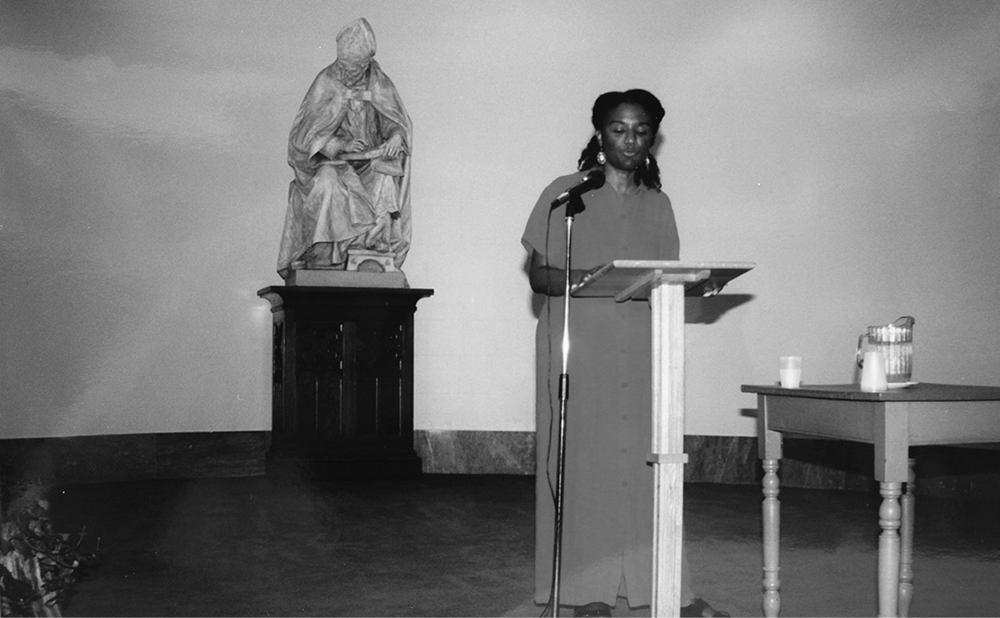
Reading at Cave Canem, at Mount Saint Alphonsus in Esopus, New York, 1999. Photograph courtesy of the Cave Canem Records, James Weldon Johnson Memorial Collection in the Collection of American Literature, the Beinecke Rare Book and Manuscript Library at Yale University.
My conversations with Harryette Mullen in Los Angeles this past December took place mostly on foot. Over the course of the three days of my visit, Mullen acted simultaneously as subject and tour guide: we walked around the campus of the University of California Los Angeles, where she teaches poetry, African American literature, and creative writing in the English department; along the cold, windy Santa Monica Pier; through the MONUMENTS exhibit at the Geffen Contemporary at MOCA; in the Mathias Botanical Garden, where she pointed out plants (a ginkgo, a Kentucky coffee tree) that had found their way into her poems; and down the streets of Little Tokyo, dodging Waymos and delivery bots. Mullen owns a car but prefers to use public transportation; she knew which bus to take to the beach and which train to take to the museum. She doesn’t have a cell phone, and pays her fare in coins.
Daily walks in Los Angeles have been a part of Mullen’s practice since she began writing Urban Tumbleweed: Notes from a Tanka Diary (2013), in which she adopts her own version of the classical Japanese form: thirty-one syllables across three lines instead of five, giving her ten syllables for each line, with “this extra one that can just float around,” she said. Itineraries frame her attention, much like the Oulipian rules, lexical constraints, and metrical forms that give shape to many of her poems and books, including her abecedary, Sleeping with the Dictionary (2002), which was a finalist for the National Book Award. (X is for “Xenophobic Nightmare in a Foreign Language.”) She delights in the play between poetry’s musical and speakerly qualities and the appearance of printed words on the page. At our first meeting, over breakfast at my hotel, she suggested that we not tape our in-person conversations and instead type out the real interview later together, in a shared document, and agreed to the recorder only once she had been reassured that she would be able to edit the draft.
Mullen was born in Florence, Alabama, in 1953. Her father worked at Talladega College and became a social worker; her mother later became a teacher. After her parents’ divorce when she was very young, Mullen and her younger sister, Kirsten, moved with their mother to Fort Worth, Texas, where their maternal grandfather was a Baptist minister. Growing up in black churches and in the South introduced Mullen to many of the cadences and vernaculars that have shaped her poems, including those in her first book, Tree Tall Woman (1981), and other early poems collected in Blues Baby (2002). But her sense of “the tradition” also encompasses the rhythms of popular music; puns, idioms, and games; and works by an extraordinary range of writers and artists, from William Blake to Gwendolyn Brooks to Betye Saar. In Muse & Drudge (1995), she entwines the blues with other lyric traditions; Trimmings (1991) and S*PeRM**K*T (1992) are books of prose poems written in dialogue with Gertrude Stein’s Tender Buttons, the latter of which also riffs on recipes and shopping lists. In Recyclopedia (2006), which collects these three volumes, she invites readers to “Recycle This Book.” Taking pleasure in both the linguistic and the tactile may be one answer to the titular question of a poem in Regaining Unconsciousness (2025): “How Can I Prove I’m Not a Robot?”
Mullen studied English as an undergraduate at the University of Texas at Austin, and earned her Ph.D. in the history of consciousness at UC Santa Cruz. She taught at Cornell before joining the faculty at UCLA, and has taught on and off at Cave Canem since 1999. At the MONUMENTS exhibit, featuring Confederate monuments and artworks in conversation with them, she guided me from piece to piece, parsing them and sharing her reactions. Mullen was drawn to contemporary prints of Jim Crow–era studio portraits by the white North Carolina photographer Hugh Mangum, of multiple clients of different races, ages, and social classes on single glass-plate negatives. Capturing the archival deterioration of the negatives and the diversity of Mangum’s clientele, the prints resemble an unlikely, ghostly family album. Mullen spoke to me about exploring her own family ghosts in a recent short story, “Consanguinity,” inspired in part by her efforts to trace her father’s family history, which led to a branch of white ancestors who were enslavers. As we stood before two carefully arranged piles of bronze ingots made from the Charlottesville monument to Robert E. Lee that was melted down in 2023, we talked of reparations for black Americans. And so the conversation kept moving, between the art in the museum, the political issues of our time, and Mullen’s writings. At the end of the day, we reversed our path and took the train and the bus back to West LA, the recorder still running.
INTERVIEWER
Did you know from the beginning that Sleeping with the Dictionary would be an abecedarian book?
HARRYETTE MULLEN
No. I thought I was writing miscellaneous poems on various subjects that didn’t have a connecting thread. I imagined the book would be called “All She Wrote”—the title of what became the first poem—but then I thought, That’s your epitaph, that’s something for your gravestone. It wasn’t a coherent project until I had the experience of waking up with the dictionary, the hardcover American Heritage, poking me in the back. I remember thinking, Oh, Sleeping with the Dictionary, that’s the title. We often call reference books companions, right? That metaphor gave me a conceptual frame. It was once I acknowledged my writing partner that I decided to order the poems alphabetically. When it was time to turn in the manuscript, I still didn’t have a Y, a U, or an I poem, so I wrote “Why You and I.”
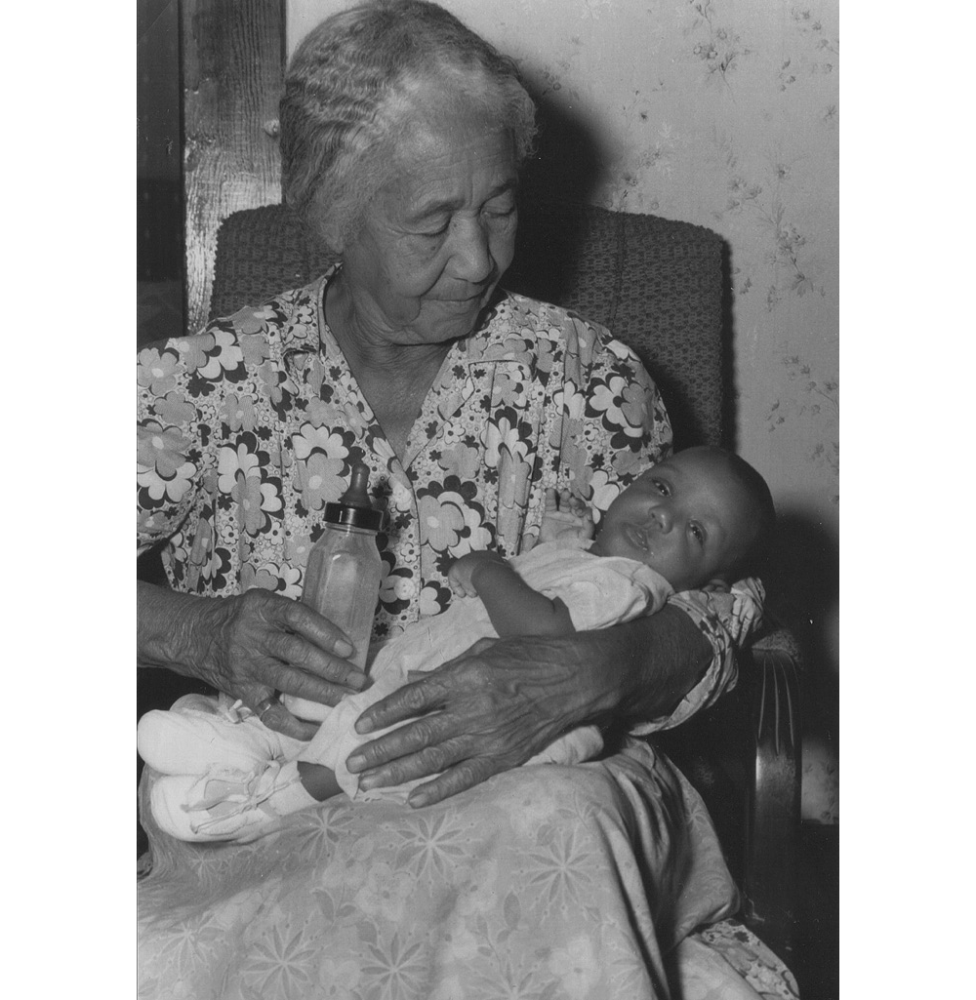
Mullen with her paternal great-grandmother, Ella Mullen, in Florence, Alabama, 1953. Photograph courtesy of Harryette Mullen.
INTERVIEWER
And you often slept with the dictionary?
MULLEN
I often go to bed with a book, or I might be scribbling in bed with a dictionary nearby for quick reference. I have a collection of dictionaries and thesauruses—Roget’s and The Synonym Finder, A Feminist Dictionary, compilations of slang and vernacular, bilingual dictionaries, the compact OED with the magnifying glass, and a few dream dictionaries. In this case, the American Heritage woke me. I try to pay attention when the unconscious gives me a hint. Like those lines of iambic that I get sometimes when I wake up. Sometimes trochees, but usually iambs.
INTERVIEWER
Iambs are your first-thing-in-the-morning rhythm?
MULLEN
Yes. “My teeth were made to tear your tender flesh,” “Can blades of grass defend a meadow?” You have to write these things down or they’ll get away from you. I was also reading a book about the Oulipo at that time, and writing a few poems using N+7. Well, not the real thing, but my version.
INTERVIEWER
What is your version of N+7?
MULLEN
It’s a game that makes the dictionary a collaborator. Oulipo writers used N+7 as a formula, a mechanical process to alter a preexisting text. What I took from them was the principle of substitution, the idea of transforming a text by substituting a word that has a similar sound or starts with the same letter or is a synonym in slang. “Dim Lady” and “Variation on a Theme Park” and “Junk Mail” were written that way.
INTERVIEWER
How about the way you use the words bitter labor in “Xenophobic Nightmare in a Foreign Language,” that poem based on the text of the 1882 Chinese Exclusion Act?
MULLEN
Bitter labor is an approximate translation of kuli in Chinese. In English, kuli became “coolie,” a racist epithet for Asian workers. Every time the law mentioned “Chinese laborers,” “Chinese person,” or “Chinese laborer,” I substituted bitter labor.
Several poems in Sleeping with the Dictionary are in some ways topical, in some ways critical. “Bilingual Instructions” I wrote when I moved to California. We had a Republican governor, and citizens had voted against bilingual instruction in the schools. But in Los Angeles we all had roller bins, trash bins for each household, with instructions in English and Spanish written on the lids. In other cases I was just trying to amuse myself, like “Kirstenography,” which was written to and for my sister.
INTERVIEWER
I love that line “when her smoother and farther wrought her chrome from the hose spittle.”
MULLEN
It’s the same principle of substitution, which, even before Oulipo, I got from “Jabberwocky,” where Lewis Carroll just inserts nonsense words into what is otherwise a brief, conventional narrative of a hero’s journey. That surprising collision of language is what makes it amusingly poetic. A lot of people have notions about writing that are blocking them from writing, but whenever I feel stuck, I can resort to something like that, some kind of parody or substitution.
INTERVIEWER
What do you think are the notions that get people blocked?
MULLEN
They seem to believe you have to know what you’re going to write—that there’s some unique and beautiful idea that just needs to be transferred from your brain to the page. People think they have to write something that nobody ever thought of, but you can write about ordinary stuff. If you start with a rule and then break the rule, it’s possible to surprise yourself. I like that the rule is there for me to mess with. You can take a text, do something to it, do something else to it, like Jasper Johns painting the flag. This is something I talk about with my creative writing students—you can transform something that already exists.
INTERVIEWER
I think sometimes college students want to write grown-up poems and not play games.
MULLEN
They want to be serious. They think games are child’s play. But, according to the cartoonist Lynda Barry, a child enjoys drawing because the paper is a place where something interesting happens. They want to find out, What’s going to happen when I start to draw? Most people stop drawing when drawing becomes a thing to be judged good or bad. In one of her exercises, she has her students put a big X on the page, so it’s no longer blank. Then they write over the X, or inside the triangles. Or you can draw a large cross to make four boxes, and write something you saw, something you heard, something you smelled or tasted, and something you felt or remembered. That’s a way of journaling, but you’ve already marked the page before you begin to write.
INTERVIEWER
When did you realize you didn’t have to start with a blank page?
MULLEN
Some people have suggested there’s a radical break after Tree Tall Woman, but for me poetry was always a way of exploring what can be done with language. I think I’ve always been trying to figure out how to write a different poem from the one before. How can you involve the reader in a little game that you’re playing with yourself? I do remember feeling, though, after Tree Tall Woman, that I didn’t want to keep writing about my life—even when it wasn’t all me, in fact. There may be things about my friends and family in that book, or in Blues Baby, but there’s also a mermaid and other invented speakers. I have a few poems in Tree Tall Woman in the voice of a mother, but I’ve never been anybody’s mother.
I didn’t want people thinking they knew who I was when they read a poem of mine. People described some of those poems as confessional, and I thought, Confessing what? Sylvia Plath scared me. Anne Sexton scared me. There was an aspect of self-dramatization that seemed dangerous to me. You could go so far that you fell right off the edge. I knew I would exhaust myself as subject matter, but I could take something and turn it upside down, inside out, add a few doodads, and that way it would become inexhaustible. There are so many accidents of language that we overlook normally, and in poetry you can call attention to them.
INTERVIEWER
How do you find those accidents?
MULLEN
Well, they’re all through the culture, in literature, folklore, media. As a reader, and as a writer, I’m following metaphor, homophones, punning language. I’m often thinking of something you say that you heard from someone else, and by the time it comes to you, you no longer know the original meaning. The word cliché comes from the printing process, from producing stereotypes—letters of type that were lined up on a tray to spell common phrases. With the mechanical reproduction of language in print culture, authors had to distinguish themselves with original writing. Whereas in oral cultures, you have to repeat in order to remember. I used to sit down and write lists of things I’d heard my mother and grandmother say—like “tighter than Dick’s hatband,” which is in Muse & Drudge. As soon as I saw it on the page, I said, Oh, this is a simile of a condom. My mother swears she had no idea. We just imagined some guy named Richard wearing a hat too small for his head.
Or in Trimmings, I was following familiar examples of metonymy and metaphor—as clothing metonymically represents the woman’s body. Skirt is slang for a woman, and nylon stockings are shaped like legs. There’s one paragraph in Trimmings that goes, “Among blowsy buxom bosomed, give us this—blowing, blissful, open. O most immaculate bleached blahs, bless any starched, loosening blossom.” Repeating sounds from the word blouse and recalling my Catholic school uniform. Originally, each paragraph had a title—“Skirts,” “Purse,” “Necklace,” “Fishnet Stockings”—but at some point I made the decision to remove them. Each of those pieces could be a riddle or a puzzle.
INTERVIEWER
Do you imagine a reader trying to solve those puzzles?
MULLEN
Yes, with enough time and interest, or they can just enjoy the language as poetry. What I love about the traditional riddle is that it’s an elaborate metaphor, often a mixed metaphor, and what throws us off is that we can’t jump quickly enough from one domain to another, as it keeps shifting. Either linguistically or metaphorically or metonymically, the domains have something in common, and they’re all pointing in the same direction, but we have to be standing in the right place to see it. To me, it’s about sharing pleasure with the reader. Maybe it’s a repetition of the pleasure that I felt when we—my sister and I as little kids—had what seemed to us intellectual conversations with our grandfather, who used to challenge us. Little Miss Etticoat with a white petticoat and a red nose, the longer she stands, the shorter she grows—that’s from the Mother Goose book he used to read to us. He would throw us a riddle and we would come back with a knock-knock joke. It was the lingua franca spoken between adults and children, like when our grandmother would challenge us to spell Conococheague, which we heard as “connick-a-jig.” I was never able to spell it correctly until, many years later, looking at a map of Chambersburg, Pennsylvania, I saw that it’s a creek near the home of my great-great-grandparents Hannah and Uriah.
INTERVIEWER
Do you read your poems out loud when you’re working on them?
MULLEN
Some of my poems are strongly visual—like “Coo/Slur” and “Zen Koan for Bob Kaufman” in Sleeping with the Dictionary, and “Forecast” in Regaining Unconsciousness, which is the shape of a cloud. I’ve never read that one aloud. But usually I do read aloud what I’m writing, and I sometimes write deliberately chunky lines that are difficult to say. I have to remind myself, when I’m reading to an audience, Slow down, be careful, because you know this is a tricky one. I like that the language in a poem doesn’t have to be euphonious. It can be discordant. It can be gnarly, crunchy. It’s something you can feel in your mouth, the mouthfeel of the poem.
Before Sleeping with the Dictionary was published, I would invite people to contribute words to “Jinglejangle.” Someone shouted out “Laffy Taffy,” which I learned was manufactured with silly jokes printed on the candy wrappers. So appropriate! That list-y poem was much shorter before I began to share it with others. It “jes grew” as I solicited suggestions and added more lines.
INTERVIEWER
There’s a series of letters that Zora Neale Hurston wrote to Langston Hughes when she was on the road visiting turpentine camps and railroad camps and holding storytelling contests for the laborers in the South. She’s trying to convince Hughes to come, and she says, Could you send me some more copies of Fine Clothes to the Jew? I read it out loud to the people in the camps, and they call it the party book and they set it to music and add verses to it.
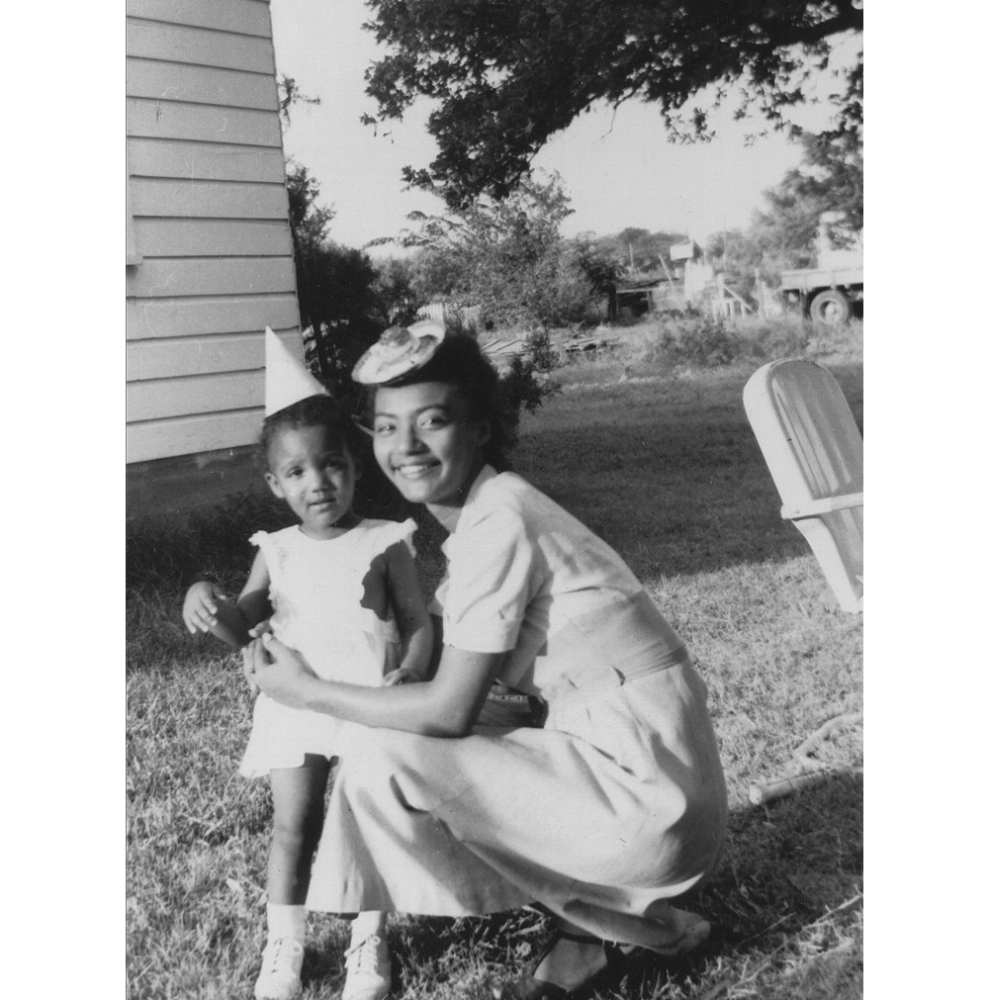
With her mother, Avis Ann Mullen, in Fort Worth, 1955. Photograph courtesy of Harryette Mullen.
MULLEN
You know what that made me remember? One of the jobs I had as a teenager was waiting tables at a summer camp for rich Texas girls. It was like a resort—they had canoe racing, horseback riding, archery, tennis, movie nights. A live band played during dinner, and all the meals were made from scratch by a locally famous black chef. The kitchen and waiting staff were all black. The men who did the landscaping and the women who did the laundry were all Mexicans. The owners, the campers, and the counselors were all white. When I was serving them, I’d hear a kid ask a counselor, “What is that?” It might be asparagus or broccoli, something they didn’t eat at home, where their parents fed them hot dogs. We, the help, made up songs about them—well, mostly about our employers—and anybody singing along could add a verse. They were spontaneous compositions, like “Chef, you’re stuffing yourself with some biscuits. Hey, chef, you’re stuffing yourself. And some butter. Yeah, chef, you’re stuffing yourself …” It could go on and on.
I realized later, Oh, this is how folklore is made. You know, in college I studied with Roger Abrahams, a folklorist specializing in African American urban lore. He wrote Deep Down in the Jungle, the book that Skip [Henry Louis Gates Jr.] references in The Signifying Monkey. Roger was a graduate student in Philadelphia, where he would collect urban toasts, orally composed narrative poems—first on street corners in black neighborhoods and then in prisons, in the tradition of Alan Lomax recording Lead Belly. It was from Roger that I first heard of “Shine and the Titanic.” There are blues songs about that mythic hero, as well as a poem by Etheridge Knight. In Roger’s class, we would talk about rapping and signifying and playing the dozens. People speaking in verbal battles are using poetic devices. There’s hyperbole, metaphor, irony, personification. These tropes of language are created and embellished when people are entertaining themselves in verbal contests. And when the monkey in the story starts signifying to the lion about the elephant, nobody reciting a toast says, Here’s an example of prosopopoeia. It’s just part of the oral performance.
INTERVIEWER
What’s the difference between signifying in a folktale and signifying in a poem?
MULLEN
Both employ creative indirection, requiring the interpretation of figurative as well as literal language. In both, what we see as simple or basic is often more complicated than it seems. With the irregular quatrains of Muse & Drudge, I was thinking about the ballad. That was the poetry of people who couldn’t read or write, and it was how they spread the news. You had to be literate to write a sestina, but not to compose a ballad. So I’m always wondering, What can I do with this on the page? How is this literature and not just reported speech? I’m often quite speakerly in a poem, but not everything is speakerly. It can also be writerly. You can mix it up.
INTERVIEWER
You write in your essay “African Signs and Spirit Writing” that there are visual and textual forms of black vernacular, not just oral ones. How did that essay begin for you?
MULLEN
I think it began with the question, Were uncolonized Africans in some way literate, beyond people who were writing in Arabic? I was interested in what information and communication systems might have existed in traditional African cultures, because the exemplary slave narrative is so much about, We are illiterate and we have to become literate. While literacy was conflated with human intelligence, enslaved people were denied the tools of alphabetic literacy. I was looking for traditional, indigenous, and vernacular systems of knowledge, and I thought maybe they could be in visual art, in sculpture and textiles. They could be in dance and song. Archaeologists in South America are studying quipus—knotted lengths of string used for recordkeeping.
INTERVIEWER
Wasn’t your dissertation about slave narratives? What drew you to them?
MULLEN
I thought the slave narratives were intriguing texts. My dissertation analyzed them as literature, even though I was told that they were historical documents and not literary texts. It was the time of the death of the author, and I thought, Let’s not kill off the author. Also, I remember reading Foucault’s Discipline and Punish, where he writes that torture as punishment had disappeared in Europe by the nineteenth century. And I said, But not on the plantation.
I was most interested in the narratives that black people actually wrote. Many are in the “as told to” category, where the text is heavily mediated. There are issues even with those “written by himself or herself,” because you still had the white editors, and the authors were still addressing white readers, imploring them to put an end to slavery. I was looking at passages, for my dissertation, that were about writing. The one that just blew me away was by William Grimes, who wrote, “If it were not for the stripes on my back which were made while I was a slave, I would in my will leave my skin as a legacy to the government, desiring that it might be taken off and made into parchment, and then bind the constitution of glorious, happy and free America. Let the skin of an American slave bind the charter of American liberty!” He’s talking about his body as a text that someone else has inscribed. And I was looking at those passages where Frederick Douglass talks about learning to read, learning to write, stealing literacy, writing in the blank spaces in the young master’s discarded copybook. Or Harriet Jacobs with the white mistress who taught her to sew and embroider. Those lessons would have started with a stitched sampler. That was how girls learned the alphabet.
I was also motivated by curiosity, because, when I was growing up, people did not talk about slavery. White people didn’t, black people didn’t. On my mother’s side, nobody ever told my grandmother that her father had been enslaved. The year of birth engraved on his headstone is incorrect. My grandmother always believed he was born after the Civil War, but he was born into slavery, in 1854, based on the earliest records. I asked my grandmother, about her maternal grandparents, “Granny, do you think Hannah and Uriah could read and write?” “Oh yes, they were literate.” But according to the census, they were illiterate—they were adults when the Civil War ended.
INTERVIEWER
Do you know when that branch of your family became literate?
MULLEN
Both sides of my grandmother’s family migrated from Virginia to Pennsylvania. My grandmother told me that her mother, Hannah and Uriah’s youngest child, who was born free in Virginia, was sent to school in Baltimore. It was mostly training to be a servant—so, she learned to cook and clean, to wash and iron laundry, and she was taught to read, write, and calculate, by the way. I don’t know how her husband, my grandmother’s father, became literate, but after he left Virginia for Pennsylvania, he became the respected pastor of a small church. I found an article in the Harrisburg paper that says he was reading the Bible at a public event. I’ve found as many as fifty marriage certificates bearing my great-grandfather’s signature in a Pennsylvania archive—records of weddings that he performed. There are archived newspaper articles about his application for the church’s charter.
My grandmother was the family archivist. She saved every scrap—letters, cards, telegrams, typed and handwritten notes of sermons and speeches, even leftover books of ration stamps from World War II. I have letters that my great-grandmother wrote to my grandmother, letters that my grandfather wrote to my grandmother, and letters that my parents wrote to her. I treasure them as my inheritance. I’ve thought a lot about my grandmother’s illiterate grandparents, her literate parents, and the ongoing struggle for freedom and literacy. There’s a poem called “Pen Name” in Regaining Unconsciousness that’s partly inspired by a piece of paper my grandmother saved, with my mother’s handwriting practice—her name copied over and over. My mother saved my early handwriting too. “Pen Name” doesn’t look like a family-history poem, but to me it is.
INTERVIEWER
What kinds of things did your great-grandmother write about in her letters?
MULLEN
She wrote about the weather, how cold it was in Harrisburg. She’s very affectionate, inquiring about the family in Texas and signing off as “your loving mother.” Once or twice she visited Fort Worth when my mother was a girl, and I have photographs of her there with my mother and my grandmother. There’s a picture of the three of them sitting on my grandmother’s sofa. I remember that sofa.
My mother moved us to Fort Worth from Alabama when I was three and a half, after my parents got divorced. We stayed with my grandparents until she got settled. My grandfather was a pastor, too, so my grandmother was a pastor’s daughter and a pastor’s wife. She was steeped in the church—we spent many a Sunday sitting on hard pews with our grandmother giving us mints and chewing gum to keep us quiet. Fort Worth is where my memories start, actually. I don’t recall much about Alabama, where my parents met as college students, and where I was born.
INTERVIEWER
You have some poems about it in Tree Tall Woman—like “Alabama Memories.”
MULLEN
Well, I was listing everything I could recall from my earliest years. Some of my memories are stories my mother told me about my childhood. I thought I remembered a tree that had fallen in a storm, and somebody dragging a large turtle by a rope, saying they were going to make soup. Those could be dreams, or false memories.
I think I was trying to take possession of a part of my life that I didn’t know much about. My father’s parents lived in the same little town where I was born. I didn’t see my father again until I was sixteen. I don’t know how long he stayed in Alabama, but he eventually moved to Chicago, where he was a supervisor in a social work agency. My sister and I had questions about our father, and our mother gave us stationery and stamps and said, “You can write to him.” We would exchange cards, letters, gifts. And we wrote to our grandparents—his parents in Alabama—and they wrote back, too. Kirsten and I are habitual writers, which we attribute to this early correspondence. My mother had photographs of our father that we could see. He was quite handsome.
INTERVIEWER
How was it to grow up in a single-parent household?
MULLEN
My mother was hardworking and resourceful. She usually had two or three jobs, as I recall. When she had saved enough, she moved us into an apartment rented from a friend, above a garage. She was finishing her B.A., working in a laundromat, and selling some kind of home-care products. When she got her degree, she became a public school teacher, and in the summer, she taught swimming lessons. She taught generations of black kids at a segregated pool where she also worked as a lifeguard.
My mother wanted to be a reading specialist—she says, “They’re planning prisons for kids who don’t learn to read.” When she went downtown to apply, they told her, “We don’t hire black people for that job.” A friend of hers eventually did become a reading specialist, but by that time my mother had decided to get her Ph.D. in education. Kirsten and I were in high school and about to go to college when she said, “I’m thinking about doing this. I need your cooperation because you’re going to have to pay for your own college. We could all be in this together. Do you agree?” So I had a small loan, and we got grants and work-study jobs. At one point my mother, my sister, and I were all students at UT Austin at the same time, with the university barely integrated by then. My mother knew some of the people who were involved in Sweatt v. Painter.
INTERVIEWER
What got your mother interested in education?
MULLEN
She was a born teacher. That’s the title of the memoir she’s written, A Born Teacher. She writes that her first-grade teacher in Harrisburg inspired her—Miss Pauline Miller, who had attended Columbia Teachers College. I thought it was because of us, after the divorce. She was very hands-on with our education. She moved us from one school to another when she was dissatisfied, which was often—I attended four public schools and three different Catholic schools, including a black Catholic school where the nuns were white.
I think I was in second grade when Fort Worth desegregated the first grade, years after Brown v. Board of Education—I was never going to get integrated, because they decided to integrate one grade each year. That was when my mother first decided to enroll us in Catholic school, but it was a struggle—she was single, and working on a teacher’s salary, which in Texas was very low. But public school would just disappoint her. In sixth grade, I was a student at the same black public school where my mother was teaching first grade, and she found out that my teacher was having me grade the other students’ papers. She caught me under the covers at night with a flashlight, and it all blew up. She claims that my sister and I and about half a dozen other kids collectively raised the standard test scores of the whole school. She founded a community school in Fort Worth after she retired from teaching in public schools, and she was proud that all the first graders and most of the kindergarteners could read, usually above grade level, by the end of the year.
INTERVIEWER
Were you always a reader?
MULLEN
My mother said we were reading and writing before first grade—she was teaching us at home. Our bedroom was like a little classroom—my sister had her desk, I had my desk, we had a bookcase that we shared, an art easel, a chalkboard and chalk. We had a puppet theater and we made our own puppets. She took us to the library every week, and when we were old enough, we’d ride our bikes to the Bookmobile. Even the segregated black school that I attended had a decent children’s library—there was a whole shelf of fairy-tale collections that I loved.
I remember reading Jane Eyre, Tom Sawyer, The Pilgrim’s Progress, which was a gift from my grandfather, and Voltaire’s Candide, borrowed from a neighbor. For fun, I was reading Tolkien’s Middle-earth books, The Chronicles of Narnia, and Nancy Drew. My grandparents subscribed to The Crisis, and we read Ebony, Jet, and Sepia, which was published in Fort Worth—that magazine had a black publisher, our neighbor across the street, Beatrice Pringle, who gave me a job as a proofreader in the summer between high school and college. As a high school student, I ventured into a store in Austin selling comics by R. Crumb and Gilbert Shelton—I had Zap Comix, Fritz the Cat, Mr. Natural, The Fabulous Furry Freak Brothers, Wonder Wart-Hog. And we went to the opera, the symphony, the ballet, to Shakespeare plays, to Van Cliburn’s piano recitals, to art and history museums—often on field trips organized for the black public schools we attended, because we were considered culturally deprived. And also to the rodeo and the stock show. Right? That was culture too. My mother paid for our piano lessons, but I wasn’t musical. The nuns told her that she should save her money.
INTERVIEWER
Were you funny growing up? Did you like to entertain people?
MULLEN
I don’t think of myself as funny. I suppose I have a goofy sense of humor, but I can’t predict what will make people laugh. I was the introvert in my family, just naturally shy. My mother was always encouraging me to be less solitary, more sociable. We had to practice public speaking. At the black schools and at church, we’d recite a poem by Langston Hughes—“Life for me ain’t been no crystal stair”—or Paul Laurence Dunbar, “When Malindy Sings,” or Gwendolyn Brooks, “We Real Cool.” You would learn your piece and recite it on demand. The adults approved of our effort and admired a good performance. Ntozake Shange writes about that in Betsey Brown. A lot of novels have these rites of passage, scenes of recognition—giving a public address, like the protagonist in Invisible Man. Or Alice Walker’s Meridian—there’s a high school public oratory competition. In the film Miss Juneteenth, which is set in Fort Worth, a girl competing in a beauty pageant recites Maya Angelou’s “Phenomenal Woman.” In the mostly white Catholic schools I attended, the nuns gave us poems to perform in group recitation—“The Highwayman” by Alfred Noyes, “The moon was a ghostly galleon tossed upon cloudy seas.” Or “The Assyrian came down like the wolf on the fold, / And his cohorts were gleaming in purple and gold”—that’s Byron. Other than the Old Testament Psalms, the poetry we read was accentual-syllabic, rhyming poetry.
INTERVIEWER
Did you write poems that rhymed when you were a child?
MULLEN
Yes, for my family and close friends, little jingles, very metrical. I don’t think I was aware of free-verse or prose poetry as formal choices. Then in high school, when I was a senior, our English teacher gave our class an assignment to write a poem about graduating. For whatever reason, I decided to write a non-rhyming poem—something about “beyond the threshold of the future.” Anyway, without letting us know, she entered them in some contest that I won. I don’t think there was a cash award, but my poem was published in a local newspaper. And I recited it before an audience.
INTERVIEWER
Did you like the poem? Do you like it now?
MULLEN
It was okay then. It was my first time seeing my name in print. When I was an English major at UT Austin, I got to see living poets read to audiences on campus—that definitely impressed me. I would go to community readings, too, and people I met encouraged me to come to open mics. Then people at the open mic readings would say, “Hey, I’m editing a magazine. Send me some work.” I would do that, and I would get published in little magazines that nobody’s ever heard of.
INTERVIEWER
Which poets did you see read at UT Austin?
MULLEN
I remember hearing Haki Madhubuti, Michael Harper, and Gloria Oden, among the African American writers visiting the university, as well as African poets including Kofi Awoonor, Dennis Brutus, and Keorapetse Kgositsile. I went to readings by Muriel Rukeyser and Adrienne Rich. Michael Harper allowed us to reprint a few of his poems in our student magazine, Blackprint. I got an autograph from Haki Madhubuti when—this is how long ago it was—he was still Don L. Lee. My mother had given me her Collected Works of William Shakespeare, and I had just come from my Shakespeare class. I said, “This is the only book I have with me. Will you sign it?” And he did.
The Black Arts Movement was happening, but the Madhubuti reading was probably a student-initiated effort. I doubt it was the English department. I never saw another black person or any person of color majoring in English while I was there, and I didn’t read a single African American author for any class I was taking inthe English department. Not Baldwin or Wright, or even Ellison. In my one course with Neil Nakadate, the only nonwhite professor in the department, we studied Fitzgerald and Hemingway. The books that I was reading by African American authors were not on the syllabus in any of my courses.
INTERVIEWER
How did you find them?
MULLEN
I haunted the library stacks and used bookstores searching for the out-of-print canon of black literature by Robert Hayden, Margaret Walker, Paul Laurence Dunbar, Phillis Wheatley. I’ve always been scouring for books—that’s how I found Oreo by Fran Ross and Francisco by Alison Mills Newman. You can’t just buy whatever is in Barnes and Noble, you know, what they’ve decided you should be reading. And I went outside the English department, studying African American folklore with Roger [Abrahams] and with Marilyn White in anthropology, and taking ethnic studies courses with Geneva Gay and John Warfield. I did take courses in Anglophone African literature with Bernth Lindfors, and Caribbean literature with Reinhard Sander, and I had a course in African literature with a visiting professor from Germany, Janheinz Jahn, the author of Muntu, who was close to the end of his life. When Skip Gates was one of the people interviewing me for my first tenure-track job, at Cornell, he asked some penetrating questions about my academic pedigree, and when I mentioned my undergraduate years at UT, he said, “Oh, you studied with Roger Abrahams and Janheinz Jahn!”
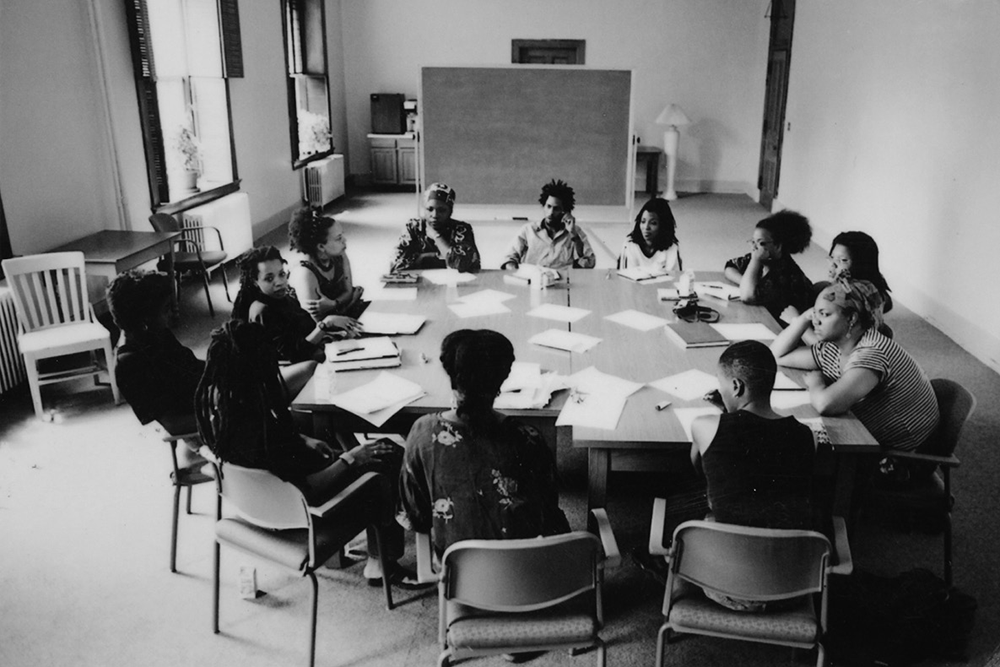
At bottom center (in floral print), teaching a workshop at Cave Canem, 2000. Photograph courtesy of the Cave Canem Records, James Weldon Johnson Memorial Collection in the Collection of American Literature, the Beinecke Rare Book and Manuscript Library at Yale University.
INTERVIEWER
Did you know from the beginning that you wanted to be a professor?
MULLEN
Maybe, as an alternative to being a starving poet. The research part sounded intimidating, but I was a good student. I had written essays that sometimes surprised my professors—though nobody accused me of plagiarism or anything like that, because they were too weirdly idiosyncratic. I was in the English honors program, and that introduced me to theory—structuralism, semiotics. I enjoyed it, and I admired my professors.
As soon as I graduated, I got a job at Austin Community College, first as an instructional assistant, and then I was promoted to study skills instructor. I ran what they called the Learning Skills Center. People would come in, and I would help them with their writing homework. Eventually I got hired as a poet by the artists-in-schools program organized by the Texas Commission on the Arts, to lead writing workshops with K-through-twelve classes. I worked mostly in Galveston, Houston, and Beaumont, driving my little hooptie from one place to another. Naomi Shihab Nye, one of my dearest poet friends, interviewed me for the job. The students basked in the brightness of her aura. I wrote Tree Tall Woman while I was working for the program. That’s a Galveston palm tree on the cover.
INTERVIEWER
How did that book find its way to publication?
MULLEN
There was a cohort of hippies and activists at UT Austin who had created a rambunctious underground newspaper, the Rag, a college generation before me, and some of those people helped me. It was a radical contingent of people engaged in the struggle against war, racism, and sexism. Community organizers, feminists, lesbians. I mean, lesbians did a lot of heavy lifting. After working on the Rag, Rita Starpattern was active in a feminist collective that opened the Common Woman Bookstore, now called BookWoman, and supported artists through an organization called Women and Their Work. Members of the collective operated Red River Women’s Press, and they printed Tree Tall Woman. Common Woman Bookstore was among the first bookstores to stock it. I suppose they liked my poetry, and they wanted to support a black woman writer. But the press almost didn’t print the book, because they didn’t care for a satirical poem of mine called “Miss Persephone.” I’d been provoked by reading Against Our Will, Susan Brownmiller’s sweeping analysis of rape culture. In her chapter “A Question of Race,” she portrays the fourteen-year-old Emmett Till as a would-be sexual predator exerting male dominance. At the time, I didn’t think of adding a note to the poem to offer context. I explained to them, “Sometimes a white woman falsely claims that a black man assaulted her.” I’m not saying all black men are blameless, I know that ain’t true. But I told them, “This is part of our history.” So they relented. Because I insisted, “I’m not taking it out.”
INTERVIEWER
Didn’t Lorenzo Thomas blurb Tree Tall Woman? How did you find a community of black poets?
MULLEN
Lorenzo and I worked in the same school district in Houston for the artists-in-schools program. We read at some of the same venues, and socialized at some of the same cafés and clubs, listening to blues, jazz, and zydeco. Through him I met other black poets, like Tom Dent of New Orleans. They’d been members of Umbra, a group of black writers, artists, and musicians in New York that included David Henderson, Calvin Hernton, Norman Pritchard, Ishmael Reed, Archie Shepp, Cecil Taylor, and Askia Muhammad Touré. I admired Tom so much. He’d been a leader of the Free Southern Theater, writing plays as well as poetry. He was a founding editor of Callaloo, with Charles Rowell and Jerry Ward—they created it for Southern black writers who felt ignored and neglected by writers of the Black Arts Movement. Lorenzo, Tom, Jerry, and Charles were active in BLKARTSOUTH, an organization of writers and artists that held meetings I attended in Atlanta, Jackson, and New Orleans, usually on the campuses of historic Black colleges and universities. I recall hearing Margaret Walker give a keynote address at Jackson State, Toni Cade Bambara reading a story at Spelman College, Lance Jeffers reading poetry at Tougaloo. This was my immersion in African American literature, since it was not part of my university education. I was learning from all these people.
I knew a lot of Mexican American poets in Texas, too—Carmen Tafolla, Inés Hernández-Ávila, and Evangelina Vigil-Piñón, who also worked for the artists-in-schools program. I shared an apartment with six or seven housemates from Texas border towns, and some of them, Inocencia Alvarez, Angelica Martinez, Cristina Ramirez, and Rosa Zuniga, were active in MAYO [the Mexican American Youth Association] and Raza Unida. They were reading and publishing in Chicano magazines such as the Austin-based Tejidos and Cecilio García-Camarillo’s Caracol. I met him at a poetry reading in Albuquerque.
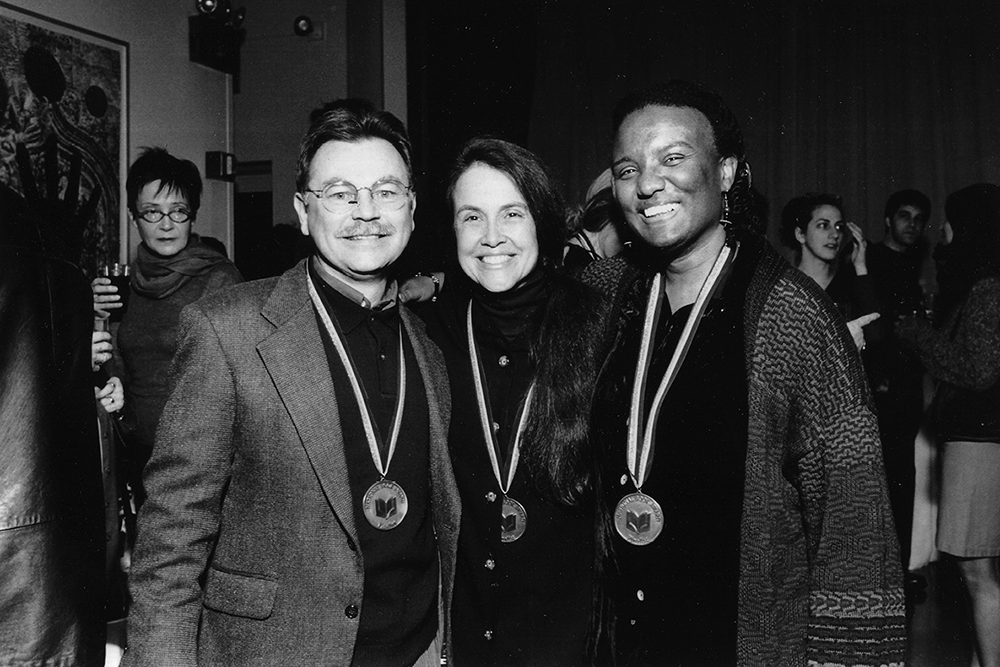
At the 2002 National Book Awards ceremony, with Alberto Ríos and Naomi Shihab Nye. Photograph courtesy of Harryette Mullen.
INTERVIEWER
How long did it take to pay off your debt after college?
MULLEN
Maybe by the second year I was employed after graduating—that was possible then, even with my modest wages. My mother had taught me how to survive on a limited budget. I worked some odd jobs, as a typist and file clerk in a lawyer’s office and as a receptionist at Goodwill Industries. I worked at a black community newspaper, the Argus, but had to quit when my paycheck bounced. I always managed to scrape by somehow. I spent a year on residencies writing Blues Baby—six months at Paisano Ranch, southwest of Austin, and another six months in Taos—and lived for a year on a stipend of three thousand dollars. There were five or ten galleries in Taos, and I would go to the opening receptions with my plastic baggies and scoop up cheese and crackers and carrot sticks and cherry tomatoes, and then I’d shop at the co-op for beans, rice, and blue cornmeal. After the seclusion of Paisano, I felt very connected to the community of Taos, and I almost lost track of my ambition to return to academia. But I did apply to the Ph.D. program at UC Santa Cruz and got accepted, so I put Blues Baby aside. I didn’t have time to go out and hustle to get somebody to publish it.
INTERVIEWER
How did you end up at Santa Cruz?
MULLEN
I was visiting UT and saw a recruitment poster with a headline, “Women and minorities: apply to UCSC.” There were pictures of women and minorities! Attached to the poster were tear-off postcards to request an application. I applied, and the next year, I was in the brochures and on the posters. The number of black people there was small enough that I knew practically every one. There were some amazing people at Santa Cruz. When Angela Davis was a visiting professor, I enrolled in her undergrad course as a graduate student just because I wanted to be in her classroom. Al Young and Lucille Clifton were visiting poets while I was there. I was Michelle Cliff’s TA for one quarter. She was living there with Adrienne Rich.
INTERVIEWER
Did you talk about your poetry with your professors?
MULLEN
Nate Mackey, who was assigned to be my advisor, was supportive. He published a few of my poems in Hambone and introduced me to other writers. I first met Will Alexander when he was visiting Nate, who was publishing Will in Hambone long before almost anyone else was paying attention. Nate had a radio program where he played everything from the blues to jazz to flamenco to pygmy yodels, and he invited me to read on air. He and Gloria Jean Watkins [bell hooks] were together at the time, and I used to have dinner with the two of them pretty regularly—I was a reader for Gloria in a women’s studies course that she taught. After dinner, Nate would retire to his study and we would hear jazz coming through the wall as he was writing. They were both very disciplined. Gloria was finishing her dissertation on Toni Morrison. In the mornings, she would call me and say, “I’ve written my daily five pages. What are you doing today?” And I’d say, “Well, I’m just waking up, and I have to go to class,” or maybe it was “Okay, let’s hang out at the bagel shop.” We would literally split a bagel—you know, Nate was a professor, but she had to pay her own way, and I was a broke graduate student. Gloria, who didn’t like to drive alone, brought me along as her uninvited guest to special events where I was introduced to Angela Davis, Audre Lorde, Mary Helen Washington, Alison Saar, and Trinh T. Minh-ha.
I was writing less poetry then, but there was a little group of graduate students who were also poets, and we met about once a month to share whatever we had. I met Bay Area poets associated with “Language” through Nate. He was publishing them and hanging out with them, and I would go to their readings in Berkeley and San Francisco.
INTERVIEWER
What did you make of the Language poets?
MULLEN
The way they talked about poetry was challenging. They were skeptical of lyric subjectivity, which I had taken for granted as the core of contemporary poetry. Of course, if you’re making any sense at all, who you are as a subject is expressed in the language, but the idea that language has a force of its own beyond the writer was useful to me. I was impressed that they were reading for fun the kinds of books I was obliged to study in my graduate seminars. I had opened the door to Gertrude Stein, and since Stein was a literary grandmother to all of them, I could grapple with their work. Stein is saying, This doesn’t fit your expectation of what a sentence looks like, what a poem looks like, or how a woman should write. She demonstrated that it’s possible to go out, as jazz musicians used to say.
INTERVIEWER
How did you encounter Stein? Was it through her that you became interested in prose poems?
MULLEN
Stein, [Jean] Toomer, and [Gwendolyn] Brooks are my prose models, my prose instructors. I think I read Stein and H.D. and Marianne Moore in a class I took with Priscilla Shaw at Santa Cruz. I had heard of “a rose is a rose,” but to actually read Gertrude Stein—I think it wasn’t until then. I read somewhere that Richard Wright was inspired by “Melanctha,” that story in Three Lives, and it was significant to me to learn of a connection between him and Stein. Because “Melanctha” is perplexing in many ways.
INTERVIEWER
Other people read “Melanctha” as a kind of minstrelsy, but I think Wright said he couldn’t believe how well Stein captured black vernacular speech.
MULLEN
Mm-hmm, which was a peculiar thing to say about that particular text. I wondered if he was being diplomatic, because he also said that her story inspired him to write in his own language, and I thought, Okay, what he must mean is, If she can put words in the mouths of black characters, let me try that, as a writer who is black.
While I was writing Trimmings and S*PeRM**K*T, I took “Melanctha” as my key to reading Tender Buttons. Because Melanctha is supposed to be biracial, and Stein, in Tender Buttons, continually mentions colors and how it’s dirty to mix them—the dirty yellow and the blackest this and the whitest that. Color seems so coded for race in those poems.
INTERVIEWER
How did you come up with the idea of responding to Tender Buttons?
MULLEN
I don’t know if Stein was intending to talk about race, but when I read “A Petticoat”—“A light white, a disgrace, an ink spot, a rosy charm”—I thought, Oh, that’s Manet’s Olympia, his portrait of a nude white woman with a black woman in the background, delivering flowers. The contrast between their bodies, the nude and her servant, led me to explore cultural signifiers of femininity and the intersection of race and gender in Trimmings.
Stein aestheticized and eroticized feminine domestic space in her hermetically private poetry. I was interested in exploring that space in relation to the world at large, and in a more accessible language. Originally, I’d planned to write three different books for the three parts of Tender Buttons—one for objects, one for food, one for rooms. In Trimmings, I was attentive to clothing because it was the most feminine object. Stein’s food is in the home, but S*PeRM**K*T takes food home from the market, because I was thinking about commodification, marketing, and advertising as well as the division of labor. My mother’s generation embraced the convenience of instant foods, and she was working multiple jobs, so sometimes our meal was Banquet turkey dinner or Patio enchiladas, which my sister and I could heat and serve ourselves. My generation wanted everything natural—you know, Let’s make our corn bread from scratch. My mother still uses Jiffy mix, but I make mine with stone-ground flour and cornmeal in a black skillet.
INTERVIEWER
Why didn’t you end up writing a response to “Rooms”? Your next published book was Muse & Drudge.
MULLEN
I did have a title. It was going to be called “Anarchitexture,” something I started but never finished. Then I decided that my collaboration with the artist Yong Soon Min on an early internet art project, WomEnhouse, was my response to Stein’s “Rooms.” WomEnhouse was a virtual version of the Womanhouse building in LA, the abandoned house that Judy Chicago, Miriam Schapiro, and other feminist artists repurposed, with installations in each room. In the digital art space, Yong Soon and I claimed the porch. Her images and my texts were addressing issues of immigration, border patrol, home, and homeland security. We were asking, Who belongs inside? Who doesn’t? Who is welcome to enter? Who isn’t?
I went to work on Muse & Drudge instead of on a third book responding to Stein, because, after Trimmings and S*PeRM**K*T, I was wondering, What happened to the people of color? They just vanished from the room all of a sudden. It was different with Tree Tall Woman, when I was reading in multiple black spaces, at the Watts Towers here in LA and at a “down-home poetry reading” organized by Ishmael Reed in the Bay Area. I had read with Lorenzo Thomas in Texas, at a church in Atlanta called Shrine of the Black Madonna, and at an HBCU in New Orleans.
INTERVIEWER
Why do you think your audience changed?
MULLEN
As the author of Tree Tall Woman, I was perceived as a fairly rootsy Southern black poet. With a Ph.D. and a tenure-track position at Cornell, my profile was changing. I’d read with Lee Ann Brown at the Ear Inn in New York, and she said, “I heard you have poems that are in conversation with Gertrude Stein. I just started my press”—which was Tender Buttons Press—“and may I see your manuscript?” She’d just published Bernadette Mayer’s Sonnets. Having a different publisher meant I attracted a different audience. S*PeRM**K*T was with Gil Ott’s Singing Horse Press, and by the time he published Muse & Drudge, I was actively trying to overcome what I was calling aesthetic apartheid, the separation of audiences with different cultural experiences. The line between readers of African American poetry and readers of so-called avant-garde poetry was rather sharply drawn, with a few exceptions. I was reading on university campuses, and people were saying I was some kind of Language poet, which was toxic to a lot of writers and audiences. People were hostile to what they supposed was language without humanity. More than once I heard, “Gertrude Stein was a racist.”
INTERVIEWER
How did you set out to counter that aesthetic apartheid in a book?
MULLEN
It was partially the range of references, the allusions, the quotations and paraphrases. There’s language in Muse & Drudge that people recognize. There’s folklore, media, a lot of music—blues, jazz, gospel, hip-hop. Sometimes actual song titles and lyrics, like “Jesus is my airplane,” from Sister Gertrude Morgan and Mother McCollum, and a slightly altered line, “I’m in your sin,” instead of Bessie Smith’s “I’m in my sin,” from “Me and My Gin.” I was also drawing on the tradition of lyric poetry. The opening quatrains identify Sappho with a blues-singing Sapphire, an archetypal hyperexpressive black woman unafraid to speak her mind. One of my fellow graduate students at Santa Cruz was Diane Rayor, who is a translator of Sappho. Her rendering of the famous poem about the unharvested apple left on the tree reminded me of Bessie Smith singing, “If you don’t like my peaches, don’t shake my tree.”
At readings, I would notice different parts of the room becoming active, hearing different parts of the work, and I enjoyed that. Muse & Drudge appealed to all kinds of readers and scholars. Evie Shockley called it an African American blues epic in Renegade Poetics, where she also wrote about Brooks, Sonia Sanchez, Anne Spencer, Ed Roberson, and Will Alexander, and that was very gratifying to me. I had a sense that, to a certain extent, you could call your audience to a book. It’s not that you have the power, but the book, if it does actually have a life, can appeal to various groups of people because of the way it’s made.
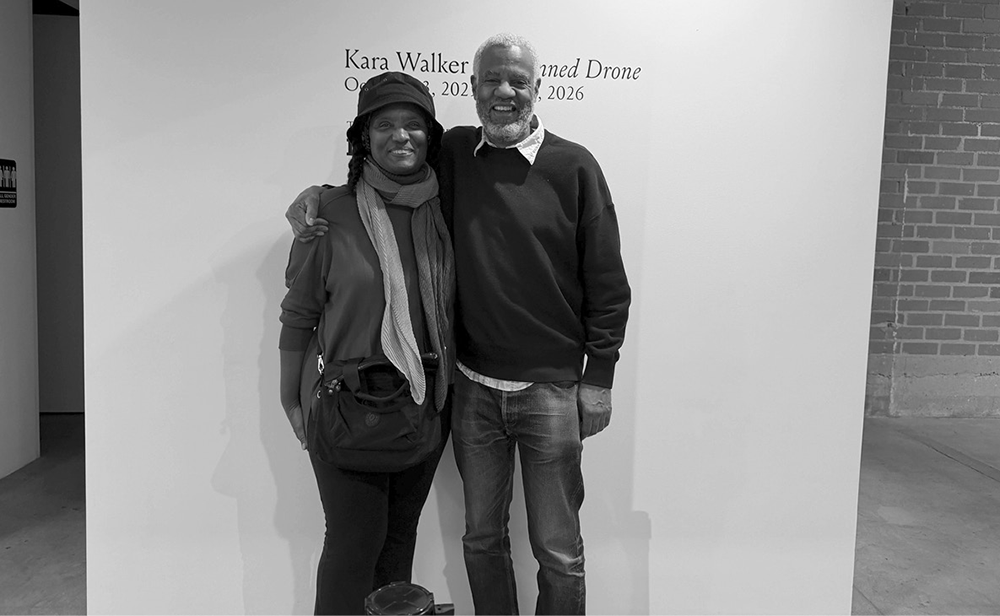
With Hamza Walker, the director of the Brick art space and the cocurator of MONUMENTS, 2026. Photograph by Meta D. Jones, courtesy of Harryette Mullen.
INTERVIEWER
Are there other readings of your work that have meant something to you?
MULLEN
When Camille Dungy chose “European Folk Tale Variant” from Sleeping with the Dictionary for her anthology Black Nature, it felt like a friendly nudge. That poem was my tribute to Toni Cade Bambara’s black vernacular version of “Goldilocks,” inspired by her community workshops with children where they read and rewrote traditional fairy tales. The kids said, “If we did all that, they’d arrest us! Yeah, we would be sent to juvie if we barged into somebody’s house and ate their food, broke their furniture, and slept in their bed.” I was riffing on that, not thinking of nature—I hadn’t thought of it as a nature poem. Camille’s choice of that poem for her project nudged me to think further about the bears and other creatures whose habitats we humans are constantly invading. She had a brilliant concept—four centuries of African American nature poetry. But who’s counting? She calls into question, What is nature? What is black nature? Who is a nature poet? I wouldn’t have thought of myself that way. I mean, we have had a very specific picture of a nature poet.
INTERVIEWER
Who would you think of? Like, Gary Snyder?
MULLEN
Gary Snyder, certainly. A true outdoorsman. And that other one—the farmer? Wendell Berry! Mary Oliver, too. I started reading her poetry because my students recommended her to me. In an interview she says that she stashes pencils in the trees, so that when she goes walking in the woods, she can find one to write a poem. Such a charming story, I thought. But what was she writing on? Leaves? Bark? I guess she might set out with a notebook in her pocket, but forget to take a pencil? Or she needed a spare in case hers broke?
INTERVIEWER
Do you think of yourself as a nature poet now?
MULLEN
Nature poet? No. Eco-poet? Environmental poet? No. That’s not my calling. I acknowledge that human beings are part of nature, just as we are political. Big deal. But Black Nature got me thinking about writing about nature in relation to culture. I thought, How do I encounter “nature” in my everyday life, as an inhabitant of the city of Los Angeles? Urban Tumbleweed was a diary, intended to support a daily practice of walking and writing. I decided I would take a walk and write a tanka, a quota of thirty-one syllables each day, every day for a year. At Cave Canem, something Sonia Sanchez would recommend to everybody was to write a haiku a day, and that, in a way, was a prompt for the book. One hot day I was sitting in the UCLA botanical garden, watching a squirrel that was stretched out on a rock in the shade. I said, “Do you wish your fur coat had a zipper?” That’s in Urban Tumbleweed. Now when I’m teaching poetry workshops, I bring students there to write their own tanka, and I’ll write with them. Some days I wrote more than one, and I probably skipped a few days, but I actually kept the diary for almost two years. By that time, it looked like a poetry manuscript. Then, to make a book, I reordered them—I put the poems on index cards and shuffled them around. I had some ideas of contrast—indoors and outdoors, urban and rural, up high and down low, beauty and ugliness, order and disorder, privilege and lack of privilege. Who has a home and who’s homeless? Who’s native and who’s not native? Collisions, oppositions, juxtapositions of human and other-than-human.
INTERVIEWER
Do you often write with your students?
MULLEN
Sometimes I’ll give them an assignment and do it myself to see what happens, especially if I’m trying out a new one. A prompt I sometimes give is to write a poem that’s all questions, like “Denigration” in Sleeping with the Dictionary. Sometimes I suggest they write questions that a child might ask, or that an intelligent nonhuman life-form might ask a human being. I like questions and I like instructions, because they’re interactive.
INTERVIEWER
Do you think readers sometimes need instructions, too?
MULLEN
When I think readers need information that the poem withholds, some context or background, I might add an epigraph to provide a hint. That happened in Regaining Unconsciousness with a poem inspired by a news article about a vegan’s custom license plate, and with another poem that’s just vowels.
INTERVIEWER
“Duet.” I was actually going to ask you about that poem, because I didn’t know what to do with it.
MULLEN
When I sent the manuscript to Graywolf, Jeff Shotts said, “Carmen [Giménez] and I didn’t get it.” I thought, Maybe it doesn’t belong in the book. Maybe I’ll just remove it. But then the epigraph came to me—“as we lose our consonance.” Later, when I visited Jennifer Firestone’s class at the New School, her students had figured it out on their own. Their experience confirmed that it was possible. Of course, they were a group, so they could work it out together.
INTERVIEWER
I can’t figure it out. Just going to be totally honest.
MULLEN
Let’s see here. I tried to leave spaces in the subtitle where the consonants are deleted. Leaving only vowels sounds a bit painful, I think, those cries of “ay,” “ee,” “ooh,” “ow.” You see this here? It’s a word with the consonants missing, and I will just tell you that the word is “America.”
INTERVIEWER
Okay. “America the Beautiful.”
MULLEN
And this word is “Every.”
INTERVIEWER
“& ‘Lift Every Voice.’ ”
MULLEN
You got it. See, that wasn’t too hard. Once you decode the titles, you see that the text is just alternating lines from those two anthems.
INTERVIEWER
“O beautiful for spacious skies.”
MULLEN
You can figure out the rest, right?


Comments
Post a Comment